

What Happened to Sacagawea After Lewis and Clark?
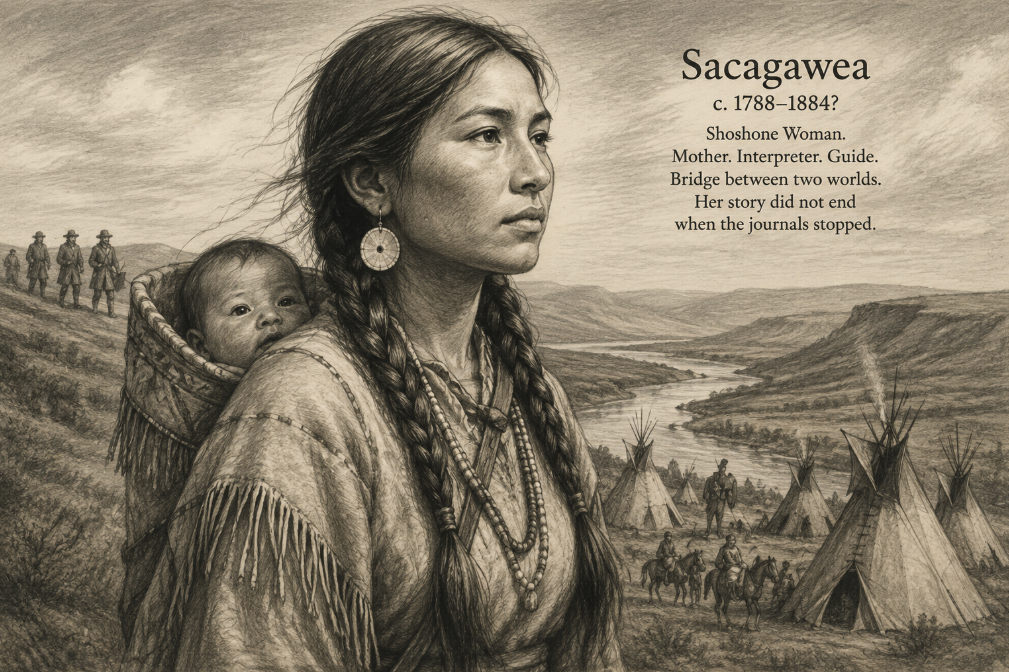
This is a digital rendered drawing of Sacagawea and her son, Jean Baptiste, aka, Pomp.
For most people, Sacagawea disappears the moment Lewis and Clark return home.
The expedition ends.
The journals close.
The famous image of the young Shoshone woman carrying a baby into the American West fades into the background.
And then history gives us one convenient sentence: Sacagawea died in 1812.
I do not believe that is where her story ended.
I believe Sacagawea survived. You can read more my thoughts about the Sacagawea death controversy and why she lived to be 99 years old.
I believe the woman who died at Fort Manuel Lisa in 1812 was likely another Shoshone woman connected to Toussaint Charbonneau’s household—possibly Otter Woman.
And I believe Sacagawea lived for decades afterward, eventually returning west and dying among the Shoshone at Wind River in 1884.
That position is disputed.
It is not the mainstream historical consensus.
But when you follow the gaps in the written record, the confusion surrounding Charbonneau’s multiple Native wives, Shoshone oral tradition, and later investigations into a woman known as Porivo, the standard story begins to look far less certain than most textbooks suggest.
So what actually happened to Sacagawea after Lewis and Clark?
The answer may be one of the greatest unfinished stories in American history.
\What Happened to Sacagawea After the Lewis and Clark Expedition?
After the Lewis and Clark Expedition ended in 1806, Sacagawea returned east with Toussaint Charbonneau and their son, Jean Baptiste Charbonneau.
The traditional account says she later traveled to Fort Manuel Lisa, became ill, and died there in December 1812.
But an alternative Shoshone tradition says Sacagawea survived far beyond 1812, separated from Charbonneau, traveled among Native communities, eventually returned to Shoshone country, and lived at the Wind River Reservation under the name Porivo, or Chief Woman, until her death in 1884.
That version of her life remains controversial—but it should not be dismissed simply because it survived through Native oral history rather than white-written records.
1806: Lewis and Clark Came Home. Sacagawea Did Not Become Famous.
When the Corps of Discovery (Lewis and Clark Expedition) returned to St. Louis in September 1806, Meriwether Lewis and William Clark were celebrated.
Sacagawea was not.
There were no speaking tours.
No monuments.
No schoolbooks telling children her story.
She simply returned to life.
Sacagawea, Toussaint Charbonneau, and their young son Jean Baptiste eventually returned toward the upper Missouri region after spending time around St. Louis.
That alone is important.
The heroic version of Sacagawea we know today was created largely after her lifetime.
To the people living around her, she was still a Shoshone woman navigating a difficult marriage, motherhood, frontier travel, and a world dominated by powerful men.
Her son, however, had caught William Clark’s attention.
Clark had become deeply fond of the child he called “Pomp.”
Jean Baptiste would later receive an education and go on to live one of the most extraordinary lives in Western history—traveling to Europe, speaking multiple languages, trapping, guiding, prospecting, and moving comfortably between Native and Euro-American worlds.
You can read his full story here: Jean Baptiste Charbonneau: What Happened to Sacagawea’s Son?
But what happened to his mother is far less clear.
The 1812 Death Record That Changed Everything
The traditional account of Sacagawea’s death rests heavily on a December 1812 journal entry written by John Luttig, a clerk at Fort Manuel Lisa.
He recorded that a Shoshone wife of Toussaint Charbonneau had died after becoming ill.
She was described as young.
She had an infant daughter.
And later historians concluded:
That must have been Sacagawea.
That conclusion eventually hardened into fact.
The problem?
Luttig never actually named Sacagawea.
That matters because Toussaint Charbonneau had more than one Native wife.
Sacagawea was not the only Shoshone woman connected to his household.
Another woman—known to history as Otter Woman—has largely disappeared from the record.
That creates a serious historical problem.
If an outsider recorded simply that “Charbonneau’s Shoshone wife” died, how certain can we really be that he was identifying Sacagawea?
We cannot.
And that is where the mystery begins.
Was the Woman Who Died in 1812 Actually Otter Woman?
This is the part of the story I find most compelling.
Charbonneau’s family structure was complicated.
He lived among Native communities.
He had relationships with multiple Native women.
White clerks and traders were often careless when recording Indigenous women, sometimes reducing them to vague descriptions instead of names.
Then one of Charbonneau’s Shoshone wives died.
History eventually decided that woman was Sacagawea.
But what if it was not?
What if historians later merged two women into one story?
That possibility has been raised before and is one reason the 1812 account has never completely silenced the alternative tradition.
The mystery becomes even deeper when we examine Lizette Charbonneau, the infant girl connected to the Fort Manuel period.
Mainstream histories generally identify Lizette as Sacagawea’s daughter.
But the surviving record is thin enough that questions remain over her maternity, Charbonneau’s household, and exactly which woman died.
This is not historical nitpicking.
If the dead woman was not Sacagawea, then nearly seventy years of her life have been erased from the traditional story.
Sacagawea and Charbonneau Were Never a Simple Love Story
Another mistake modern storytelling makes is presenting Sacagawea and Charbonneau like a frontier husband-and-wife adventure team.
Their relationship was far more complicated.
Sacagawea had been captured from the Shoshone as a child.
She eventually entered Charbonneau’s household while still very young.
Whether we describe the relationship as marriage, ownership, coercion, survival, or some mixture of all four, we should not pretend Sacagawea entered it from a position of equal power.
That context matters when asking what happened to her later.
If she survived 1812, it is entirely plausible that she eventually left Charbonneau and sought a different life.
The later Wind River tradition says exactly that.
The Story of Porivo: Could She Have Been Sacagawea?
Decades after Sacagawea supposedly died, an elderly Shoshone woman lived in Wyoming who became known as Porivo, sometimes translated as “Chief Woman.”
According to Shoshone oral history, Porivo had lived an extraordinary life.
She knew stories associated with long-distance travel.
She had connections to the world of traders and interpreters.
She reportedly possessed memories consistent with the Lewis and Clark era.
And some elders identified her as Sacagawea.
In the 1920s, Dakota physician Charles Eastman investigated the question of Sacagawea’s final resting place.
He interviewed Native elders and ultimately concluded that Porivo was Sacagawea.
Historian Grace Raymond Hebard later popularized the same conclusion.
The University of Nebraska’s Lewis and Clark scholarship lays out the controversy surrounding the 1812 and 1884 death traditions.
Mainstream historians remain skeptical.
But skepticism is not the same as disproof.
Did Sacagawea Return to the Shoshone?
According to the Wind River tradition, yes.
And if true, there is something deeply fitting about that ending.
Sacagawea began life among the Lemhi Shoshone.
She was taken away from them as a child.
She crossed the continent with Lewis and Clark.
She became a mother.
She lived among Mandan and Hidatsa communities.
She moved through the fur-trade world.
And after decades of wandering between cultures, she eventually returned to her people.
The Lemhi Shoshone perspective preserved by the University of Idaho emphasizes Sacagawea’s continued Shoshone identity—her language, cultural knowledge, knowledge of plants, and recognition of her homeland.
She never stopped being Shoshone merely because history remembered her alongside white explorers.
That is important.
What Would Sacagawea Have Seen If She Lived Until 1884?
This is where the story becomes almost unbelievable.
If the Wind River account is correct, Sacagawea lived long enough to see the world she crossed in 1805 transformed beyond recognition.
Think about it.
She may have witnessed:
The rise and fall of the great fur-trade era.
The mountain men pushing deeper across the Rockies.
The Oregon Trail carrying entire families west.
The California Gold Rush.
The Mexican-American War.
The Civil War.
The transcontinental railroad.
The near destruction of the buffalo herds.
The reservation era.
The closing of the frontier world she had known as a young woman.
When Sacagawea traveled with Lewis and Clark, enormous portions of the West were still unknown to the United States.
By 1884, railroads crossed the continent.
Telegraph lines carried information faster than any horse.
Mining towns had become cities.
Native nations had been pushed onto smaller and smaller pieces of their ancestral land.
The transformation happened inside one human lifetime.
Possibly hers.
What Happened to Jean Baptiste?
One of the most painful parts of the later Sacagawea tradition concerns Jean Baptiste.
Her son became a remarkable frontiersman in his own right.
William Clark helped oversee his education.
He later traveled to Europe.
He returned to America and worked as a trapper, interpreter, guide, scout, and prospector.
He understood both Native and Euro-American worlds in a way few people could.
The later tradition suggests Sacagawea longed to reconnect with him.
Whether they ever truly reunited remains uncertain.
Jean Baptiste died in 1866 while traveling toward Montana.
If Sacagawea was alive at Wind River then, she outlived the infant she once carried across the continent.
That thought changes the entire emotional weight of her story.
You can read my full breakdown and the life of Jean Pomp Baptiste here.
Why Did William Clark Believe Sacagawea Was Dead?
This is one of the strongest arguments against the Wind River theory.
Years after the expedition, William Clark made a list of expedition members and marked Sacagawea as dead.
That deserves weight.
Clark knew her personally.
But the same document also contains mistakes concerning other members of the expedition.
Patrick Gass, for example, was reportedly listed as dead even though he lived until 1870.
So Clark’s notation is evidence.
It is not absolute proof.
In an era before instant communication, reliable identification, birth certificates, databases, and standardized recordkeeping, people disappeared from one another’s lives constantly.
Especially across the American West. By the time William Clark wrote this document, it’s believed in alternate history that Sacagawea had run off to live with The Comanche tribe in the southwest region of the United States. So therefore, Clark would assume she had died, as she was no longer in St. Louis.
What Does the National Park Service Say About Sacagawea’s Death?
The National Park Service biography of Sacagawea still presents 1812 as the generally accepted death date.
That position is important and should not be hidden.
Mainstream historians have substantial documentary reasons for believing Sacagawea died young.
But Shoshone oral tradition preserves another account.
And the federal government itself acknowledges the Wind River tradition as part of the historical debate.
The responsible position is not to pretend there is no controversy.
There is.
So, Did Sacagawea Die in 1812 or 1884?
Here is where I land.
I believe she lived to be 99 years old. Hard to refute Clarks documentation of adopting Otter Women son, Tess and not Jean Baptiste, whom he was very close with. More so, when you have multiple native tribe oral traditions all aligned (The Comanche, Shoshone and Lakota) I believe that’s some strong fact based evidence we must consider.
I believe the 1812 record was attached to the wrong woman. I’m confident it was Otter Women.
I believe Charbonneau’s complicated household created the conditions for that mistake.
I believe Indigenous oral history deserves more weight than historians traditionally gave it.
And I believe the woman remembered as Porivo was very likely Sacagawea.
Can I prove that beyond all doubt?
No.
Neither can anyone else.
But I am not convinced that a vague 1812 journal entry should erase decades of Shoshone memory.
History is supposed to make us curious.
It should make us question easy answers.
And when the written record was created overwhelmingly by outsiders—traders, officers, missionaries, government agents—we should be careful before assuming the people without pens had no history worth listening to.
Sacagawea’s Life Was Bigger Than Lewis and Clark
Sacagawea has been flattened into a symbol.
A young Native woman.
A baby on her back.
Lewis and Clark beside her.
Westward expansion in the distance.
But she was a human being.
She was taken from her homeland.
She survived captivity.
She became a mother.
She crossed mountains.
She interpreted between cultures.
She helped men who barely understood the country they were entering.
And if the Wind River tradition is true, she survived long enough to watch that country transform completely.
That is the Sacagawea story I find far more believable.
Not because it is prettier.
Because it is messier.
And history is usually messy.
The clean version says she died at 24 or 25 and disappeared.
The other version says she survived.
Endured.
Adapted.
Returned home.
And lived into her 90s.
I know which story I believe.
Frequently Asked Questions About Sacagawea After Lewis and Clark
What happened to Sacagawea after the Lewis and Clark Expedition?
After the expedition ended in 1806, Sacagawea returned east with Toussaint Charbonneau and Jean Baptiste. The traditional account says she died at Fort Manuel Lisa in 1812. Shoshone oral tradition instead says she survived, eventually returned west, and died at Wind River in 1884.
Did Sacagawea die in 1812?
Most mainstream histories say yes, based largely on a journal entry recording the death of a Shoshone wife of Toussaint Charbonneau. However, the woman was not identified by name, creating room for dispute over whether the deceased woman was actually Sacagawea.
Did Sacagawea live until 1884?
According to Shoshone oral tradition and the conclusions of Charles Eastman and Grace Raymond Hebard, Sacagawea survived until 1884 and lived among the Shoshone at Wind River under the name Porivo.
Who was Porivo?
Porivo was an elderly Shoshone woman associated with Wind River who was identified by some Native elders and later investigators as Sacagawea.
How old would Sacagawea have been in 1884?
If Sacagawea was born around 1788–1790 and died in 1884, she would have been roughly 94 to 96 years old.
Was Otter Woman the woman who died in 1812?
It is possible, but not proven. Otter Woman was another Native woman connected to Toussaint Charbonneau. Because the 1812 death record did not name Sacagawea directly, some researchers believe later historians may have confused the identities of the women.
Did Sacagawea ever return to the Shoshone?
According to the Wind River oral tradition, yes. She eventually returned to Shoshone country and lived among her people during the final years of her life.
The Final Lesson
History loves clean endings.
Real and raw history rarely give us one.
Sacagawea may have disappeared from the written record after Lewis and Clark.
That does not mean she disappeared from the world.
Sometimes history survives in journals.
Sometimes it survives in government documents.
And sometimes it survives because grandmothers tell grandchildren:
She came home.
That deserves to be heard too.