

Who Was Cameahwait? Sacagawea’s Brother and the Shoshone Chief Who Helped Save Lewis and Clark
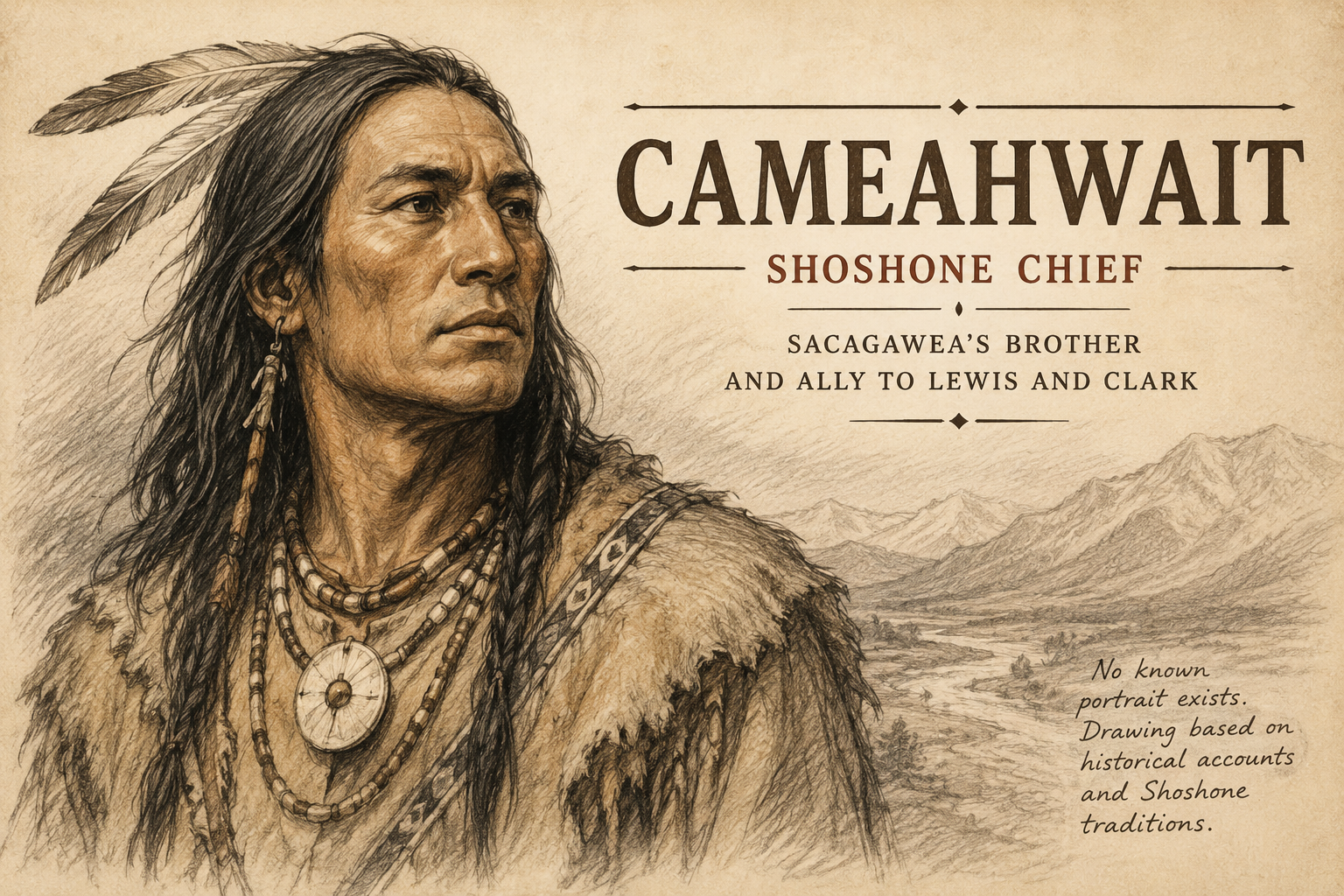
Sacagawea is one of the most recognizable names connected to the Lewis and Clark Expedition.
Her brother is not.
But in August 1805, Cameahwait, a chief among the Shoshone encountered by the Corps of Discovery, suddenly found himself holding enormous influence over the future of one of the most famous expeditions in American history.
Lewis and Clark had reached the Rocky Mountains.
Their boats were becoming useless.
Their food supplies were strained.
Winter was approaching.
And somewhere beyond the mountains lay the Columbia River and the Pacific Ocean.
There was one major problem:
They needed horses.
The Shoshone had them.
And the man Lewis needed to convince to help him was Cameahwait.
Then Sacagawea arrived.
What happened next became one of the most extraordinary reunions of the Lewis and Clark Expedition — and one of the clearest examples of just how important Native relationships were to the survival of the Corps of Discovery.
Who Was Cameahwait?
Cameahwait was a Shoshone leader encountered by Meriwether Lewis near the Continental Divide in August 1805.
William Clark recorded versions of his name as “Ka-me-ah-wah” and described him as the principal chief among the Shoshone they met. Clark also recorded a war name translated as Black Gun and associated Cameahwait’s name with “Come & Smoke.”
The expedition journals provide some of the strongest surviving written evidence about him.
According to the original Lewis and Clark expedition journals preserved by the University of Nebraska, Lewis questioned Cameahwait about the geography west of the mountains and relied heavily on information supplied by him and other Shoshone people.
That information mattered tremendously.
Lewis and Clark were moving into a landscape they did not understand.
The Shoshone did.
Cameahwait knew the mountains, river systems, neighboring Native nations, travel routes and realities waiting on the other side of the Continental Divide.
The expedition needed more than a map.
They needed local knowledge.
Lewis and Clark Were Running Into a Wall
By the summer of 1805, the Corps of Discovery had traveled thousands of miles up the Missouri River.
But the geography was changing.
The water route that had carried the expedition west could not simply carry them through the Rocky Mountains.
Lewis had hoped the headwaters of western rivers might provide something resembling an easy connection toward the Columbia.
Instead, the Corps faced mountains.
Lots of them.
The idea of simply hauling boats across a short divide and putting them back into another navigable river was disappearing.
If the expedition wanted to continue west, it needed horses capable of carrying men, supplies and equipment across brutal mountain terrain.
That made contact with the Shoshone one of the expedition’s most important objectives.
It also explains why Sacagawea’s actual role in the Lewis and Clark story was so much more complicated than the simplified Hollywood version of her “guiding” the expedition across the continent.
Lewis and Clark knew Sacagawea spoke Shoshone.
They knew they were approaching Shoshone country.
And they knew those relationships could become critical.
They were right.
Meriwether Lewis Meets Cameahwait
Lewis crossed the Continental Divide at Lemhi Pass in August 1805 and soon encountered Shoshone people.
The initial meetings were cautious.
That should not be surprising.
The Shoshone had enemies. Armed strangers appearing from the east represented risk, not adventure.
Lewis needed to convince Cameahwait that his party came peacefully.
More importantly, he needed Cameahwait to return east with him and meet the larger Corps of Discovery party traveling with William Clark.
Cameahwait eventually agreed.
But he and his people remained nervous.
At several points, Lewis worried the Shoshone might believe he was leading them into some kind of trap.
The stakes were enormous.
If Cameahwait walked away, Lewis could lose his chance at obtaining the horses he desperately needed.
Then Clark's party arrived.
With them came Sacagawea.
Sacagawea Recognized Cameahwait
On August 17, 1805, one of the most human moments in the Lewis and Clark journals unfolded.
Sacagawea entered the Shoshone camp.
And she recognized Cameahwait.
Meriwether Lewis recorded that Sacagawea “proved to be a sister of the Chif Cameahwait.”
The reunion immediately transformed the meeting.
Lewis described the scene as deeply emotional. Sacagawea also recognized another woman who had reportedly been captured around the same time she had been taken from her people years earlier.
The National Park Service account of the Shoshone encounter preserves Lewis's description of the reunion and the negotiations that followed.
Think about the odds.
Years earlier, Sacagawea had been separated from the world of her childhood.
She eventually found herself hundreds of miles away among the Mandan and Hidatsa villages, connected to French-Canadian trader Toussaint Charbonneau.
Then Toussaint Charbonneau and Sacagawea joined Lewis and Clark during the expedition west.
Thousands of miles into that journey, the Corps desperately needed help from a Shoshone leader.
That leader turned out to be Sacagawea’s brother.
You could not write a better frontier story.
Was Cameahwait Really Sacagawea’s Biological Brother?
There is an important historical nuance here.
The Lewis and Clark journals clearly describe Cameahwait as Sacagawea’s brother.
That is the traditional account and remains the version familiar to most historians.
However, Native accounts of Sacagawea’s ancestry are not uniform.
A modern Mandan, Hidatsa and Arikara oral-history account published by the National Park Service presents a different Sacagawea tradition. In that account, Cameahwait had been adopted as a relative by Sacagawea’s family rather than necessarily being her biological brother.
That distinction deserves acknowledgment.
Native kinship did not always map neatly onto the European definitions later historians applied to words like brother, sister and cousin.
What is not disputed is the larger point:
Sacagawea and Cameahwait recognized one another through a meaningful kinship relationship, and that relationship immediately mattered to the expedition.
Cameahwait Had Something Lewis and Clark Desperately Needed
Horses.
Lewis and Clark could not make the next stage of their journey with boats alone.
They needed pack animals to cross the mountains.
Cameahwait and his people agreed to trade horses to the Americans.
The Corps acquired animals from the Shoshone and began preparing for the crossing westward.
The expedition journals describe Lewis trading clothing, knives and other goods in the effort to obtain horses.
The Americans also presented Cameahwait with a medal bearing the likeness of President Thomas Jefferson.
This was part diplomacy, part trade and part the strange political theater that often followed the Corps across the continent.
Jefferson had dispatched explorers into lands populated and controlled by Native nations long before the United States possessed any meaningful authority there.
A presidential medal did not suddenly make the Shoshone American subjects.
What mattered on the ground was relationship.
Cameahwait had the horses.
Cameahwait had knowledge.
Cameahwait had influence among his people.
And Lewis and Clark needed his cooperation.
Cameahwait Also Gave Lewis Something Just as Valuable: Information
The horses get most of the attention.
But Cameahwait’s geographic knowledge may have been nearly as important.
Lewis questioned him about the country ahead.
Where did the rivers run?
What tribes lived beyond the mountains?
Could the expedition continue west?
What kind of terrain would they face?
According to Lewis’s journal, Cameahwait explained what he knew and referred Lewis to other knowledgeable Shoshone men for additional geographic information.
This is another part of the Lewis and Clark story that gets lost when we describe the Corps as simply “exploring unknown territory.”
It was unknown to them.
It was not unknown.
Native people had traveled, hunted, traded, fought and lived across these landscapes for generations.
Lewis and Clark repeatedly depended upon Native knowledge to understand the country they were crossing.
Cameahwait was part of that network.
Did Cameahwait Save the Lewis and Clark Expedition?
“Save” is a strong word.
But there is a legitimate argument for it.
Imagine the Corps without Shoshone cooperation.
No dependable supply of horses.
Little reliable knowledge about the route ahead.
A massive mountain barrier.
Deteriorating weather.
Limited supplies.
And hundreds of miles still separating them from the Pacific.
Cameahwait did not personally carry the expedition across the mountains.
And Sacagawea did not single-handedly guide Lewis and Clark from St. Louis to the Pacific.
History is usually more complicated than the legends we create afterward.
But both were critical at precisely the moment the Corps needed them.
The importance of horses becomes even clearer when considering what happened next.
The expedition eventually entered the Bitterroot Mountains and endured one of the most punishing stretches of the entire journey.
The men became desperately hungry.
Game was scarce.
Terrain was brutal.
Horses themselves eventually became a food source.
Without horses at the beginning of that crossing, the challenge would have been dramatically worse.
Sacagawea Was More Than the Famous Woman Carrying a Baby
The Cameahwait encounter also helps us better understand Sacagawea.
Her story is frequently reduced to an image:
A young Native woman.
A baby on her back.
Lewis and Clark walking beside her.
But Sacagawea’s real importance came from the worlds she connected.
She understood languages the Americans did not.
She recognized geography.
Her presence with an infant helped communicate that the Corps was not simply an invading war party.
And when the expedition reached the Shoshone, her personal history unexpectedly became part of American history.
The woman who had once been separated from her people suddenly became one of the most important human bridges available to Lewis and Clark.
Her child would later live an extraordinary life of his own. Jean Baptiste Charbonneau, Sacagawea’s son would travel from Native villages to St. Louis, Europe, the fur trade and the California Gold Rush.
Sacagawea’s story after the Corps returned east is even more mysterious. The question of what happened to Sacagawea after Lewis and Clark remains one of the most fascinating debates surrounding her life.
But in August 1805, there was no mystery about her usefulness.
Lewis and Clark needed the Shoshone.
Sacagawea knew Cameahwait.
And Cameahwait chose to help.
Cameahwait Disappears From the Famous Story
That is perhaps the most remarkable part.
Sacagawea became an American icon.
Lewis and Clark became household names.
Cameahwait largely disappeared.
There are no photographs of him.
There is no enormous popular mythology surrounding his life.
Compared with Sacagawea, relatively little about Cameahwait survives in the written historical record after his interactions with the Corps.
He becomes another example of how American history can remember an expedition while forgetting some of the people who made that expedition possible.
The same thing happens with Native women whose names barely survived at all. Otter Woman’s forgotten connection to Sacagawea is another example of how entire lives can nearly disappear when the people recording history considered someone secondary to their own story.
Cameahwait was not secondary in August 1805.
For a brief but critical moment, he stood at the center of everything.
The Overlooked Shoshone Chief Who Changed the Expedition
Lewis and Clark are remembered as explorers who conquered distance through courage, planning and endurance.
They certainly possessed all three.
But they did not cross the continent alone.
Again and again, Native people provided food, directions, horses, geographic intelligence, trade relationships and communication that allowed the expedition to continue.
Cameahwait represents that larger truth.
When Lewis reached the Shoshone, he did not encounter an empty frontier.
He encountered a leader.
He encountered a people.
He encountered knowledge he did not possess.
Then Sacagawea arrived and recognized the chief.
Suddenly an American expedition, a Shoshone family story and the enormous geography of the West collided in one remarkable moment.
Cameahwait gave Lewis and Clark horses.
He gave them information.
He gave them cooperation.
And he helped open the route toward the Pacific.
Sacagawea may be the name history remembers.
But when the Corps of Discovery needed help most, her brother Cameahwait was one of the men who helped keep the expedition moving west.
That deserves to be remembered too.