History, AI & Authenticity: How Chronicles of History Uses Artificial Intelligence
The realness of this brand, website, history and AI.
Yes, Chronicles of History uses artificial intelligence.
But probably not in the way you think.
I believe AI can be an incredible tool for researching, organizing and communicating history — provided the human behind it remains responsible for the ideas, questions, judgment and final message.
That is how I use it here.
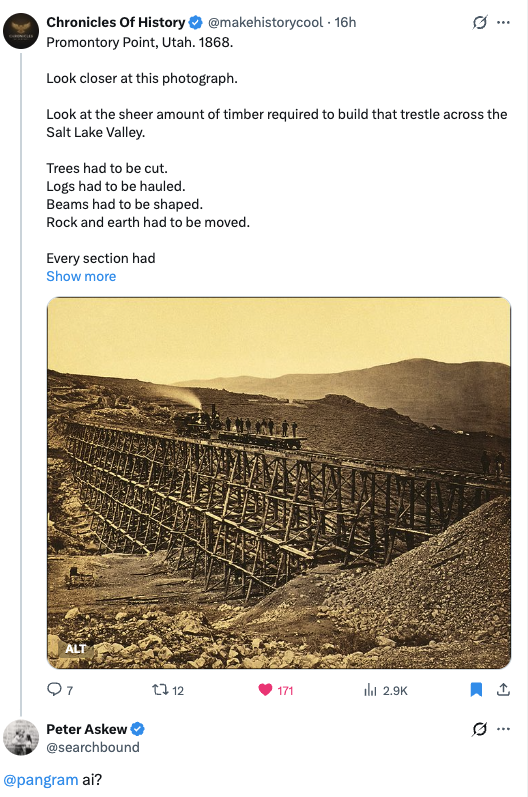
This all came about because of the X post I have linked here, which was posted August 9th, 2026.
One of my followers commented, “AI?” It sparked a long discussion in the comments about how COH uses
artificial intelligence, and it’s one I think worth talking about and publicly stating here.
Overview
Chronicles of History uses AI to assist with research, historical verification, organization and editing.
The topics, questions, opinions, interpretations and lessons come from me.
I do not use AI to digitally recreate historical photographs and present them as real.
AI is a tool in the process.
It is not the historian, the storyteller or the reason this brand exists.
The Stories Start With Me
Usually, the process begins with a question.
Who was this person?
What really happened here?
Why has this story been forgotten?
How does this moment in history relate to the world we live in today?
And most importantly: what can it teach us?
That last question is at the heart of Chronicles of History.
I didn't build COH simply to retell old stories.
There are already encyclopedias, museums, history books and thousands of websites capable of telling you when something happened.
I'm interested in why it still matters.
History is filled with people who faced war, uncertainty, poverty, migration, political division, brutal landscapes, personal loss, enormous risk and decisions that changed generations.
They struggled with leadership.
They raised families.
They built communities.
They failed.
They sacrificed.
They endured.
And while our world looks radically different from theirs, human nature hasn't changed nearly as much.
Chronicles of History exists to connect their experiences to ours.
To understand where we came from.
To recover stories worth remembering.
And to look at the courage, mistakes, sacrifice, faith, resilience and character of those who came before us and ask what they might teach us about how we live today.
This Is Not an AI-Generated History Brand
I want to be particularly clear about this.
Chronicles of History is not an AI content machine.
It isn't a collection of automatically generated articles wrapped around historical keywords.
It isn't an account scraping old photographs, asking AI to write captions and publishing whatever comes back.
There are plenty of accounts doing that.
That isn't what I'm building.
Every subject I pursue begins with something that genuinely interests me.
I find a photograph.
I encounter a person I've never heard of.
I drive through an old town and wonder what happened there.
I read a strange detail in a historical account.
I come across a claim that doesn't quite make sense.
Or I find myself thinking about how an event from 150 years ago connects to something we're experiencing today.
Then I start digging.
I bring my questions, observations, theories and often very rough writing into the research process.
AI is one of the tools I use to help me investigate them.
It can help me find holes in my thinking, verify a date, provide additional context, challenge an assumption, organize research or take a paragraph I've butchered and make it readable.
But AI didn't become curious about that person.
I did.
AI didn't decide that forgotten photograph deserved another look.
I did.
AI didn't determine what that person's life, failure, courage or sacrifice means to me.
I did.
And ultimately, I decide what Chronicles of History says.
That distinction matters.
How Chronicles of History Uses AI and My Personal Approach On It.
Once I have a subject or an idea, I use AI as a research and editorial tool.
I may give it my notes, theories, questions or rough thoughts and ask it to help me:
investigate historical claims
identify contradictions or missing context
verify dates, names and events
locate areas that require deeper research
expand historical context
organize a story
challenge one of my assumptions
improve clarity and grammar
clean up rough writing
make complicated history easier to understand
connect historical events to broader themes
Sometimes I am right.
Sometimes I am partly right.
Sometimes further research proves me wrong.
That is part of the process.
The goal should never be to force history to fit a predetermined narrative.
The goal is to keep digging until the best available evidence tells the story.
AI Does Not Choose What I Believe
Artificial intelligence can provide information.
It cannot decide what matters to me.
The lessons I draw from history — about courage, failure, leadership, faith, family, freedom, resilience, sacrifice and human nature — are my interpretations.
Many Chronicles of History posts begin as scattered thoughts I have after seeing an old photograph or reading about a person.
AI helps me pressure-test those thoughts, expand the historical context and communicate them more clearly.
It does not manufacture my interest in the subject.
It does not determine my worldview.
And it does not decide my conclusions for me.
Chronicles of History Does NOT Generate Historical Photographs
This is particularly important to me.
Every historical photograph I publish on the Chronicles of History website or share through the COH X account is authentic.
I do not use AI to recreate historical photographs.
I do not digitally render people into old photographs.
I do not manufacture historical scenes and present them as photographic evidence.
And I do not alter authentic photographs in a way that changes what actually existed in the original image.
When you see an old photograph attached to one of my posts on X, you are looking at a real historical photograph.
The same standard applies to historical photographs used throughout the Chronicles of History website.
In roughly 90% of cases, I can trace the photographs I use back to an original archive, collection, museum, historical society, Library of Congress record, university collection or another documented source.
If the authenticity of a photograph I publish is ever reasonably questioned, I am happy to provide the original source or documentation whenever it is available.
There is one important distinction.
I do occasionally use clearly illustrative, AI-generated artwork within some of my long-form blog content.
Those images are intended to serve as illustrations — not historical photographs— and they are visually presented as such.
They are never intended to fool a reader into believing they are authentic photographs from the period.
That line matters to me.
Historical photography is powerful precisely because someone was really standing there.
That person existed.
That landscape existed.
That moment happened.
There is something irreplaceable about looking into the face of someone photographed 100 or 150 years ago and knowing the camera actually captured them.
When you look into their eyes, you are not looking at someone's modern interpretation of that person.
You are looking at them.
That connection to the past is one of the things that makes history so powerful.
AI can help us investigate history.
It can help us understand it.
It can even help us visualize parts of it when clearly presented as illustration.
But it should never quietly rewrite the historical record.
If I present something as a historical photograph on Chronicles of History, my standard is simple: it needs to be real.
AI Is Not a Historical Source
AI itself should not be treated as a primary historical source.
Neither should a simple internet search.
AI can help identify information, connect ideas and accelerate research, but meaningful historical claims should ultimately be grounded in reliable historical evidence.
That can include primary documents, archival collections, government records, books, academic research, museums, historical societies, newspapers, photographs, letters, journals and other credible sources.
And history is not always clean.
Records disappear.
Eyewitnesses disagree.
Memories change.
Stories become exaggerated.
Political and cultural perspectives influence how events are recorded.
Sometimes two credible sources tell very different versions of the same event.
When a historical question is genuinely disputed, I would rather acknowledge the uncertainty than pretend the answer is settled.
That uncertainty is part of history too.
Why Use AI At All?
Because it allows one curious person to investigate more questions than would have been possible before.
That does not replace historians.
It does not replace archives.
It does not replace books.
It does not replace primary sources.
And it certainly does not replace human judgment.
What AI can do is accelerate parts of the process.
A photograph that once might have produced nothing more than a short caption can become the beginning of a much larger investigation.
A forgotten name can lead to an extraordinary life story.
A questionable claim can be challenged instead of simply repeated.
A connection between two historical events can lead to an entirely new direction of research.
AI gives us another tool for asking better questions.
What matters is how we use it.
The Mission of Chronicles of History
Technology will change.
The mission won't.
Chronicles of History exists because I believe we've become increasingly disconnected from the people and experiences that built the world we inherited.
History isn't supposed to be nothing more than names and dates memorized for a test.
It is accumulated human experience.
It shows us what happens when leadership succeeds and when it fails.
What strong communities can accomplish.
What division can destroy.
What ordinary people are capable of enduring.
What freedom has cost.
What previous generations sacrificed.
What happens when people lose courage.
And what human beings can accomplish when circumstances demand more from them than they thought they possessed.
Those lessons aren't obsolete.
We may need them now more than ever.
I believe understanding where we came from helps us better understand where we are going.
That means remembering the good without pretending the bad didn't happen.
It means studying courage alongside cruelty.
Achievement alongside failure.
Sacrifice alongside injustice.
The builders and the destroyers.
The famous and the forgotten.
The people who got history right and the people who got it terribly wrong.
Because the point isn't to worship the past.
The point is to learn from it.
My goal with Chronicles of History is to make history interesting enough that people want to discover it — and meaningful enough that they carry something from it back into their own lives.
You can read our official COH mission here.
The Standard I Try to Follow
My philosophy is simple:
Human curiosity. Historical evidence. AI assistance. Human judgment.
Chronicles of History is not an automated history website.
There is a person behind it.
I choose the stories.
I chase the questions.
I form the opinions.
I decide what gets published.
AI helps me research more deeply, challenge assumptions, organize information and communicate those ideas more clearly.
And as these tools continue to improve, I intend to keep using them.
Not to manufacture history.
Not to replace human curiosity.
And not to flood the internet with content for the sake of content.
But to understand the past more deeply and help more people become interested in it again.
AI helps me do more of that. It does not replace the reason I'm doing it.