

The Complicated Truth About Toussaint Charbonneau and Sacagawea
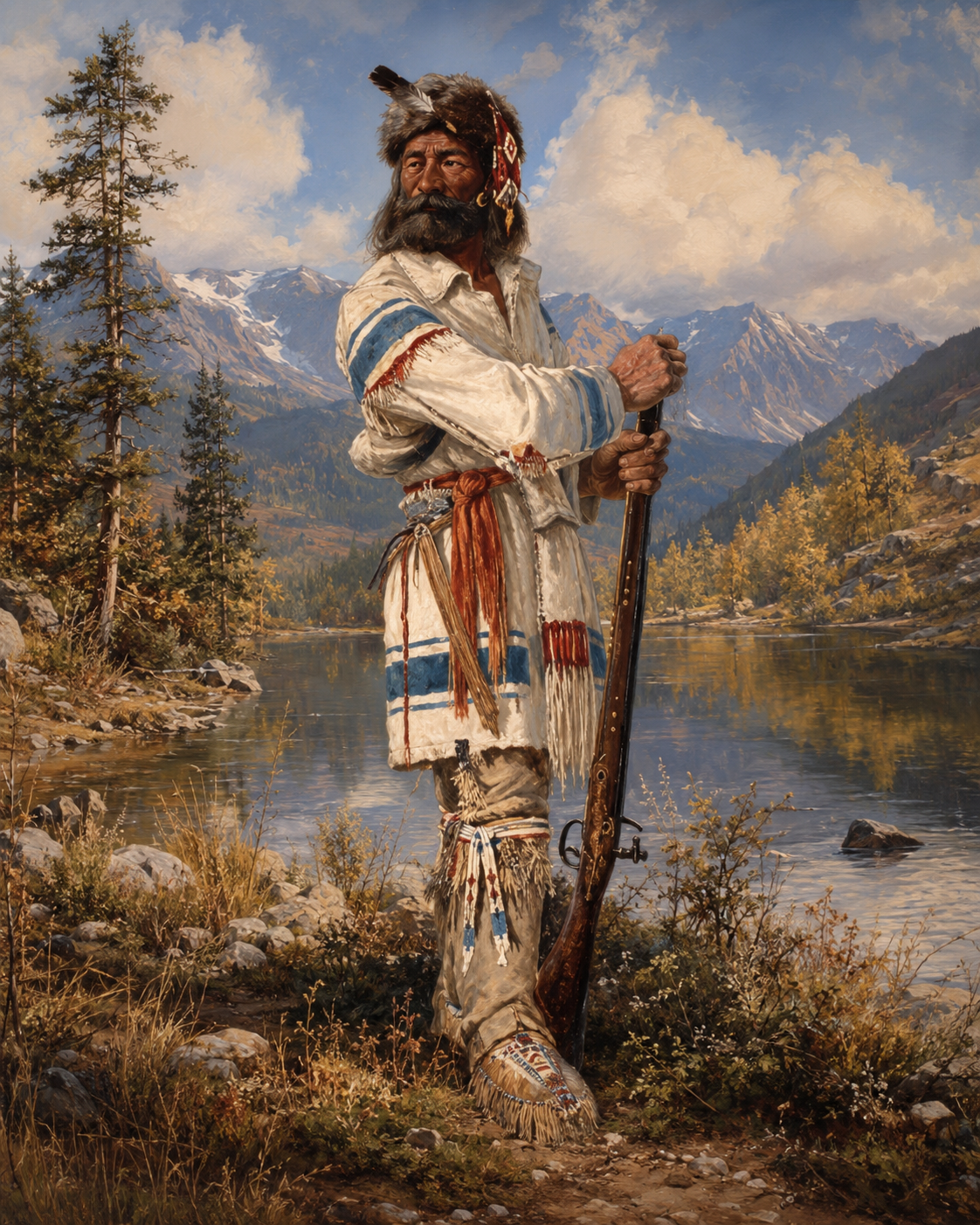
*This picture is a digital render and drawing. There is NO actual photo of Toussaint Charbonneau.
History often remembers men by their titles and women by their usefulness to them.
Toussaint Charbonneau is usually introduced as Sacagawea’s husband. A French-Canadian trader. An interpreter. A member of the Lewis and Clark Expedition. A man who traveled with the Corps of Discovery as America pushed west across a continent it was only beginning to understand.
But that clean description hides a much harder story.
Before Sacagawea became one of the most recognized Native women in American history, she was a young Shoshone girl taken from her people. Before she became a guide, interpreter, mother, and symbol of courage, she was pulled into a world of captivity, trade, power, and survival. And by the time Lewis and Clark met her near the Mandan and Hidatsa villages, she was already tied to a much older man named Toussaint Charbonneau.
Charbonneau’s name survived because he was recorded by other men with pens. Sacagawea’s name endured because her courage outgrew the record they left behind.
This is the complicated truth about Toussaint Charbonneau and Sacagawea.
Who Was Toussaint Charbonneau?
Toussaint Charbonneau was a French-Canadian fur trader and interpreter best known as the husband of Sacagawea and a member of the Lewis and Clark Expedition. He lived among the Mandan and Hidatsa people, where Sacagawea had been taken after being captured from her Lemhi Shoshone homeland as a child. While many historical sources call Sacagawea Charbonneau’s wife, the circumstances around their relationship point to a severe imbalance of age, power, freedom, and choice.
Who Exactly Was Toussaint Charbonneau and Why It Matters?
Toussaint Charbonneau was born around 1767, likely near Montreal, in what was then French Canada. Like many men of the fur trade, he moved west into the borderlands of commerce, survival, and cultural exchange. By the early 1800s, he was living among the Mandan and Hidatsa villages near the Knife River in what is now North Dakota.
That region mattered.
It was not some empty wilderness waiting for Lewis and Clark to discover it. It was a world of Native nations, trade networks, languages, alliances, rivalries, and old paths across the plains. The Mandan and Hidatsa villages were important centers of trade. People came there to exchange corn, horses, hides, weapons, tools, knowledge, and news.
Charbonneau found his place in that world as a trader and interpreter. He spoke French and some Hidatsa. He had relationships with Native communities. He knew enough of the land and trade system to make himself useful.
But useful does not mean noble.
When Meriwether Lewis and William Clark reached the Mandan villages in the winter of 1804–1805, they needed interpreters. According to the National Park Service’s account of Charbonneau and Sacagawea being hired, Lewis and Clark saw value in Charbonneau’s interpreting ability, but also in Sacagawea’s Shoshone and Hidatsa language skills.
They knew they would eventually need help communicating with the Shoshone. The expedition could not cross the Rocky Mountains without horses, and the Shoshone were expected to be critical to that effort.
Charbonneau offered himself as an interpreter. But the true value he brought was not himself.
It was Sacagawea.
Sacagawea Before Charbonneau
Sacagawea was born among the Lemhi Shoshone, likely around 1788, in present-day Idaho. Her early life was not the polished legend many Americans later learned in school. It was marked by violence and separation.
According to the National Park Service biography of Sacagawea, she was taken from her Lemhi Shoshone people by a Hidatsa raiding party when she was still a young girl. She was removed from her homeland, her language world, and her childhood.
That single fact changes everything.
Because when we later find Sacagawea living among the Mandan and Hidatsa, tied to Charbonneau, traveling with Lewis and Clark, and carrying her infant son across the American West, we are not looking at a woman who entered the story from a position of comfort or power.
We are looking at someone who had already survived displacement.
The clean textbook version often begins with her usefulness to the expedition. But Sacagawea’s story did not begin with Lewis and Clark. It began before them, among her own people, before she was taken.
That matters.
Because if we begin her story with the expedition, she becomes a supporting character in someone else’s adventure.
If we begin her story with her captivity, her survival becomes impossible to ignore.
For more on the larger debate around her later life and death, read Sacajawea Didn’t Die in 1812 — The Real Story They Don’t Teach.
Was Sacagawea Charbonneau’s Wife, Slave, or Captive?
This is where the story becomes difficult.
Many historical sources describe Sacagawea as Charbonneau’s wife. That is the common label. It is the one most often used in official summaries, schoolbooks, museums, and biographies.
But the word “wife” does not answer the deeper question.
Was she free to choose?
The National Park Service notes that Sacagawea was taken by a Hidatsa raiding party from her Lemhi Shoshone people and later married Toussaint Charbonneau while living among the Mandan and Hidatsa. The historical record also makes clear that Charbonneau was much older than Sacagawea and already had another Native wife named Otter Woman.
That should make modern readers pause.
Sacagawea was a teenager. Charbonneau was roughly three decades older. She had been captured from her people. She was living in a world shaped by trade, diplomacy, survival, and male power. Whether the relationship is described as marriage, captivity, purchase, or coercion, the reality was not equal.
History often hides force behind polite words.
A woman can be called a wife in the record and still have had very little choice in becoming one. A man can be called an interpreter and still have benefited from a young Native woman whose language, identity, and homeland made him valuable.
That is the tension at the heart of Charbonneau’s legacy.
He was not remembered because he was extraordinary.
He was remembered because Sacagawea was.
Otter Woman: The Other Forgotten Wife
Sacagawea was not the only Native woman connected to Charbonneau.
He also had another wife named Otter Woman. Like Sacagawea, Otter Woman has often been pushed to the edge of the story. She is usually mentioned briefly, if at all, as another wife of Charbonneau.
But that small detail opens a larger window into the world around the Lewis and Clark Expedition.
Native women were often central to trade relationships on the frontier. They helped connect cultures, languages, families, and economic systems. But they were also vulnerable to exploitation. Men like Charbonneau moved through Native worlds and European trade networks, often gaining access, status, and survival through relationships with Native women.
Sacagawea became famous because she went west.
Otter Woman nearly disappeared because she stayed behind.
And that is one of the great tragedies of history. Fame does not always follow importance. Sometimes it follows proximity to the men who wrote things down.
Otter Woman’s story matters because it reminds us that Sacagawea was not an isolated figure. She was part of a larger world of Native women whose lives were shaped by captivity, marriage, trade, survival, motherhood, and silence in the written record.
Read more: Who Was Otter Woman? The Overlooked Woman Connected to Sacagawea and the Lewis and Clark Expedition
Why Lewis and Clark Needed Sacagawea More Than Charbonneau
Lewis and Clark officially hired Charbonneau as an interpreter. But the expedition’s need for him was deeply tied to Sacagawea.
Charbonneau spoke French and some Hidatsa. Sacagawea spoke Hidatsa and Shoshone. That mattered because the Corps of Discovery would eventually need to negotiate with the Shoshone for horses to cross the Rocky Mountains.
Without horses, the expedition could stall.
Without communication, negotiations could fail.
Without Sacagawea, Charbonneau’s value dropped dramatically.
This is one of the most overlooked truths of the expedition:
Charbonneau was the man officially hired. Sacagawea was the reason he mattered.
She was young. She was a mother. She was traveling with an infant. She was moving through lands that carried pieces of her own past. And when the expedition reached the Shoshone, her presence became more than useful. It became providential.
The Lewis and Clark Trail Heritage Foundation notes that Sacagawea spoke both Shoshone and Hidatsa and served as an important communication link for the expedition. Her role was not simply symbolic. It was practical, human, and historically important.
Sacagawea recognized her people. She helped bridge worlds. She became a living sign that the expedition was not simply a war party moving west. Her presence, with a child on her back, communicated something that armed men alone could not.
That does not mean the expedition was harmless. It does not erase what American expansion would later bring to Native nations.
But in that moment, Sacagawea’s presence mattered.
She helped the expedition survive.
Charbonneau helped translate.
There is a difference.
For more on why this expedition deserves deeper national recognition, read Why the Lewis and Clark Expedition Deserves a National Holiday.
The Man in the Record and the Woman in the Memory
Toussaint Charbonneau appears in history because he was attached to official events. He was named in journals. He was hired by the expedition. He traveled with Lewis and Clark. He received payment. He remained connected to the American fur trade and frontier world after the expedition ended.
But Charbonneau never became the moral center of the story.
Sacagawea did.
That says something.
Charbonneau had the title. Sacagawea had the legacy.
Charbonneau had the contract. Sacagawea had the courage.
Charbonneau was written into the record by men. Sacagawea was remembered by a nation still trying to understand what her story really meant.
For many years, Americans turned Sacagawea into a symbol that was easier to celebrate than understand. She became the helpful guide, the young mother, the Native woman pointing west. Statues and paintings often showed her leading the way, sometimes in ways that stretched or simplified the historical record.
But the real Sacagawea is more powerful than the myth.
She was not simply a guide.
She was a survivor of capture. A teenage mother. A translator across worlds. A woman moving through a violent and uncertain frontier. A person whose life was shaped by forces much larger than herself, yet whose presence changed one of the most famous expeditions in American history.
The myth makes her useful.
The truth makes her human.
Jean Baptiste and Lizette Charbonneau
Sacagawea and Charbonneau had a son, Jean Baptiste Charbonneau, born in February 1805, shortly before the expedition moved west from Fort Mandan. He traveled with the Corps of Discovery as an infant and became a favorite of William Clark, who nicknamed him “Pomp” or “Pompy.”
Jean Baptiste would go on to live a remarkable life of his own. He was educated under Clark’s care, traveled to Europe, became involved in frontier life, and lived between cultures in ways that mirrored the complicated world into which he had been born.
Sacagawea also had a daughter, Lizette Charbonneau, whose life remains far less documented. Like so many women and children on the edges of the frontier record, Lizette appears briefly and then fades into uncertainty.
That silence should not be mistaken for insignificance.
It should remind us how often history preserves the names of men while losing the lives of women and children.
Read more: Lizette Charbonneau: The Forgotten Daughter in the Sacagawea Mystery
Why Charbonneau’s Story Still Matters
It would be easy to turn Toussaint Charbonneau into a villain and leave it there.
But history is usually more complicated than that.
Charbonneau was a product of the fur trade world. He was a trader, interpreter, husband, opportunist, survivor, and man of the frontier. He moved through cultures, but he also benefited from systems that placed Native women in vulnerable positions.
That is why his story matters.
Not because he was great.
But because he reveals the world around Sacagawea.
He shows us how empire often moved through relationships before it moved through armies. He shows us how women were used as bridges between men, nations, economies, and ambitions. He shows us how American expansion depended not only on explorers and maps, but on Native knowledge, Native labor, Native languages, and Native women whose stories were rarely told with the dignity they deserved.
This connects to a much broader Native history that deserves to be told with more depth and honesty. For another window into that world, read What Was Daily Life Like for the Lakota on the Frontier? and The Last Pawnee Sacrifice, 1836 — The Morning Star Ritual.
Charbonneau’s life forces us to ask harder questions.
Who gets called an explorer?
Who gets called a helper?
Who gets paid?
Who gets remembered?
Who gets reduced to someone else’s wife?
And who, despite all of that, becomes the person history cannot forget?
The Legacy History Got Wrong
The Lewis and Clark Expedition is often told as a story of courage, discovery, and American ambition. It was all of those things. But it was also a story of dependence.
The Corps depended on Native nations for food, direction, diplomacy, horses, shelter, and survival. They depended on people whose worlds already existed long before the United States sent men west to map them.
Sacagawea stands at the center of that truth.
Her presence reminds us that the American story was never built by one kind of person. It was shaped by soldiers, settlers, Native nations, enslaved people, traders, mothers, interpreters, warriors, farmers, scouts, and children born into worlds they did not choose.
Charbonneau’s name belongs in the story, but not at the center of it.
He was the man who claimed Sacagawea.
But he never owned her legacy.
That belongs to her.
And maybe that is the lesson that still endures.
History may record power first, but memory has a way of correcting the record. The men with titles are not always the ones who matter most. Sometimes the person carrying the child, speaking the language, recognizing the land, and enduring the impossible is the one who outlives them all.
Sacagawea did.
Key Facts About Toussaint Charbonneau and Sacagawea
Toussaint Charbonneau: French-Canadian fur trader and interpreter
Known for: His role in the Lewis and Clark Expedition and his relationship to Sacagawea
Sacagawea: Lemhi Shoshone woman captured as a child and later connected to the Mandan-Hidatsa village world
Charbonneau’s wives: Sacagawea and Otter Woman are both commonly identified as wives of Charbonneau
Children: Jean Baptiste Charbonneau and Lizette Charbonneau
Expedition role: Charbonneau and Sacagawea joined the Corps of Discovery in 1805
Why it matters: Their story reveals the complicated realities of captivity, Native women’s roles, frontier trade, power, translation, and American expansion
Frequently Asked Questions About Toussaint Charbonneau and Sacagawea
Who was Toussaint Charbonneau?
Toussaint Charbonneau was a French-Canadian fur trader and interpreter who joined the Lewis and Clark Expedition. He is best known as Sacagawea’s husband, though his historical importance is largely tied to her language skills, identity, and role in the expedition.
Was Sacagawea married to Toussaint Charbonneau?
Most historical sources describe Sacagawea as one of Charbonneau’s wives. However, because Sacagawea had been captured from her Lemhi Shoshone people as a child and was much younger than Charbonneau, modern readers and historians often question how much freedom or choice she had in that relationship.
Did Toussaint Charbonneau own Sacagawea?
The historical record often uses the language of marriage rather than ownership. However, Sacagawea’s capture, displacement, young age, and relationship with a much older trader raise serious questions about coercion, captivity, and power. A careful reading of the history shows that the relationship was deeply unequal. To be direct, Sacagawea was his slave. She lived most her life wanting to get free from his grasp.
Who was Otter Woman?
Otter Woman was another Native wife of Toussaint Charbonneau. She is often mentioned only briefly in historical accounts, but her story matters because it shows that Sacagawea was part of a larger world of Native women connected to trade, captivity, marriage, and frontier power.
Why did Lewis and Clark bring Sacagawea?
Lewis and Clark needed interpreters and hoped to negotiate with the Shoshone for horses to cross the Rocky Mountains. Sacagawea spoke Shoshone and Hidatsa, making her extremely valuable to the expedition’s success.
Why is Sacagawea more remembered than Charbonneau?
Sacagawea is remembered because her courage, survival, language skills, motherhood, and role in the expedition became far more meaningful than Charbonneau’s official title. He was hired as an interpreter, but her presence became central to the story.
Related Chronicles of History Articles
Sacajawea Didn’t Die in 1812 — The Real Story They Don’t Teach
Who Was Otter Woman? The Overlooked Woman Connected to Sacagawea and the Lewis and Clark Expedition
Lizette Charbonneau: The Forgotten Daughter in the Sacagawea Mystery
Why the Lewis and Clark Expedition Deserves a National Holiday
Fort Necessity, Lawrence Washington, and the Making of George Washington