

Jean Baptiste Charbonneau: What Happened to Sacagawea’s Son?
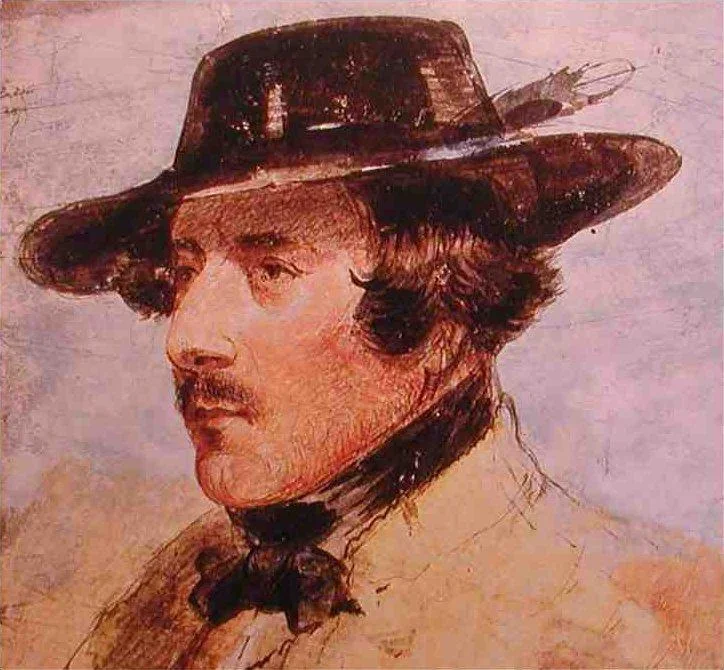
Jean Baptiste Charbonneau entered the world in one of the most unusual places imaginable.
He was born on February 11, 1805, inside Fort Mandan in present-day North Dakota, while the Corps of Discovery prepared to continue west into country few white Americans had ever seen.
His mother was Sacagawea, the young Shoshone woman whose language skills, knowledge, courage, and presence became essential to the Lewis and Clark Expedition.
His father was Toussaint Charbonneau, a French-Canadian fur trader and interpreter whose relationship with Sacagawea remains one of the most complicated parts of the expedition’s history.
Before Jean Baptiste could walk, he had crossed mountains, traveled thousands of miles, and reached the Pacific Ocean.
But that was only the beginning.
The infant remembered by history as the baby carried on Sacagawea’s back grew into one of the most culturally versatile men of the American West.
He was raised around Native communities. He was educated under William Clark’s protection. He lived among European nobility. He became a trapper, guide, interpreter, military scout, public official, and gold seeker.
Jean Baptiste Charbonneau did not simply live between two worlds.
He learned how to move through several of them.
What Happened to Sacagawea’s Son?
Jean Baptiste Charbonneau survived the Lewis and Clark Expedition and later received an education in St. Louis under the guardianship and financial support of William Clark.
As a young man, he traveled to Europe with Duke Paul Wilhelm of Württemberg, where he spent several years expanding his education and language skills.
After returning to North America, Jean Baptiste went back west. He worked as a fur trapper, hunter, guide, interpreter, military scout, magistrate, and gold prospector.
According to the Oregon Encyclopedia’s biography of Jean Baptiste Charbonneau, he died in eastern Oregon in 1866 while traveling toward another western mining opportunity.
His life stretched from the Lewis and Clark Expedition to the California Gold Rush.
Few Americans of his generation experienced more of the changing West.
Jean Baptiste Charbonneau Was Born Into the Corps of Discovery
Sacagawea gave birth to Jean Baptiste at approximately five o’clock in the evening on February 11, 1805.
The delivery was difficult.
In his journal, Meriwether Lewis recorded that Sacagawea’s labor had been long and painful. Because it was her first child, those around her worried about whether she would safely deliver the baby.
A man at the fort suggested giving her a small amount of crushed rattlesnake rattle mixed with water. Lewis wrote that only minutes after she drank it, the child was born.
Lewis described him simply as “a fine boy.”
The original account can still be read in the Lewis and Clark Journals entry from February 11, 1805.
Two months later, Sacagawea carried Jean Baptiste out of Fort Mandan as the Corps of Discovery continued west.
He crossed the northern plains, entered the Rocky Mountains, reached the Pacific Ocean, and returned east before he was two years old.
The men called him Pomp, Pompy, or sometimes Little Pomp.
William Clark became especially attached to him.
Clark referred to Jean Baptiste affectionately as “my boy Pomp” and later named a prominent rock formation along the Yellowstone River Pompy’s Tower. Today, it is known as Pompeys Pillar.
Jean Baptiste was not officially enlisted as a soldier or explorer.
But he became the youngest member of the Lewis and Clark Expedition.
The Baby Who Helped Build Corps of Discovery Morale
Jean Baptiste could not interpret a language, negotiate for horses, navigate a river, or carry supplies.
Yet his presence mattered.
The Corps of Discovery was a heavily armed group moving through Native homelands. To the nations they encountered, the expedition could easily have appeared threatening.
But a war party generally did not travel with a young mother and infant.
Sacagawea and Jean Baptiste helped signal that the expedition came with diplomatic intentions rather than plans for an immediate attack.
Their presence humanized the Corps.
The child also gave the men something they desperately needed: a sense of normalcy.
They endured bitter cold, hunger, disease, dangerous rivers, steep mountain passes, exhausting portages, and months of uncertainty.
In that environment, a baby became a source of joy.
The men watched him grow. They played with him. They referred to him fondly in their journals and correspondence.
Jean Baptiste was not simply cargo carried across the continent.
He became part of the expedition’s family.
He helped lift morale during one of the hardest journeys in early American history.
William Clark’s Promise to Raise “My Boy Pomp”
After the Corps returned in 1806, William Clark made Toussaint Charbonneau an extraordinary offer.
Clark had developed a genuine affection for Jean Baptiste. He offered to help raise and educate the boy in St. Louis.
In a later letter to Charbonneau, Clark wrote:
“You well know my fondness for him and my anxiety to take and raise him as my own child.”
The Charbonneau family did not immediately remain in St. Louis. They initially returned to the Mandan and Hidatsa villages of the upper Missouri.
But in 1809, Toussaint, Sacagawea, and Jean Baptiste traveled to St. Louis, partly so the boy could receive a formal education.
The history of that transition is described in The Charbonneaus in St. Louis.
Jean Baptiste was baptized and eventually placed under Clark’s care.
Clark was not his biological father, but he became one of the most important mentors in his early life. He paid for Jean Baptiste’s schooling and provided access to opportunities that would have been unavailable to nearly any other child born at Fort Mandan.
That relationship placed Jean Baptiste in another world.
He was the son of a Shoshone mother and French-Canadian father. He had spent his infancy among explorers, soldiers, traders, and Native nations.
Now he was receiving a classical education in St. Louis.
Jean Baptiste Charbonneau Was Raised Between Cultures
Jean Baptiste’s education did not begin in a classroom.
It began among the Hidatsa and Mandan communities of the upper Missouri.
It continued among the diverse members of the Corps of Discovery.
It later developed through formal schooling in St. Louis under William Clark’s sponsorship.
That upbringing gave him a rare ability.
Jean Baptiste understood that the American West was not divided neatly between Native people and white settlers.
It was a complicated world of tribal nations, French traders, British merchants, American soldiers, Spanish-speaking communities, European travelers, missionaries, trappers, and families of mixed ancestry.
Jean Baptiste learned to function within that world.
Historical accounts associate him with English, French, German, and Spanish. He was also familiar with Native languages, traditions, and methods of communication.
He could sit among educated Europeans.
He could communicate with military officers and American officials.
He could guide men across remote western country.
He could also move among Native communities in ways many white officials could not.
Jean Baptiste belonged fully to no single world.
But he understood several.
That may have been his greatest strength.
From Fort Mandan to European Society
As a young man, Jean Baptiste met Duke Paul Wilhelm of Württemberg, a German nobleman, naturalist, and explorer traveling through North America.
The duke took an interest in him and invited Jean Baptiste to Europe.
He accepted.
During the 1820s, Jean Baptiste spent several years in Europe, particularly in the German state of Württemberg. His experience reportedly included further education, language study, travel, and exposure to aristocratic society.
The Oregon Encyclopedia notes that his European journey ultimately allowed him to travel farther than any other person connected to the Lewis and Clark Expedition.
Consider the distance he had traveled—not merely in miles, but in human experience.
He had been born inside a rough frontier fort.
His mother had carried him across the Rocky Mountains.
He had grown up around Native villages, traders, and explorers.
He had been educated under one of America’s most famous frontier leaders.
Now he was living among European nobility.
Jean Baptiste could have remained in Europe.
He did not.
Why Did Jean Baptiste Return to the American West?
Jean Baptiste returned to the United States around 1829.
Despite his education, language skills, and European connections, he chose to return west.
For much of the next several decades, he worked in occupations that demanded toughness, adaptability, and firsthand knowledge of the land.
He became a fur trapper, hunter, guide, and interpreter in the Rocky Mountains.
The Discovering Lewis and Clark biography of Jean Baptiste divides his life into several distinct periods: his education, his European experience, his years as a mountain man, his military service, and his later life in California.
Jean Baptiste returned during the height of the mountain-man era.
The fur trade brought together people who might otherwise have remained separated by thousands of miles and radically different cultures.
Native nations, French-speaking traders, American merchants, Mexican communities, British companies, and European adventurers all crossed paths in the West.
Jean Baptiste was uniquely prepared for it.
He had enough formal education to communicate with officers and officials.
He possessed the cultural familiarity needed to move among Native communities.
He understood frontier customs and had the physical endurance required to survive remote country.
He was not merely a well-educated man who decided to become a trapper.
He was a product of the West itself.
Jean Baptiste Became a Guide, Scout, and Interpreter
Jean Baptiste’s abilities eventually carried him into the American Southwest.
During the Mexican-American War, he served as a guide and scout for American military forces moving through New Mexico and toward California.
He assisted the Mormon Battalion during its difficult march toward the Pacific. His knowledge of western terrain and ability to communicate across cultures made him valuable in country unfamiliar to most American soldiers.
He later lived in California and served as an alcalde near Mission San Luis Rey.
An alcalde was a local official who could perform duties similar to those of a mayor, judge, sheriff, or magistrate.
It was an unusual position for the son of Sacagawea.
Jean Baptiste had been born inside a frontier fort and carried across the continent as an infant.
Now he was serving as a public authority in recently conquered California.
He had moved from Native villages to St. Louis classrooms, from European estates to mountain camps, and from military trails to public office.
Very few men could have crossed those boundaries.
Jean Baptiste did it repeatedly.
A Man Who Could Connect Different Worlds
Jean Baptiste possessed a blend of abilities rarely found in the early American West.
He understood Native people because Native identity was part of his own life.
His mother was Shoshone.
His earliest years were spent within Native and mixed-trade communities.
He knew the customs, relationships, and dangers of a world many white Americans barely understood.
At the same time, Clark’s influence had given him a formal education.
His years in Europe exposed him to language, etiquette, nobility, and a much wider world.
Jean Baptiste reportedly spoke Spanish and German in addition to English and French.
That meant he could communicate with Native people, American soldiers, French traders, Mexican residents, and European travelers.
He could sleep in a mountain camp and survive difficult country.
But he could also operate comfortably around educated and powerful men.
Jean Baptiste was not simply caught between cultures.
He had learned from each of them.
That made him one of the most adaptable figures in the history of the American frontier.
Jean Baptiste and the California Gold Rush
Like thousands of other men, Jean Baptiste was eventually pulled into the expanding world of western mining.
He lived and worked in California during the Gold Rush era.
He mined for gold, operated around frontier settlements, and continued seeking opportunity as the American West rapidly changed around him.
The California of the late 1840s and 1850s would have looked radically different from the country he had crossed as a baby.
When Jean Baptiste was born, much of the continent beyond St. Louis remained outside meaningful American control.
By the time he reached California, American settlers, soldiers, miners, merchants, and speculators were pouring west.
Native lands were being seized.
Old trade networks were disappearing.
Military roads were becoming migration routes.
Jean Baptiste had lived long enough to witness the American West move from the age of exploration into the age of conquest and settlement.
How Did Jean Baptiste Charbonneau Die?
In 1866, Jean Baptiste was approximately 61 years old.
He decided to leave California and travel toward another mining opportunity, likely in the Montana Territory.
It was one final western journey.
While traveling through what is now eastern Oregon, Jean Baptiste reportedly crossed cold water and became seriously ill.
He was taken to a stage station near Danner, Oregon, but his condition worsened.
Jean Baptiste Charbonneau died on May 16, 1866.
The National Park Service account of Jean Baptiste Charbonneau’s death explains that news of his death eventually reached his former home in Auburn, California.
He was buried in the high desert near present-day Jordan Valley, Oregon.
Jean Baptiste entered the world at Fort Mandan while Lewis and Clark prepared to cross the continent.
More than six decades later, he left it the same way he had lived much of his life:
Moving through the American West.
Searching for whatever waited beyond the next horizon.
Did Sacagawea Spend Years Searching for Jean Baptiste?
This part of Jean Baptiste’s story remains disputed.
The most widely accepted documentary account holds that Sacagawea died at Fort Manuel in 1812.
A contemporary journal described the death of one of Toussaint Charbonneau’s wives, and William Clark later recorded Sacagawea as dead.
However, Shoshone oral traditions tell another story.
According to the Wind River tradition, Sacagawea survived for decades, traveled widely, eventually returned to the Shoshone people, and died in Wyoming in 1884.
Some versions of that tradition connect her later travels to a long search for Jean Baptiste.
For those who accept the Wind River account, this becomes one of the most emotional parts of Sacagawea’s story.
A mother who had carried her son across the continent may have spent years trying to find the boy who entered William Clark’s world, traveled across the Atlantic, and disappeared into the enormous distances of the American West.
You can read the full argument in Sacajawea Didn’t Die in 1812—The Real Story They Don’t Teach.
Jean Baptiste’s younger sister also sits near the center of the controversy. Her uncertain story is explored in Lizette Charbonneau: The Forgotten Daughter in the Sacagawea Mystery.
Another important figure in the disputed 1812 account is Otter Woman, Toussaint Charbonneau’s other Native wife.
The documentary and oral-history traditions remain in conflict.
That uncertainty should be stated honestly.
But Native oral history should not automatically be dismissed simply because it was not preserved inside an American official’s ledger.
For generations, Native communities preserved their history through memory, family testimony, oral teaching, and cultural tradition.
Written records matter.
So does the reality that written records did not preserve every Native life equally.
Jean Baptiste Charbonneau Was More Than Sacagawea’s Son
History often remembers Jean Baptiste as an infant.
He appears on Sacagawea’s back in paintings, monuments, coins, and schoolbooks.
He is treated as part of her image but rarely given a complete life of his own.
That is a mistake.
Jean Baptiste Charbonneau was a child of the Corps of Discovery, but he became far more than its youngest traveler.
He was educated through the support of William Clark.
He crossed the Atlantic and lived in Europe.
He learned multiple languages.
He trapped in the Rocky Mountains.
He guided soldiers through the Southwest.
He interpreted between cultures.
He became a public official in California.
He witnessed the fur trade, the Mexican-American War, the California Gold Rush, and the transformation of the American West.
Jean Baptiste was Native and European.
Educated and rugged.
Comfortable around nobility, yet repeatedly drawn back toward wild country.
He did not live between two worlds because he could not choose one.
He lived between them because both worlds were already inside him.
The Legacy of Jean Baptiste Charbonneau
The American West was never built by one kind of person.
It was shaped by Native nations, explorers, interpreters, traders, soldiers, captives, immigrants, scouts, mountain men, missionaries, mothers, and children born into worlds they did not choose.
Jean Baptiste Charbonneau represents that complicated reality.
His life cannot be reduced to one identity.
He was not simply Sacagawea’s son.
He was not simply William Clark’s student.
He was not simply a Native man, a European-educated gentleman, a trapper, a guide, or a gold seeker.
He was all of those things.
Jean Baptiste crossed borders that most people of his time never approached.
He adapted without completely surrendering the worlds that made him.
He began his life as the smallest member of America’s most famous western expedition.
He finished it as a seasoned frontiersman still searching for opportunity in the country his mother had once carried him across.
That is what happened to Sacagawea’s son.
He lived an incredible life.
Frequently Asked Questions About Jean Baptiste Charbonneau
Who was Jean Baptiste Charbonneau?
Jean Baptiste Charbonneau was the son of Sacagawea and Toussaint Charbonneau. Born in 1805 at Fort Mandan, he traveled as an infant with the Lewis and Clark Expedition and later became a trapper, guide, interpreter, military scout, public official, and gold prospector.
What happened to Sacagawea’s son after the Lewis and Clark Expedition?
Jean Baptiste was educated in St. Louis with support from William Clark. He later traveled to Europe, returned to the American West, worked in the fur trade, guided military expeditions, served as an alcalde in California, and participated in the Gold Rush era.
Was Jean Baptiste Charbonneau the youngest member of the Lewis and Clark Expedition?
Yes. Jean Baptiste traveled with the Corps of Discovery as an infant and is generally recognized as the expedition’s youngest member.
Why was Jean Baptiste called Pomp?
William Clark gave Jean Baptiste the nickname Pomp or Pompy. Clark later named Pompeys Pillar along the Yellowstone River after him.
Did William Clark adopt Jean Baptiste Charbonneau?
Clark offered to raise and educate Jean Baptiste and later acted as his guardian and financial sponsor. Although the arrangement is often described as an adoption, Clark’s exact legal relationship to Jean Baptiste is less clear than that word sometimes suggests.
Did Sacagawea’s son travel to Europe?
Yes. Jean Baptiste traveled to Europe with Duke Paul Wilhelm of Württemberg and spent several years there during the 1820s.
What languages did Jean Baptiste Charbonneau speak?
Historical accounts associate Jean Baptiste with English, French, German, and Spanish. His upbringing also gave him familiarity with Native languages and cultures.
What did Jean Baptiste do after returning from Europe?
He returned to the American West and worked as a fur trapper, hunter, guide, interpreter, military scout, public official, and gold prospector.
How did Jean Baptiste Charbonneau die?
Jean Baptiste became seriously ill while traveling through eastern Oregon in 1866. He died near present-day Danner, Oregon, on May 16, 1866.
Did Sacagawea search for Jean Baptiste?
Some Shoshone oral traditions maintain that Sacagawea survived beyond 1812 and spent part of her later life searching for Jean Baptiste. The story is important to the Wind River tradition but remains disputed by historians who accept the documentary account that Sacagawea died in 1812.