

Lizette Charbonneau: The Forgotten Daughter in the Sacagawea Mystery
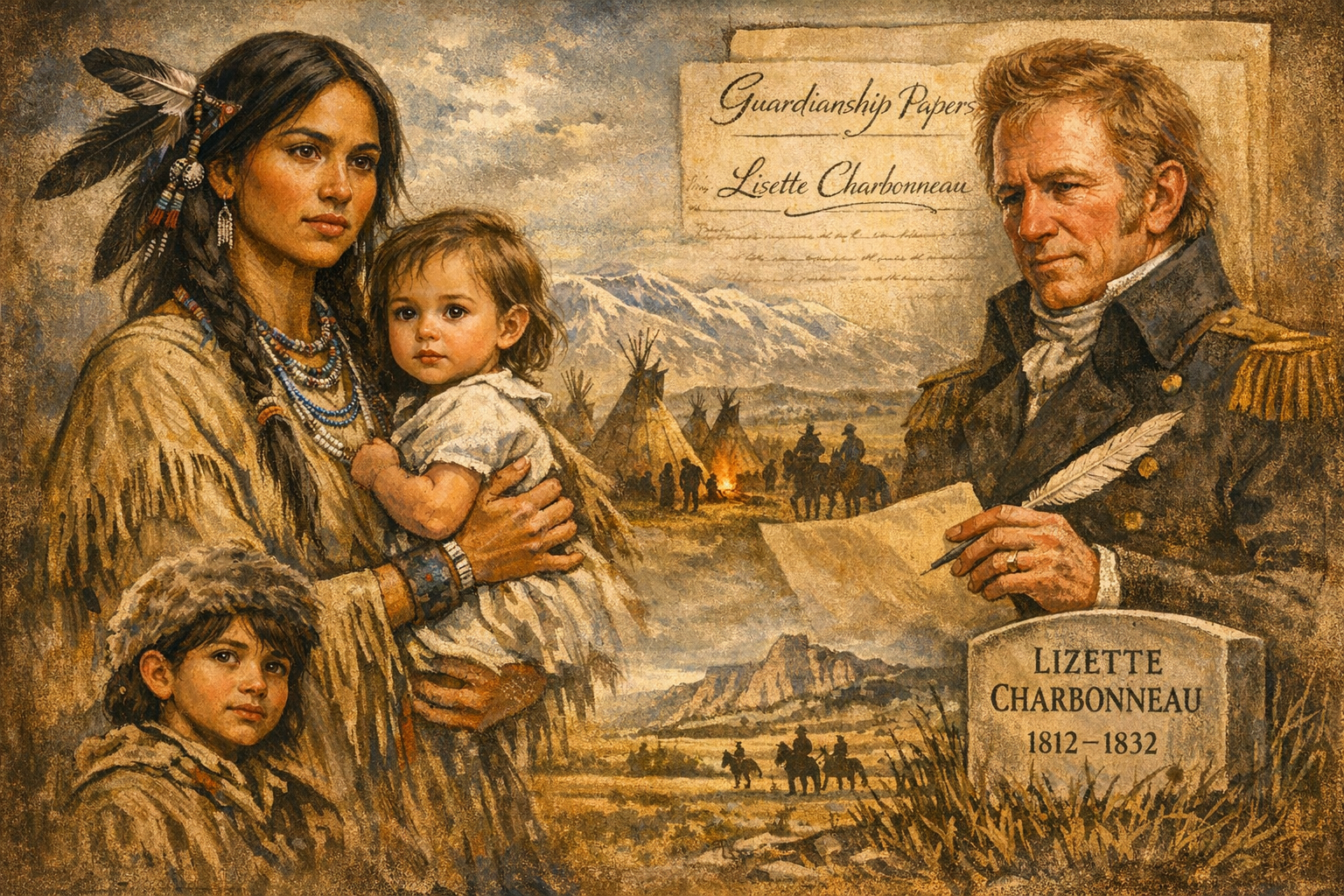
When people search for Lizette Charbonneau, they are usually looking for more than a name. And the truth is, there’s almost zero mention about who she is out there…
They are looking for a missing piece in one of the most debated stories in American history.
Lizette Charbonneau is remembered as the daughter of Sacagawea and Toussaint Charbonneau, born around 1812. But almost everything about her life sits inside a much larger historical argument: Did Sacagawea truly die in 1812, as many historians have long maintained, or did she survive and live for decades afterward, as later oral traditions and alternative accounts claim? That question matters because Lizette is not just a footnote. In many ways, she is one of the most important figures in the entire debate.
Unlike her brother Jean Baptiste Charbonneau, who lived a remarkably documented and adventurous life, Lizette has remained almost hidden in the historical record. She appears only briefly, but those brief appearances are powerful. Her existence ties directly into the accepted narrative of Sacagawea’s final years, and for that reason alone, the story of Lizette Charbonneau deserves far more attention than it usually gets.
Who was Lizette Charbonneau?
The standard historical account identifies Lizette Charbonneau—sometimes spelled Lisette Charbonneau—as the infant daughter of Sacagawea and Toussaint Charbonneau. Most mainstream summaries place her birth around 1812, near the end of Sacagawea’s life, and connect her directly to the events surrounding Fort Manuel on the Missouri River.
That alone makes Lizette historically important.
If Sacagawea gave birth to Lizette in 1812, and if the woman recorded as Charbonneau’s wife who died that same year was in fact Sacagawea, then Lizette becomes part of the strongest documentary case for the conventional timeline. That is why historians and researchers keep coming back to her name. She is not merely a daughter mentioned in passing. She is one of the clearest links between Sacagawea’s family life and the long-running dispute over her death.
Why the name Lizette Charbonneau matters so much
At first glance, Lizette seems like a minor historical figure. There are no famous portraits of her, no dramatic journals in her own voice, and no long public story attached to her like there is with Sacagawea or Jean Baptiste. But sometimes history turns on the people who appear only once or twice in the record. Lizette is one of those people.
Her name surfaces in connection with a guardianship record involving William Clark. According to later summaries of that record, Clark became guardian to Charbonneau’s children, including a girl identified as Lisette Charbonneau, about one year old. That matters because historians have long used Clark’s guardianship and later notes listing Sacagawea as dead as evidence that Sacagawea had already died by that point. In other words, Lizette is not on the edge of the story. She sits very close to its center.
The accepted historical version
The mainstream historical version goes like this:
After the Lewis and Clark Expedition, Sacagawea and Toussaint Charbonneau spent time in St. Louis and later returned west. In late 1812, shortly after the birth of a daughter named Lizette, a woman identified as Charbonneau’s wife reportedly died at Fort Manuel. William Clark later became the legal guardian of both Jean Baptiste and Lizette. Clark also wrote in later records that Sacagawea was dead. This chain of evidence has long supported the widely accepted conclusion that Sacagawea died in December 1812.
This is the version most reference works still present. Encyclopaedia Britannica, for example, notes that shortly after the birth of Lizette, a woman believed to be Sacagawea died at the end of 1812, and that Clark then became the legal guardian of both children. Britannica also notes that little is known of Lizette’s life before her reported death in St. Louis in 1832.
If you are looking strictly at the documentary trail, that is the clearest traditional case.
Where the myth begins
But the Sacagawea story has never been that simple.
For generations, there have been alternate traditions claiming Sacagawea did not die in 1812. Some accounts say the woman who died at Fort Manuel was not Sacagawea at all, but another one of Charbonneau’s Native wives. Other traditions place Sacagawea much later in life, living among Shoshone people and dying decades afterward, even as late as 1884 on the Wind River Reservation. Britannica acknowledges that these traditions exist, though it notes that many historians attribute them to confusion with other Indigenous women whose lives may have overlapped with Sacagawea’s story.
And that is exactly where Lizette Charbonneau becomes so interesting.
Because if the accepted 1812 death narrative is wrong, then Lizette’s identity—and even her maternal connection to Sacagawea—becomes part of a much larger historical puzzle. Was Lizette truly Sacagawea’s daughter? Was she the daughter of another wife? Was the confusion caused by poor recordkeeping, outsider assumptions, or the way Indigenous women were flattened into generic labels by white clerks and traders? Those questions are why the myth and history around Lizette Charbonneau continue to pull people in.
Lizette Charbonneau and the Sacagawea debate
This is the heart of it.
The argument over Lizette Charbonneau is really an argument over how history gets written.
On one side, you have documentary evidence: guardianship records, later summaries, and Clark’s own notation that Sacagawea was dead. On the other side, you have oral history, later testimony, and skepticism about whether the documentary record correctly identified which of Charbonneau’s wives actually died in 1812. The debate is not just about dates. It is about whose evidence gets privileged.
That is part of why Lizette Charbonneau carries so much symbolic weight. If she was indeed Sacagawea’s daughter, born shortly before Sacagawea’s death, she strengthens the conventional historical timeline. If, however, the identification was mistaken, then Lizette becomes a clue that the record itself may have been flawed from the start.
William Clark’s role in Lizette Charbonneau’s story
One reason Lizette survives in the written record at all is because of William Clark.
Clark maintained a deep interest in the welfare of Sacagawea’s children, especially Jean Baptiste. Historical summaries indicate that he became guardian to the Charbonneau children, including Lizette, after the reported death of their mother. Clark’s role has been used by historians to support the conclusion that the children were orphaned or effectively placed under his care after a family collapse tied to the 1812 death account.
But Clark’s records also raise questions.
They preserve names, relationships, and rough ages, but they do not solve every ambiguity. Frontier records were often fragmentary. Spellings shifted. Indigenous identities were filtered through outsiders who did not always understand the people they were describing. That does not mean the records are worthless. It means they must be read carefully. And when we read carefully, Lizette Charbonneau looks less like a settled detail and more like a hinge point in a much bigger historical mystery.
What happened to Lizette Charbonneau?
This is where the trail grows faint.
Mainstream reference sources state that little is known about Lizette’s life and that she died in St. Louis on June 16, 1832, with burial at the Old Catholic Cathedral Cemetery. That is the most commonly repeated account in modern summaries. But compared with her brother Jean Baptiste, Lizette left almost no visible footprint in the public historical imagination. No legendary western career. No European tour. No widely quoted correspondence. Just a few records—and silence.
That silence is part of what fuels ongoing curiosity around her.
People searching for Lizette Charbonneau often expect a larger story and are surprised to discover how little survives. But in another sense, that absence is the story. Lizette represents the countless women and children in frontier America whose lives mattered deeply and yet were barely preserved on the page.
Was Lizette Charbonneau really Sacagawea’s daughter?
The most honest answer is this: the mainstream historical record says yes, but the wider Sacagawea controversy keeps the question alive for some researchers.
Most reference sources identify Lizette as the daughter of Sacagawea and Toussaint Charbonneau. That is still the standard presentation. But because the larger dispute over Sacagawea’s death remains one of the most famous unresolved debates connected to the Lewis and Clark era, Lizette’s place in the story gets revisited again and again.
If your own research leans toward the view that Sacagawea lived beyond 1812, then Lizette becomes a particularly important name to examine. Not because the answer is easy, but because this is one of the exact places where historians and alternative interpreters diverge. That makes Lizette Charbonneau one of the most fascinating under-discussed figures connected to Sacagawea’s legacy.
Why Lizette Charbonneau deserves more attention
History tends to spotlight the boldest names and flatten everyone else into background scenery.
Lizette Charbonneau should not be background scenery.
She was born into one of the most iconic and contested stories in early American history. Her mother—if the standard record is correct—was Sacagawea, one of the most recognized Indigenous women in the American past. Her brother became one of the more remarkable frontier figures of the 19th century. Her life intersects with William Clark, St. Louis, the fur trade, the Lewis and Clark legacy, and the biggest unresolved question surrounding Sacagawea’s death. That is not a minor life. That is a forgotten one.
And forgotten lives matter.
They force us to slow down. They remind us that the people history leaves in the margins are often the ones who reveal the most about how the story was built in the first place.
The truth about Lizette Charbonneau
So who was Lizette Charbonneau? That remains a mystery. Some believe she was the daughter of Otter Women, Toussaint Charbonneau’s other wife. Others believe she was Sacagawea’s own daughter.
Here’s the honest truth about her thought — She was almost certainly a real child who appears in early 19th-century records connected to Toussaint Charbonneau, William Clark, and the world that followed the Lewis and Clark Expedition. Mainstream history identifies her as Sacagawea’s daughter, born around 1812, and holds that she died young in St. Louis in 1832. But because Lizette sits so close to the disputed timeline of Sacagawea’s death, her story also lives inside the borderland between accepted history and historical myth.
That is why interest in Lizette Charbonneau keeps coming back.
She is not famous because historians know too much about her. She is compelling because we know too little—and because what little we do know touches one of the deepest mysteries in the American West.
If you want to understand the Sacagawea debate, don’t just study Sacagawea.
Study Lizette Charbonneau too.
Because sometimes the smallest name in the record opens the biggest question.