

Who Was Otter Woman? The Overlooked Woman Connected to Sacagawea and the Lewis and Clark Expedition
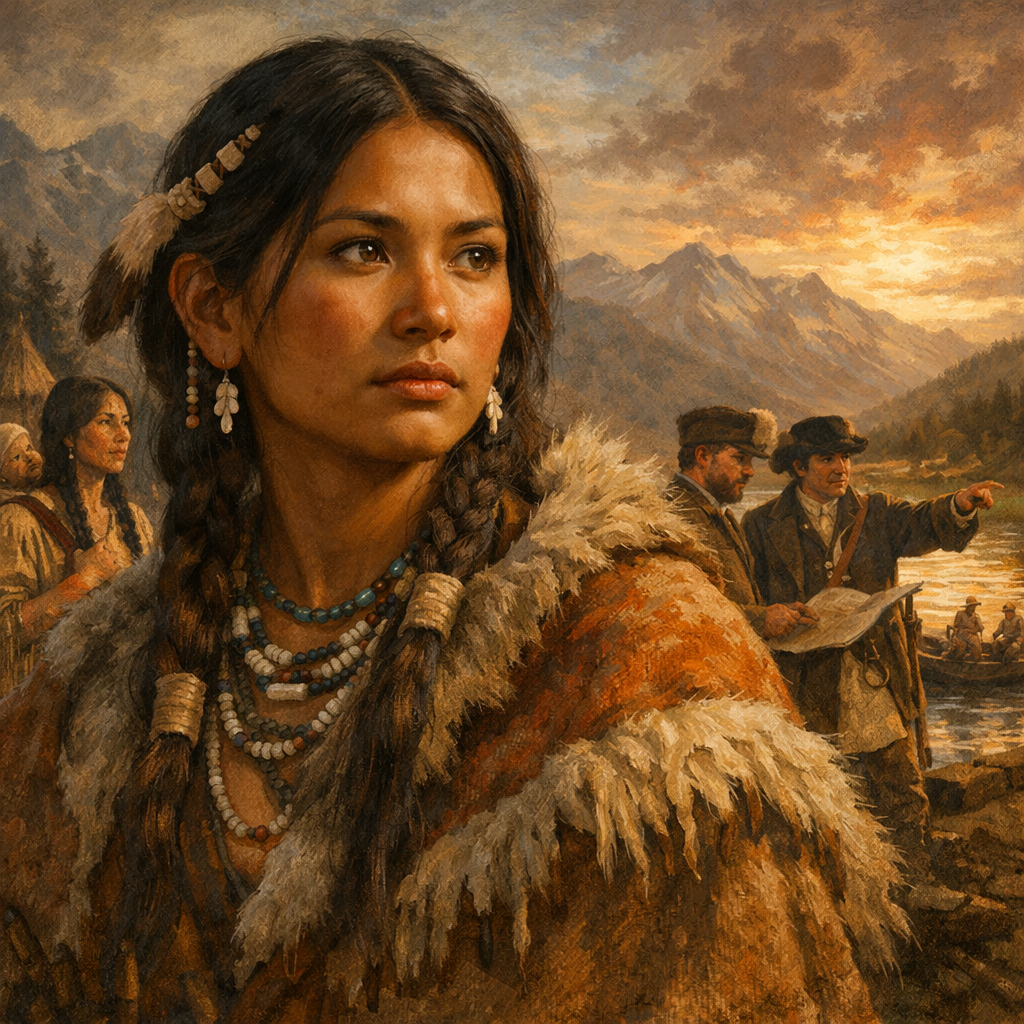
History remembers Sacagawea.
But almost no one remembers Otter Woman.
Yet Otter Woman appears in the same world, tied to the same fur-trade frontier, the same Shoshone tragedy, and the same man who would later travel with Lewis and Clark. Her story is fragmentary, often buried in passing references, but it opens a window into the harder truth behind the romanticized frontier story many Americans were taught.
If Sacagawea’s life has too often been simplified, Otter Woman’s has almost entirely disappeared.
So who was Otter Woman, and why does she matter?
Who Was Otter Woman?
Otter Woman was a Native woman, generally identified in historical records as a Shoshone woman, who was living as one of Toussaint Charbonneau’s wives before the Lewis and Clark expedition set out west. National Park Service material on Sacagawea notes that Charbonneau already had another wife named Otter Woman when Sacagawea entered his household.
That detail alone matters.
It reminds us that the world surrounding Sacagawea was not some clean heroic tale. It was a violent and unstable borderland shaped by raiding, captivity, trade networks, and unequal power. According to the National Park Service, Sacagawea had been taken from her Lemhi Shoshone people when she was still a girl and was living among the Mandan and Hidatsa by the time Lewis and Clark encountered her. She’s also a key person in proving that Sacagawea’s death actually didn’t happen in 1812.
Otter Woman stood in that same brutal world. No question about it, her reality, along with other Native women of that time, was very rough.
Otter Woman and Sacagawea
The reason people search for Otter Woman today is usually because of Sacagawea.
Sacagawea is one of the most recognizable women in early American history, but Otter Woman is often mentioned only in a sentence or two: she was another Native wife of Charbonneau, and unlike Sacagawea, she did not become widely known through the expedition journals. The historical record on her is thin, but Lewis and Clark’s circle clearly understood that Charbonneau had two Shoshone-speaking wives, which helped make him useful as a potential interpreter.
That is one of the cruel patterns of frontier history.
One person becomes famous.
Another, standing only a few feet away in the same story, is almost erased.
Otter Woman’s obscurity is part of what makes her historically important.
The World Otter Woman Lived In
To understand Otter Woman, you have to understand the northern plains and Rocky Mountain frontier in the early 1800s.
This was a world where Native nations, traders, interpreters, military expeditions, and fur companies all collided. Women could become central to diplomacy, translation, trade, and survival, yet still be barely recorded in written history. Sacagawea herself is often remembered as a “guide,” but the National Park Service says the journals provide little evidence that she led the expedition in the popular sense. Instead, her importance lay more in interpretation, diplomacy, cultural connection, and signaling peaceful intent.
That matters for Otter Woman too.
She helps us see that Native women on the frontier were not background figures. Even when the written record is sparse, they were often central to how men moved through Native territories, how trade relationships formed, and how expeditions survived.
Toussaint Charbonneau and the Women Around Him
Any honest telling of Otter Woman’s story has to mention Toussaint Charbonneau.
Charbonneau is best remembered as Sacagawea’s husband and a member of the Lewis and Clark expedition, but he was already embedded in the fur-trade world before the Corps of Discovery hired him. The historical record indicates that he had both Sacagawea and Otter Woman in his household.
This is where modern readers should slow down.
The old textbook version of frontier history often made these arrangements sound ordinary or harmless. They were not. Sacagawea was very young, and the National Park Service explicitly notes that we do not know how much choice she had in her marriage.
Otter Woman’s story points to the same darker reality: Native women were often swept into systems they did not control.
Why Otter Woman Was Left Out of the Famous Story
One reason Otter Woman is so little known is simple: she did not travel west with Lewis and Clark in the way Sacagawea did. Sacagawea became visible in expedition records because she was present for one of the most documented journeys in American history. Otter Woman, by contrast, remained mostly outside that spotlight.
But there is something bigger going on too.
American history has a habit of turning complicated people into symbols. Sacagawea became a symbol of courage, motherhood, westward expansion, and even national unity. Otter Woman never got transformed into a symbol, so she was left behind.
That does not mean she was less important.
It means she was less convenient to remember.
Otter Woman and the Reality Behind the Legend of Sacagawea
If you study Sacagawea long enough, you eventually run into a hard truth: the popular version of her story is often far too tidy.
The real story includes kidnapping, language loss, forced displacement, survival, childbirth under extreme conditions, and complex Native politics. Otter Woman belongs inside that same frame. Her presence forces us to see Sacagawea’s life not as a neat patriotic legend, but as part of a much rougher and more painful frontier reality.
That is one reason the keyword “Otter Woman” matters.
People searching it are often looking for more than a name. They are looking for the missing context around Sacagawea.
Why Otter Woman Still Matters Today
Otter Woman matters because forgotten people often tell us the truth that famous people cannot.
Sacagawea’s story is important, but Otter Woman reminds us how much history goes unrecorded. She stands for the Native women whose names were barely preserved, whose lives were mentioned only in passing, and whose presence shaped major events even when historians gave them almost no space.
She also matters because the Lewis and Clark era is still too often told from the viewpoint of the expedition itself. Otter Woman shifts the angle. She helps us see the West not just as a map to be crossed, but as a homeland already filled with nations, families, women, suffering, and survival.
She’s also a key person in seeing if the very unknown baby of, Lizette Charbonneu, was actually Sacagawea’s or was this a daughter of Otter Women?
Final Thoughts: Otter Woman Was More Than a Footnote
So, who was Otter Woman?
She was a Native woman caught in the violent currents of the early American frontier. She was connected to Sacagawea, tied to Toussaint Charbonneau, and part of the same historical world that produced the Lewis and Clark expedition. Even though the record on her is limited, what survives is enough to show that she was part of a much bigger story than most Americans ever hear.
And maybe that is the real value of remembering her.
Not because the record tells us everything.
But because it does not.
Otter Woman reminds us that history is often built around the people who were written about, while many others, just as real and just as human, were left in the margins.
For those willing to look deeper, the margins are often where the true story begins.