
The Fetterman Massacre: How 81 U.S. Soldiers Rode Into a Lakota Trap
December 21, 1866.
Wyoming Territory.
A column of United States soldiers marched away from Fort Phil Kearny into the freezing country north of the fort.
There were infantrymen.
Cavalrymen.
Civilian volunteers.
Experienced officers who had survived the Civil War.
At their head was Captain William J. Fetterman.
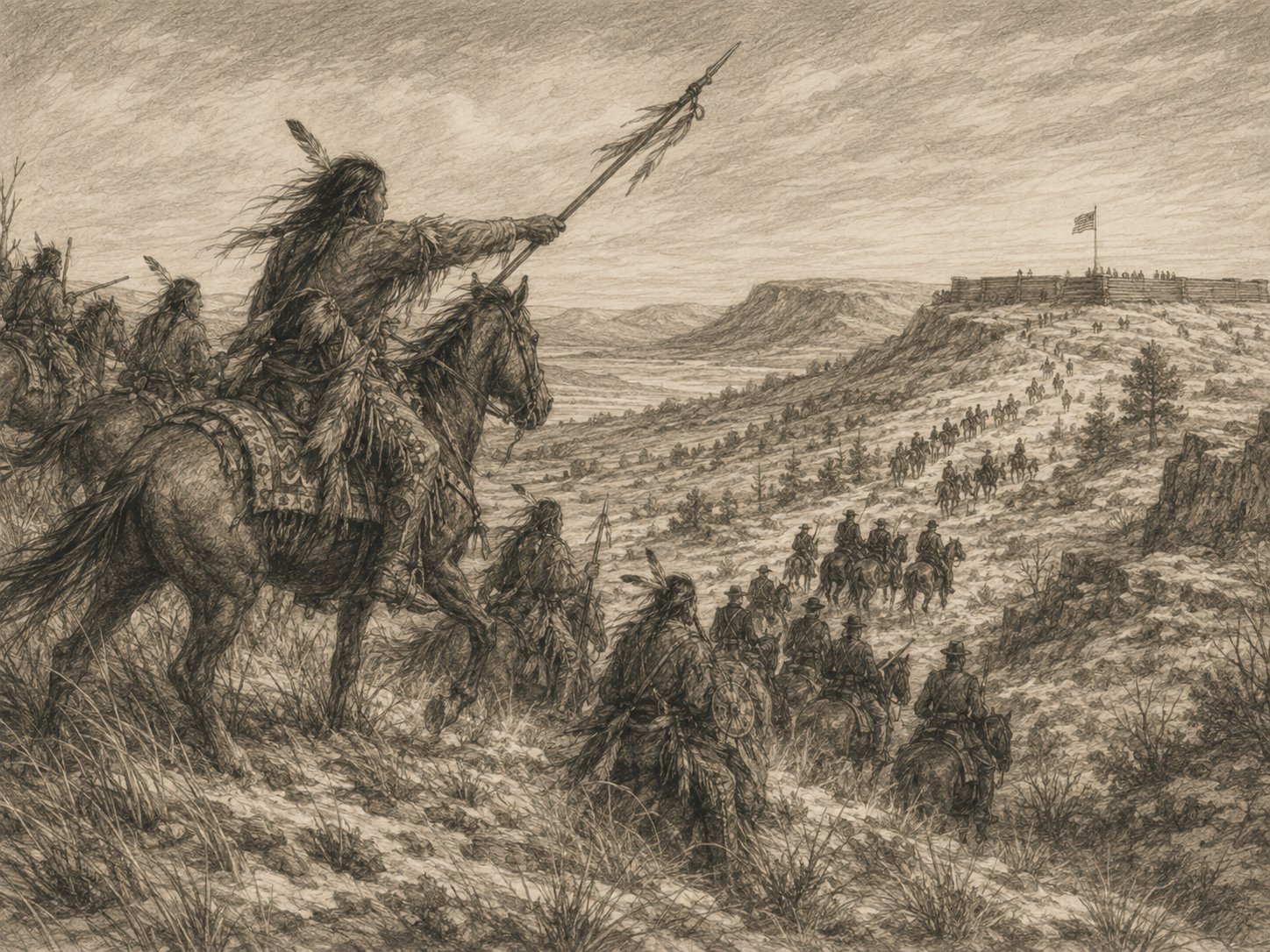
A few miles away, Native warriors appeared almost casually along the ridges.
They rode close enough to be seen.
Then pulled away.
Stopped.
Turned.
Moved again.
One of them was a young Oglala Lakota warrior whose name would eventually become known across the world:
Crazy Horse.
The soldiers followed.
That was exactly what the warriors wanted.
Within a short time, Fetterman's entire command had crossed into country hidden from the view of Fort Phil Kearny.
Waiting beyond the ridge were perhaps more than a thousand Lakota, Northern Cheyenne and Arapaho warriors.
Twenty or thirty minutes later, all 81 members of Fetterman's force were dead.
For decades, Americans remembered what happened as the Fetterman Massacre.
The Lakota remembered something very different.
They remembered a victory.
And if we want to understand the Plains Wars honestly, that is where this story has to begin.
What Was the Fetterman Massacre?
The Fetterman Massacre occurred on December 21, 1866, near Fort Phil Kearny in present-day Wyoming.
Captain William J. Fetterman led a force consisting of U.S. infantry, cavalry and two armed civilians out of the fort after warriors attacked a wood train operating nearby.
Native warriors deliberately drew the soldiers away from the relative security of the fort and across Lodge Trail Ridge.
Once Fetterman's command entered the chosen ground, a much larger force of Lakota, Northern Cheyenne and Arapaho warriors closed around them.
No one in Fetterman's 81-man force survived.
The engagement is also known today as the Fetterman Fight, while Lakota traditions have referred to it as the Battle of the Hundred Slain.
The word "massacre" became common in American newspapers and later histories, but it can distort what actually happened. These were not defenseless civilians being attacked without warning.
They were armed soldiers operating inside contested Native country during an active war.
And they had been outmaneuvered.
Modern Wyoming historians have increasingly emphasized that distinction when reconsidering what happened at Fetterman. Read WyoHistory's New Perspectives on the Fetterman Fight
The War Was Already Underway Before Fetterman Rode Out
The Fetterman Massacre did not begin on December 21.
Its roots ran directly through the Bozeman Trail.
After gold discoveries in Montana Territory, Americans wanted a faster route from the established emigrant trails to the booming mining settlements farther north.
The Bozeman Trail offered one.
There was one enormous problem.
It passed directly through the Powder River country, an important hunting region fiercely defended by the Lakota, Northern Cheyenne and their allies.
The United States increasingly viewed the route as a road that needed protection.
The Native nations living and hunting there saw something else:
An invasion.
Soldiers followed emigrants.
Forts followed soldiers.
Fort Reno, Fort Phil Kearny and Fort C.F. Smith were established along the route.
What had been Native hunting country was suddenly being crossed by wagons, livestock, miners and military patrols.
The National Park Service describes how those forts and the protection of the Bozeman Trail helped ignite what became Red Cloud's War. Read the National Park Service history of the Bozeman Trail and Red Cloud's War
To understand why the Lakota fought so aggressively to protect this country, you first have to understand that this was not empty "frontier."
It was home.
Lakota society was built around family, horses, buffalo, political relationships, spiritual traditions and movement across the Plains. Our deeper history of daily life for the Lakota on the American frontier looks at the civilization that existed long before Fort Phil Kearny appeared on the landscape.
By 1866, protecting that world increasingly meant fighting.
Red Cloud Was Winning a War
Red Cloud is often remembered as another Native chief resisting American expansion.
That description does not go nearly far enough.
The Oglala Lakota leader was overseeing one of the most successful Native military campaigns ever fought against the United States.
Throughout 1866, Lakota, Cheyenne and Arapaho warriors pressured the Bozeman Trail forts.
They attacked travelers.
They hit supply movements.
They targeted livestock.
They threatened woodcutting parties.
They struck military detachments.
And perhaps most importantly, they refused to fight the kind of war the United States Army was comfortable fighting.
That matters.
Many of the soldiers and officers arriving on the Plains had just come through the Civil War.
They understood large armies.
Formations.
Defensive positions.
Artillery.
Massed fire.
Defined battlefields.
Command structures built around keeping units together and moving them toward an identifiable enemy.
The northern Plains were different.
There might be no obvious battlefield.
The enemy might appear, disappear and reappear miles away.
A handful of riders might actually be bait.
A retreat might not be a retreat at all.
The ridge ahead might hide ten men.
Or a thousand.
Plains warriors fought with an intimate understanding of terrain, enormous mounted mobility and generations of experience in warfare conducted across vast open country.
The horse was central to that world.
The Lakota had developed into one of the great mounted powers of the Plains. Horses transformed hunting, travel, raiding, wealth and warfare. A skilled mounted warrior could cover enormous ground, change direction rapidly, fight independently and reunite with a larger force almost instantly.
The U.S. Army could be formidable.
But on this battlefield, it was trying to learn a game its opponents already knew.
Jim Bridger Saw the Problem
Few Americans understood this better than Jim Bridger.
By 1866, Bridger had spent decades in the West.
He had trapped the Rockies, crossed enormous stretches of country, interacted with Native nations, guided emigrants and soldiers, established Fort Bridger and accumulated the kind of geographic knowledge no military textbook could replace.
He also understood something some Civil War veterans apparently struggled to appreciate:
Fighting mounted Plains warriors was not the same as fighting Confederate infantry.
Accounts associated with Fort Phil Kearny describe Bridger warning Army officers that their experience fighting in the South had not prepared them for what they were facing.
Whether every colorful sentence later attributed to Bridger was recorded precisely is another question.
But his point was correct.
The Army was facing men who knew the ground better than they did.
They could ride better than most soldiers.
They understood how the Army reacted.
And they were beginning to use those reactions against it.
The detailed Warfare History Network account of the Fetterman Massacre and Bozeman Trail campaign provides an excellent reconstruction of the escalating attacks around Fort Phil Kearny and the tactical situation facing the garrison.
December 6 Was Almost a Warning
The trap that destroyed Fetterman was not invented that morning.
Weeks earlier, Native warriors had already tested a similar tactic.
On December 6, around 100 warriors attacked a wood train.
When soldiers responded, the warriors appeared to withdraw.
The Army followed.
Then the apparent retreat changed direction.
The pursuing troops suddenly found themselves under much heavier pressure.
Colonel Henry B. Carrington, commander at Fort Phil Kearny, became increasingly cautious.
The Lakota and their allies had learned something too.
The soldiers could be pulled.
Attack something important.
Show yourself.
Retreat.
Encourage pursuit.
Stretch the force away from the fort.
Then turn the landscape itself into a weapon.
The idea was beautifully simple.
The execution required extraordinary discipline.
A decoy warrior had to look vulnerable enough to pursue while remaining close enough to danger to keep the soldiers interested.
He could not flee too quickly.
If he did, the soldiers might stop.
He could not linger too long.
If he did, he could be shot.
The entire operation depended on timing, horsemanship, communication and trust.
That is where Crazy Horse enters the story.
Crazy Horse and the Decoy Riders
Crazy Horse was still a young man in 1866.
He was not yet the legendary figure Americans would associate with Little Bighorn ten years later.
But he already possessed a formidable reputation among his people.
On December 21, Crazy Horse was among the warriors associated with the decoy force intended to draw the soldiers away from Fort Phil Kearny.
Other prominent Native warriors were also involved.
Accounts include Northern Cheyenne leader Morning Star—often called Dull Knife by Americans—as well as Black Shield, Big Nose, White Bull and others.
Red Cloud led the broader war effort.
Crazy Horse and the decoy warriors helped execute the battlefield trap.
That distinction matters.
This was not one great chief standing on a hill personally directing thousands of warriors like a European general.
Plains warfare depended on respected leaders, war parties, individual initiative, communication and fighters capable of reacting rapidly to changing circumstances.
The strategy nevertheless required coordination.
Large numbers of warriors remained concealed.
The decoys presented themselves to the soldiers.
Then they began moving away.
Crazy Horse reportedly made the performance especially convincing, at one point slowing enough to create the appearance that something was wrong with his horse or equipment.
Imagine watching this through the eyes of a soldier.
The enemy is right there.
He appears vulnerable.
He is withdrawing.
You have cavalry.
You have armed infantry behind you.
You have spent months watching men around the fort get attacked.
Now finally, perhaps, you can catch them.
So you move forward.
Exactly as planned.
William Fetterman Takes Command
At approximately 11 a.m. on December 21, a signal from outside Fort Phil Kearny reported that a wood train was under attack.
A relief force was needed.
Captain James Powell initially prepared to lead it, but Fetterman, the senior captain, received command.
Fetterman was not an inexperienced coward walking blindly into his first fight.
He was a Civil War veteran.
He had served with distinction.
He had received brevet promotion for his wartime service.
The popular image of him as nothing more than an arrogant fool has been increasingly challenged by historians.
This is also where one of the most famous quotations in Western history requires caution.
Fetterman was later said to have claimed that, given 80 men, he could ride through the entire Sioux nation.
It is a perfect quote because of what happened next.
It may also be historical mythology.
Later accounts heavily influenced the image of Fetterman after his death, and modern research has questioned whether he actually made the famous boast exactly as remembered.
History is usually more interesting when we do not force it into a perfect morality play.
Fetterman did not have to be stupid for the Native victory to be brilliant.
In fact, the opposite may be more impressive.
Experienced soldiers were defeated because their opponents executed a better plan.
81 Men Ride Away From Fort Phil Kearny
Fetterman's force ultimately consisted of 81 men:
49 infantrymen.
27 cavalrymen.
Three officers, including Fetterman.
And two civilians, James Wheatley and Isaac Fisher.
The civilians carried Henry repeating rifles, advanced weapons capable of much faster fire than the standard muzzle-loading weapons carried by many of the soldiers.
Carrington later maintained that he had explicitly ordered Fetterman not to cross Lodge Trail Ridge.
That point became one of the great controversies surrounding the battle.
Some witnesses supported Carrington's version.
Others created uncertainty about exactly what orders Fetterman received or understood.
What is certain is that Fetterman's command eventually moved beyond the ridge.
The fort could no longer see them.
And the warriors continued drawing them forward.
Then the Plains Came Alive
Once the soldiers had moved far enough into the trap, the character of the battlefield changed almost instantly.
Warriors appeared from concealed positions.
Not ten.
Not twenty.
Hundreds.
Then more.
Estimates vary, but the soldiers may have faced well over 1,000 Native warriors.
The cavalry had moved ahead of much of the infantry.
The force was stretched.
Its mobility was limited.
Its retreat route was threatened.
And suddenly the men who thought they had been pursuing a retreating enemy understood the truth.
They had never been the hunters.
They were the ones being hunted.
Lakota, Cheyenne and Arapaho horsemen closed rapidly.
Arrows filled the air.
Warriors moved across ground they knew intimately.
Some fought mounted.
Others attacked on foot.
The soldiers attempted to establish defensive positions among rocks and elevated ground.
Wheatley and Fisher used their Henry rifles with devastating effect for a time.
But two repeating rifles could not reverse what had already happened.
The Native force had achieved what the operation was designed to achieve:
Fetterman's men were isolated.
Surrounded.
Outnumbered.
And too far from Fort Phil Kearny for immediate rescue.
The Battle Was Over in Minutes
The fighting appears to have lasted somewhere around 20 to 30 minutes.
Think about that.
Eighty-one armed men.
Civil War veterans among them.
Infantry.
Cavalry.
Officers.
Repeating rifles.
Gone.
No member of Fetterman's force escaped to tell the story.
Later reconstruction had to rely on battlefield evidence, military accounts, archaeology and Native oral histories.
The final fighting became close and violent.
Rifles gave way to pistols.
Pistols gave way to knives, clubs and hand-to-hand combat.
Fetterman died with his men.
So did Captain Frederick Brown.
Lieutenant George Grummond.
Wheatley.
Fisher.
Every soldier who had crossed the ridge.
Native casualty estimates remain uncertain, but the result itself was unmistakable.
The Lakota, Northern Cheyenne and Arapaho had won completely.
This Was Native Military Skill, Not Luck
This is the part of the story that deserves more emphasis.
The Fetterman Massacre is frequently told primarily as a lesson in American arrogance.
Fetterman should not have pursued.
Carrington's warnings were ignored.
The soldiers underestimated their opponents.
All of that has value.
But it still places the United States at the center of the story.
What if we reverse the perspective?
The soldiers did not simply "make a mistake."
Native warriors made them make it.
They studied how the garrison responded to attacks.
They repeatedly pressured the wood trains.
They understood that soldiers would pursue small groups of warriors.
They selected terrain that concealed the larger force.
They deployed skilled riders as bait.
They controlled the pace of the pursuit.
They allowed Fetterman's force to move far enough away from reinforcement.
Then they closed the trap.
That is military strategy.
And the horsemanship required to perform it was not decoration around the story.
It was fundamental to the victory.
The horse allowed Plains warriors to control distance in a way foot soldiers could not.
They could approach.
Withdraw.
Turn.
Scatter.
Regroup.
Create uncertainty.
Force decisions.
Then mass quickly when the moment arrived.
Years later, those same qualities—mobility, terrain knowledge, decentralized action and ferocious mounted response—would again help Lakota and Cheyenne warriors overwhelm American soldiers at the Battle of Little Bighorn and Greasy Grass.
Fetterman was not Little Bighorn.
But there is a line connecting them.
A Different Kind of War on the Plains
The Civil War had ended only a year and a half earlier.
The United States Army had just emerged from a conflict involving enormous armies, industrial logistics, railroads, telegraphs, artillery and battles where tens of thousands of soldiers could occupy the same field.
Now some of those veterans were fighting another kind of war entirely.
There were no massive armies waiting in formation.
The battlefield could stretch for miles.
The enemy could refuse battle entirely until conditions favored them.
A few riders could determine the movement of an entire detachment.
Local knowledge could matter more than rank.
Horsemanship could matter more than parade-ground discipline.
A ridge could be more valuable than another company of infantry.
The United States possessed vastly greater national resources.
But on the Powder River frontier in 1866, Red Cloud's coalition controlled the tactical environment.
That is one of the reasons the Fetterman victory mattered so much.
It showed that American military power was not automatically decisive simply because the Civil War had demonstrated how enormous that power could become.
The Plains had their own rules.
And for the moment, the Lakota and their allies were setting them.
Our article on Zebulon Pike's early expedition into the American West shows how little the United States understood about huge portions of the interior only sixty years earlier. By Fetterman's generation, Americans had mapped far more territory—but maps did not equal mastery.
Native Nations Were Not One Side
There is another important piece of Plains history that can easily be lost.
"Native Americans" were never a single political or military bloc.
The Lakota had allies.
They also had enemies.
The Cheyenne had their own interests.
The Arapaho had theirs.
The Crow, Pawnee, Shoshone and others had long histories of conflict, trade and alliance that existed independently of the United States.
Later U.S. campaigns would rely heavily on Native scouts who had their own reasons for fighting Lakota and Cheyenne forces.
Our history of Frank North and the Pawnee Scouts explores that complicated reality.
The broader history of the Pawnee itself is equally complicated, including religious traditions examined in our account of the final documented Pawnee Morning Star sacrifice.
Understanding those distinctions makes Fetterman more meaningful.
The victory belonged to a specific coalition of Native peoples fighting for specific interests in specific country.
What Happened After the Fetterman Massacre?
News of the defeat shocked the United States.
At the time, it was one of the worst defeats the U.S. Army had suffered in decades of warfare against Native nations.
But the Fetterman victory was not an isolated flash of success.
Red Cloud's War continued.
The following year brought additional fighting, including the Wagon Box Fight and Hayfield Fight.
American troops held their positions in those engagements with help from newer breech-loading weapons, but the underlying strategic question remained:
Was keeping the Bozeman Trail open worth the military cost?
Eventually, the answer became no.
The Treaty of Fort Laramie of 1868 ended Red Cloud's War.
The United States agreed to abandon the forts along the Bozeman Trail.
Fort Phil Kearny was evacuated.
Fort C.F. Smith was abandoned.
Fort Reno was abandoned.
The Bozeman Trail through the contested Powder River country was effectively closed to American traffic.
Red Cloud had accomplished what he had gone to war to accomplish.
The Americans left.
That point deserves to be stated plainly:
Red Cloud Won His War
Native history is filled with stories where resistance is remembered primarily by how it ended.
Eventually the buffalo disappeared.
Eventually reservations expanded.
Eventually American military and economic power overwhelmed Native resistance across much of the continent.
Because we know what came later, there is a tendency to write every earlier Native victory as if defeat were already inevitable.
But people in 1866 did not live knowing the ending.
And in Red Cloud's War, the ending was a Lakota-led strategic victory.
The U.S. Army had entered the Powder River country.
The Lakota and their allies fought them.
The Army eventually withdrew.
The forts were abandoned.
The trail was closed.
Very few Native leaders of the nineteenth century could claim such a clear military and diplomatic result.
The Warfare History Network describes the eventual outcome as a rare victory for Plains peoples in their effort to defend their country from American encroachment.
That is why the Fetterman Massacre belongs in a larger history than just the destruction of 81 men.
From Fetterman to Little Bighorn
Ten years later, another American force would ride toward another large Native population in Montana.
Again, Crazy Horse would be there.
Again, soldiers would underestimate the number and capability of the warriors ahead of them.
Again, Lakota and Cheyenne mobility would become decisive.
Again, an American command would be overwhelmed.
Custer's defeat at Little Bighorn became infinitely more famous.
But Fetterman came first.
The Battle of the Hundred Slain demonstrated that Plains warriors could do more than raid supply trains or harass isolated settlers.
They could plan.
Coordinate.
Deceive.
Concentrate force.
Choose terrain.
And completely destroy an organized U.S. military command.
Our larger collection of American frontier and American history stories follows many of these connected figures, battles and Native nations across the transformation of the West.
Why Is It Called the Fetterman Massacre?
For generations, the most common American name was the Fetterman Massacre.
That title reflects the shock Americans felt when they learned that an entire military detachment had been killed.
Today, many historians prefer Fetterman Fight.
The Lakota name Battle of the Hundred Slain places the event within an entirely different historical memory.
There is value in knowing all three.
"Massacre" describes how nineteenth-century America processed the defeat.
"Fetterman Fight" treats it more neutrally as a military engagement.
"Battle of the Hundred Slain" reminds us that the people who won the battle had their own name, memory and history.
Here, I use Fetterman Massacre because it remains the name many Americans recognize and search for.
But the history should not stop with that name.
Because calling something a massacre can subtly turn the losing soldiers into the protagonists and the victorious warriors into nothing more than the force that killed them.
They were more than that.
The Fetterman Massacre Was a Lakota Victory
On December 21, 1866, 81 men rode or marched away from Fort Phil Kearny.
None returned.
But the real story is larger than their deaths.
It is the story of a Native coalition defending the Powder River country.
It is the story of Red Cloud conducting a war the United States struggled to contain.
It is the story of Crazy Horse and other skilled warriors turning pursuit into deception.
It is the story of Plains horsemen who understood movement, terrain and timing at a level their opponents could not match that morning.
And it is the story of an American Army beginning to understand that victory in the Civil War did not mean it understood warfare everywhere else on the continent.
The soldiers at Fort Phil Kearny represented a nation with almost unlimited resources compared with the Native nations opposing it.
But resources are not the same thing as battlefield mastery.
On that cold December morning, the Lakota, Northern Cheyenne and Arapaho chose the ground.
They controlled the movement.
They created the deception.
They sprang the trap.
And they won.
The Fetterman Massacre was not merely a terrible day for the United States Army.
It was one of the greatest Native military victories of the American West.
FAQ: The Fetterman Massacre
When was the Fetterman Massacre?
The Fetterman Massacre occurred on December 21, 1866, near Fort Phil Kearny in present-day Wyoming.
How many soldiers died in the Fetterman Massacre?
A total of 81 men in Fetterman's force were killed, including U.S. soldiers, officers and two civilian volunteers.
Did anyone survive the Fetterman Massacre?
No member of Fetterman's command survived the battle.
Who defeated Fetterman?
A large coalition of Lakota, Northern Cheyenne and Arapaho warriors defeated Fetterman's command.
Was Crazy Horse at the Fetterman Massacre?
Yes. Crazy Horse is widely associated with the decoy force that helped lure Fetterman's soldiers beyond Lodge Trail Ridge and into the larger ambush.
Was Red Cloud at the Fetterman Massacre?
Red Cloud was the central Lakota leader of the broader war against the Bozeman Trail forts, but the available evidence does not establish that Red Cloud personally directed the battlefield action on December 21. His campaign created the strategic conditions for the victory, while Crazy Horse and other Native leaders were more directly associated with the trap itself.
Why did Fetterman lose?
Fetterman's command was lured away from Fort Phil Kearny by Native decoy riders, became isolated beyond Lodge Trail Ridge and encountered a much larger Native force waiting in concealed positions. Lakota, Cheyenne and Arapaho warriors combined superior local knowledge, mobility, deception and numbers to overwhelm the soldiers.
Did William Fetterman really say he could defeat the Sioux with 80 men?
The famous claim that Fetterman said he could "ride through the whole Sioux Nation" with 80 men has been repeated for generations, but modern historians have questioned whether the statement was accurately attributed to him. His reputation was heavily shaped by accounts written after his death.
What was Red Cloud's War?
Red Cloud's War was fought primarily from 1866 to 1868 over American use and military protection of the Bozeman Trail through the Powder River country. Lakota, Cheyenne and Arapaho resistance eventually contributed to the abandonment of the Bozeman Trail forts under the 1868 Treaty of Fort Laramie.
Did the Lakota win Red Cloud's War?
Yes. In practical military and strategic terms, Red Cloud's coalition achieved its immediate objective. The United States abandoned the Bozeman Trail forts and withdrew from the contested Powder River country under the settlement reached in 1868. It remains one of the clearest Native victories over U.S. expansion during the Plains Wars.