

The Battle of Little Bighorn: The Day Custer Fell and the Plains Fought Back
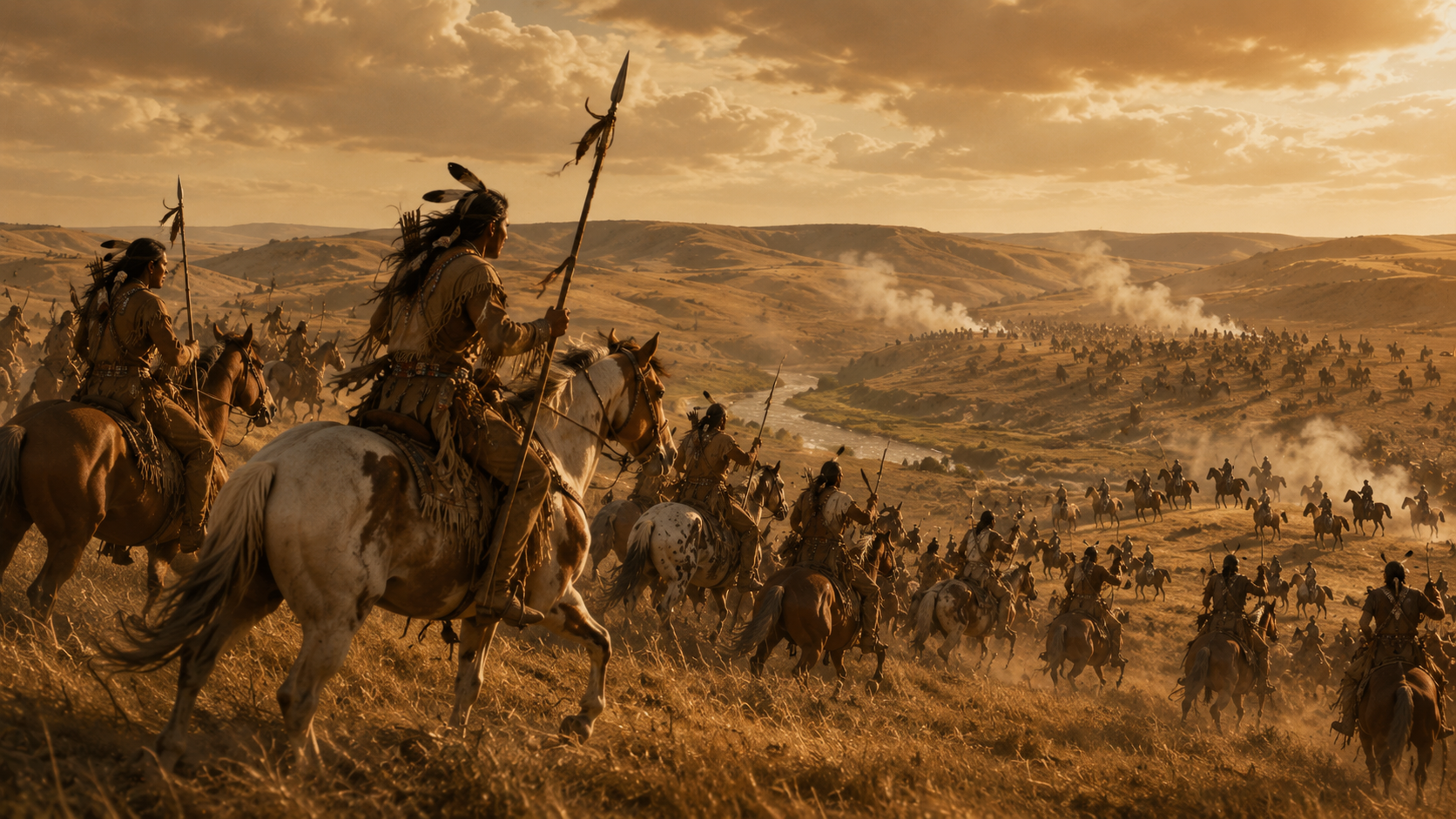
On June 25, 1876, along the ridges and riverbanks of southern Montana, one of the most famous battles in American history unfolded. To generations of Americans, it became known as the Battle of Little Bighorn or “Custer’s Last Stand.” But to many Lakota, Cheyenne, and Arapaho people, it is remembered as the Battle of the Greasy Grass.
The name matters.
“Custer’s Last Stand” puts George Armstrong Custer at the center of the story. “The Battle of the Greasy Grass” shifts the focus back to the people defending their families, their land, their way of life, and their right to exist outside the control of the United States government.
The Battle of Little Bighorn was not simply a dramatic military disaster. It was the result of broken treaties, westward expansion, the invasion of the Black Hills, the destruction of Native sovereignty, and the refusal of Plains nations to quietly surrender their homelands.
Tomorrow, June 25, 2026, marks the 150th anniversary of the opening day of the battle. A century and a half later, the story still matters because it forces us to look honestly at the American frontier — not only through the eyes of soldiers and settlers, but through the eyes of Native nations who were fighting to protect everything they knew.
For more stories from this same era, explore our broader collection of American history articles, where the American frontier is told through forgotten figures, complicated legacies, and the people often left out of the traditional textbook version.
What Was the Battle of Little Bighorn?
The Battle of Little Bighorn was fought on June 25–26, 1876, near the Little Bighorn River in present-day Montana. The battle pitted the U.S. Army’s 7th Cavalry, led in part by Lieutenant Colonel George Armstrong Custer, against a large village of Lakota, Northern Cheyenne, and Arapaho people.
The National Park Service describes the battlefield as a landscape of ridges, bluffs, ravines, and river bottomland. It was not a clean battlefield in the way maps sometimes make it appear. It was broken ground, difficult terrain, and a place where confusion could spread quickly.
The U.S. Army came to force Native people onto reservations. The Lakota, Cheyenne, and Arapaho were gathered near the river because they were refusing to give up their freedom, their hunting grounds, and their way of life.
For the United States, the battle became a shocking defeat. For the Native warriors and families gathered there, it became one of the most famous victories of Indigenous resistance in North American history.
You can read a brief day-by-day historical entry on the battle in our June 25th history archive.
Why Did the Battle of Little Bighorn Happen?
To understand the Battle of Little Bighorn, you have to begin before the first shot was fired.
The roots of the battle go back to the struggle over the northern Great Plains and especially the Black Hills. The 1868 Treaty of Fort Laramie recognized lands for the Sioux and Arapaho, including the Black Hills. But after gold was discovered there, American pressure intensified.
The Black Hills were not just valuable land. To the Lakota, they were sacred.
The United States wanted control. Miners wanted gold. Settlers wanted land. Railroad interests wanted access. Military leaders wanted Native nations confined to reservations. The Lakota and their allies wanted to live as they had lived — with movement, hunting, family, ceremony, and sovereignty.
That collision made war almost inevitable.
By 1876, the U.S. government had ordered Native people who were not on reservations to report to agencies by a deadline. Many did not comply. Some never agreed to give up their lands in the first place. Others were following buffalo, joining relatives, or living beyond direct government control.
The Army was sent to force the issue.
That is the world Custer rode into.
Sitting Bull’s Vision Before the Battle
Weeks before the battle, Sitting Bull, the Hunkpapa Lakota spiritual leader, took part in ceremony. According to Lakota accounts, he had a vision of soldiers falling into camp like grasshoppers. The vision was interpreted as a sign that victory was coming.
This part of the story is important because Sitting Bull was not simply a “war chief” in the way many older American accounts describe him. He was a spiritual leader, statesman, and respected figure whose influence reached across Native communities.
The Smithsonian’s National Museum of the American Indian has written about how the values connected to Lakota leadership — bravery, generosity, perseverance, and wisdom — continued to shape Lakota survival long after the battle. You can read more from the Smithsonian on how Lakota values endured after Little Bighorn.
Sitting Bull’s vision gave meaning to what was coming. But the battle itself would be decided by movement, terrain, numbers, leadership, and the will of Native warriors defending their families.
The Village Along the Greasy Grass
The Native village near the Little Bighorn River was large — much larger than Custer expected.
It included Lakota, Northern Cheyenne, and Arapaho families. There were warriors, elders, women, children, horses, tipis, food, belongings, and everything that made up a living community. This was not simply a military camp. It was a village.
That distinction matters.
When the 7th Cavalry approached, they were not just attacking warriors. They were approaching a place where families lived. For the Lakota, Cheyenne, and Arapaho, the battle was not an abstract military contest. It was immediate. It was personal. It was about protecting the people in the village.
This same world of Plains life is connected to our article on daily life for the Lakota on the frontier, where family, buffalo, horses, tipis, and spiritual life shaped survival on the Great Plains.
Custer’s Fatal Decision
George Armstrong Custer was already famous before Little Bighorn. He had built his reputation during the Civil War as a bold cavalry commander. But boldness can become recklessness.
On June 25, 1876, Custer and the 7th Cavalry moved toward the Native village. Instead of keeping his command together, Custer divided his forces. Major Marcus Reno was ordered to attack from one direction. Captain Frederick Benteen was sent elsewhere. The pack train lagged behind. Custer took several companies with him toward what would become the final battlefield.
This decision became one of the most debated choices in American military history.
Custer believed speed and surprise could win the day. He also underestimated the size of the village and the number of warriors ready to fight. The Native response was fast, coordinated, and overwhelming.
Reno’s attack faltered. His men retreated under heavy pressure. Benteen eventually joined Reno’s position, and their combined forces came under siege.
Custer, meanwhile, moved toward the ridges north of the village.
He would not come back.
The Fight on the Ridges
The final moments of Custer’s command have been debated for generations. Because none of the soldiers directly with Custer survived, the story has been reconstructed from battlefield evidence, Native oral histories, archaeology, military reports, and later accounts.
What is clear is this: Custer’s men were surrounded, outnumbered, and overwhelmed.
The old myth imagined a small band of heroic soldiers standing in a neat circle, firing until the last man fell. But the reality was likely far more chaotic. Men scattered across ridges and ravines. Horses fell. Units broke apart. Smoke, gunfire, dust, fear, and confusion filled the landscape.
Native warriors, including Lakota and Cheyenne fighters, moved with speed and knowledge of the terrain. Leaders such as Crazy Horse, Gall, Two Moon, and others became central to the battle’s memory. A decade earlier, Crazy Horse and others made a name for themselves from killing 81 U.S. soldiers at The Fettermen Battle and Massacre.
The Smithsonian’s National Museum of the American Indian includes the battle under the Native name The Greasy Grass Fight, a reminder that this was not only Custer’s story. It was a Native victory told and remembered through Native eyes.
By the end of the fighting around Custer’s position, he and the men under his immediate command were dead.
How Many Died at the Battle of Little Bighorn?
The National Park Service notes that 268 members of the 7th Cavalry, civilians, and Indian scouts were killed. Native casualties are harder to know precisely, but estimates often range from roughly 60 to 100 Lakota and Cheyenne deaths.
Those numbers matter, but they do not tell the full human story.
Every person killed belonged to a family. Every death carried grief. The battlefield was not just a symbol. It was a place of fear, loss, courage, and mourning.
The Battle of Little Bighorn was a stunning Native victory, but it was not without cost.
Why Is It Called Custer’s Last Stand?
The phrase “Custer’s Last Stand” became famous because American memory often turned Custer into a martyr. Paintings, books, newspapers, Wild West shows, and later films helped build the image of Custer as a heroic figure overwhelmed by Native warriors.
But that version leaves out the deeper truth.
Custer was not defending his homeland. The Lakota, Cheyenne, and Arapaho were.
The phrase “Custer’s Last Stand” centers the defeated commander. The phrase “Battle of the Greasy Grass” remembers the people who were defending their families, their land, and their freedom.
This is one reason modern historians, Native scholars, and educators often push readers to rethink the battle. The story is not just about how Custer died. It is about why Native nations fought.
For more frontier stories that challenge the traditional version of the American West, read about Frank North and the Pawnee Scouts, another complicated figure tied to Native history, military service, and westward expansion.
What Happened After Little Bighorn?
In the short term, the Battle of Little Bighorn shocked the United States. News of Custer’s defeat arrived during the nation’s centennial year, just as Americans were celebrating 100 years since the Declaration of Independence.
The timing made the defeat feel even more dramatic.
But the Native victory did not stop U.S. expansion. In fact, it intensified the military campaign against the Lakota, Cheyenne, and their allies. The U.S. government responded with more force, more pressure, and a stronger push to confine Native people to reservations.
Many Native leaders eventually surrendered. Sitting Bull and some followers fled to Canada before later returning. Crazy Horse surrendered in 1877 and was killed later that year while in U.S. custody.
The victory at Little Bighorn was real. But it was followed by harsher consequences.
That is one of the great tragedies of the battle. The Lakota, Cheyenne, and Arapaho won the day, but the United States still had the numbers, resources, and political will to continue the war.
Why the 150th Anniversary Matters
On June 25, 2026, the Battle of Little Bighorn turns 150 years old.
Anniversaries can easily become shallow history. They can turn into quick posts, recycled quotes, or simple “on this day” facts. But this anniversary deserves more than that.
The Battle of Little Bighorn forces us to ask bigger questions:
Who gets remembered as a hero?
Who gets labeled as an enemy?
Whose version of the frontier became the official story?
And what happens when we finally tell the story from the perspective of the people defending their homeland?
The battle matters because it reveals the collision at the heart of the American West. One side saw expansion, progress, and national destiny. The other side saw invasion, broken promises, and the destruction of a way of life.
Both cannot be understood honestly without the other.
The Legacy of the Battle of the Greasy Grass
The Battle of Little Bighorn remains one of the most studied battles in American history. But the most important lesson may not be military at all.
It is a lesson about memory.
For decades, many Americans remembered the battle mainly as the place where Custer died. But for Lakota, Cheyenne, Arapaho, and other Native people, it was a place where warriors defended families, protected a village, and resisted a government that had broken its promises.
The story is not simply about defeat or victory. It is about the cost of empire, the strength of Native resistance, and the danger of telling history from only one side.
A century and a half later, the Battle of Little Bighorn still speaks.
It reminds us that the American frontier was not empty. It was already home.
It reminds us that Native nations were not passive victims of history. They were active defenders of their people and their future.
And it reminds us that the stories we inherit are not always the whole truth.
Sometimes history has to be retold from the ridge, from the river, from the village, and from the people who were there long before the cavalry arrived.
Quick Facts About the Battle of Little Bighorn
Date: June 25–26, 1876
Location: Near the Little Bighorn River in present-day Montana
Other Name: Battle of the Greasy Grass
Main Combatants: U.S. 7th Cavalry against Lakota, Northern Cheyenne, and Arapaho warriors
U.S. Commander: Lieutenant Colonel George Armstrong Custer
Native Leaders Associated With the Battle: Sitting Bull, Crazy Horse, Gall, Two Moon, and others
Result: Major Native victory
U.S. Deaths: 268 soldiers, civilians, and Indian scouts killed
Native Deaths: Estimated around 60–100 Lakota and Cheyenne
Why It Matters: The battle became the most famous Native victory of the Plains Wars and one of the most debated events in American frontier history.
FAQ: Battle of Little Bighorn
What happened at the Battle of Little Bighorn?
The Battle of Little Bighorn was fought on June 25–26, 1876, when Lakota, Northern Cheyenne, and Arapaho warriors defeated the U.S. 7th Cavalry near the Little Bighorn River in Montana.
Why is the Battle of Little Bighorn also called the Battle of the Greasy Grass?
Many Native people refer to the battle as the Battle of the Greasy Grass because that was the Native name associated with the area near the river. This name centers the Native perspective rather than focusing only on Custer.
Why did Custer lose at Little Bighorn?
Custer lost because he underestimated the size of the Native village, divided his forces, lacked full intelligence, and faced a large, determined Native force defending its families and homeland.
Was Sitting Bull at the Battle of Little Bighorn?
Sitting Bull was present with the Native village and was a major spiritual and political leader. He is especially remembered for a vision that many interpreted as predicting victory.
Was Crazy Horse at Little Bighorn?
Yes, Crazy Horse is widely associated with the battle and is remembered as one of the key Lakota war leaders involved in the fighting.
How many soldiers died with Custer?
Custer and the men under his immediate command were killed. In total, 268 members of the 7th Cavalry, civilians, and Indian scouts died during the battle.
Why is the Battle of Little Bighorn important?
The Battle of Little Bighorn is important because it was a major Native victory against U.S. expansion and remains one of the most famous and misunderstood battles in American history.
Closing Battle of The Little Big Horn Thoughts
Custer was cocky, and he got crushed and defeated because of it. It’s important to know the real history of what happened that day. If this article helped you better understand the Battle of Little Bighorn, the Battle of the Greasy Grass, or the Native side of the American frontier, please repost it, share it, or send it to a friend who loves history. The more these stories are shared, the more we help keep the overlooked pieces of American history alive.