

What Was Daily Life Like for the Lakota on the Frontier?
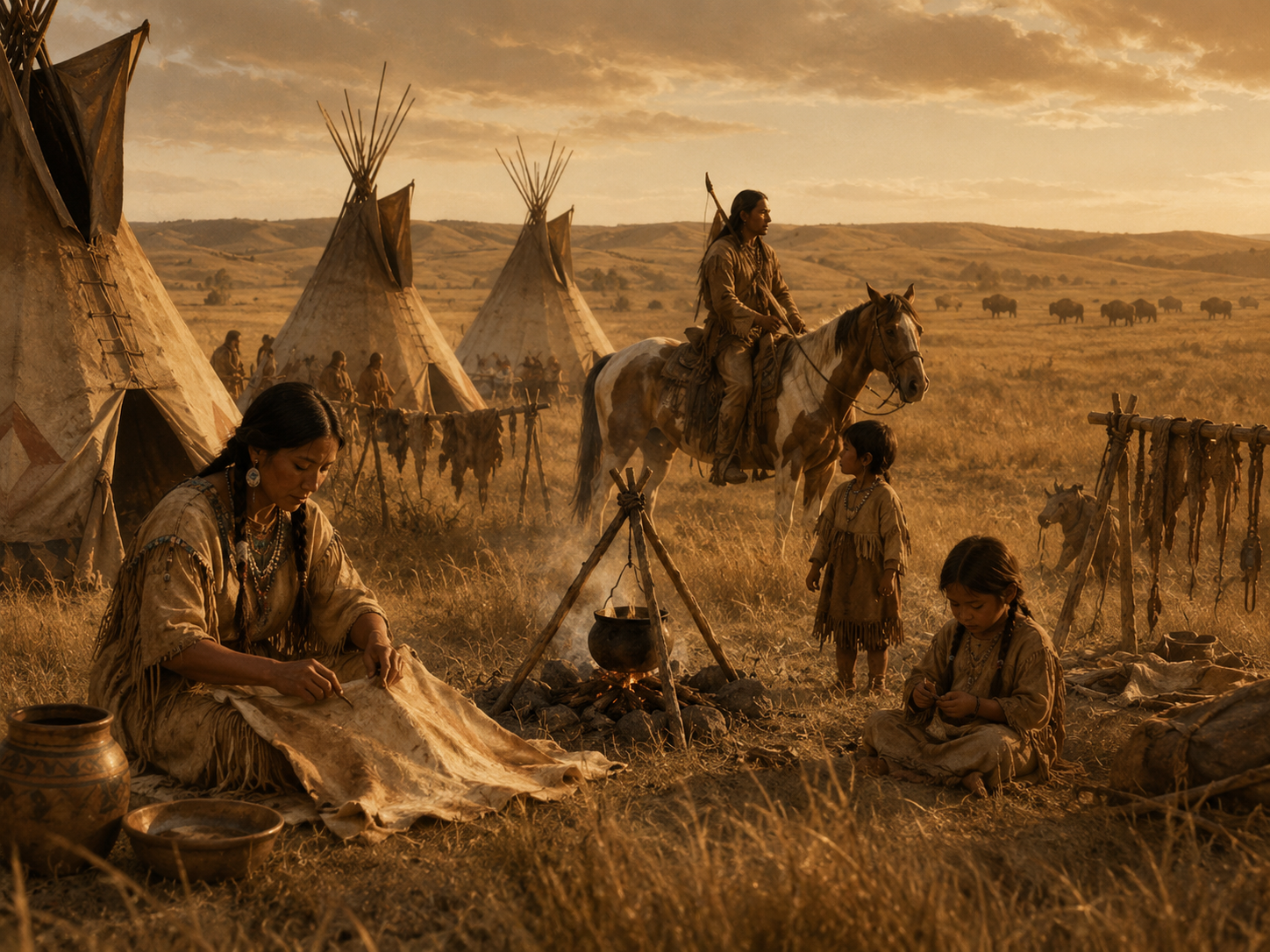
Daily life for the Lakota on the frontier was centered around family, community, buffalo, horses, spiritual traditions, and movement across the Great Plains. The Lakota lived in organized camps, followed seasonal hunting patterns, relied heavily on the buffalo, and built a powerful culture shaped by kinship, ceremony, survival, and deep connection to the land.
When people picture the American frontier, they often imagine wagon trains, cavalry forts, cattle drives, and settlers moving west. But long before the United States expanded across the Plains, the Lakota were already living in a highly organized world of family life, trade, hunting, storytelling, ceremony, and political leadership.
To understand the Lakota frontier, it helps to understand the broader world of American history, where Native nations, westward expansion, military conflict, and cultural survival all collided.
The Lakota were not simply “living on the frontier” as outsiders described it. They were living in their homeland. Their daily life was shaped by the seasons, the buffalo, the horse, spiritual responsibility, and the growing pressure of American expansion.
Who Were the Lakota?
The Lakota were part of the Oceti Sakowin, often translated as the Seven Council Fires. This larger Native confederacy included the Dakota, Nakota, and Lakota peoples. The National Museum of the American Indian explains that the Oceti Sakowin, or Seven Council Fires, included multiple related nations with deep ties to the Northern Plains.
By the 1700s and 1800s, many Lakota bands lived across the northern Great Plains, including areas of present-day South Dakota, North Dakota, Nebraska, Wyoming, and Montana. These lands were not empty wilderness. They were homelands filled with trails, hunting grounds, winter camps, sacred places, river valleys, and trade routes.
The Smithsonian’s Native Knowledge 360° project gives helpful context on how Native nations of the Northern Plains understood homeland, kinship, and belonging. For the Lakota, land was not simply property. It was connected to identity, ancestors, ceremony, and survival.
This same frontier world also connects to the story of Sacagawea, the Lewis and Clark expedition, and the Native women whose stories are often reduced to footnotes in American history.
The Buffalo Was at the Center of Lakota Daily Life
It is impossible to understand daily life for the Lakota without understanding the importance of the buffalo, or tatanka.
The buffalo provided food, shelter, clothing, tools, weapons, containers, bedding, and spiritual meaning. The National Park Service notes that bison were deeply important in Lakota culture, especially because so much of daily life depended on the animal.
Buffalo meat provided nourishment. Hides became tipi covers, robes, bedding, moccasins, bags, and clothing. Bones could be shaped into tools. Sinew became thread and bowstrings. Horns, hooves, fat, hair, and organs all had uses. Very little was wasted.
A successful buffalo hunt could sustain a Lakota camp for weeks or months, but the work did not end when the hunt was over. Meat had to be butchered, dried, and stored. Hides had to be scraped, stretched, softened, tanned, smoked, and sewn. Tools had to be repaired. Food had to be protected from weather and animals.
This work required cooperation across the entire camp. Men, women, children, and elders all had roles. The buffalo connected almost every part of Lakota life, from food and shelter to ceremony and identity.
The destruction of the buffalo herds in the 1800s was not just an environmental tragedy. It was an attack on the foundation of Lakota life. As the buffalo disappeared, the traditional rhythm of daily life became harder to maintain.
What Was a Lakota Camp Like?
A Lakota camp was organized, practical, and deeply social. Tipis were arranged according to family relationships, band structure, and community customs. Relatives lived close together, and daily life depended on cooperation.
The tipi was one of the most important parts of Lakota daily life. It was portable, strong, and perfectly suited for the Great Plains. A tipi could be taken down, packed, moved, and raised again as the camp followed buffalo herds or shifted with the seasons.
Inside the tipi, space was organized carefully. Bedding, tools, food, clothing, weapons, and sacred items each had their place. A fire burned near the center for warmth and cooking. Smoke flaps helped control airflow. The tipi was not just a shelter. It was a home, kitchen, gathering space, storage place, and workshop.
According to the National Park Service, many Plains tribes moved across large regions in pursuit of bison, while others combined agriculture with seasonal hunting. This pattern of movement across the Plains was not aimless wandering. It was a strategic way to live in a demanding environment.
A Lakota camp might be moved depending on food, weather, water, safety, trade, ceremony, or hunting needs. Mobility was one of the strengths of Plains life.
What Did Lakota Women Do Each Day?
Lakota women were central to the survival and strength of the community. Their work was skilled, demanding, and essential.
Women often owned the tipi and many of the household goods. They were responsible for setting up and taking down the tipi, preparing food, processing buffalo hides, sewing clothing, making storage containers, gathering plants, raising children, and maintaining the home.
Tanning hides was one of the most difficult and important jobs. A buffalo hide had to be cleaned, scraped, stretched, softened, and smoked. This could take days of hard physical labor. A finished hide might become a robe, tipi cover, bedding, parfleche bag, or moccasins.
Lakota women also created beautiful beadwork, quillwork, and clothing. These designs were not merely decoration. They could reflect family identity, personal skill, cultural meaning, and spiritual ideas.
Because Lakota life was mobile, practical intelligence mattered. Women knew how to pack efficiently, prepare food for travel, protect supplies, care for children, and keep a household functioning through constant movement.
For another overlooked Native woman connected to the same broad frontier era, read about Otter Woman, a figure tied to Sacagawea, Toussaint Charbonneau, and early American frontier history.
What Did Lakota Men Do Each Day?
Lakota men also carried major responsibilities. They hunted buffalo and other game, cared for horses, protected the camp, scouted surrounding areas, made weapons, participated in councils, and built reputations through bravery, generosity, and service.
Buffalo hunting required skill and courage. A hunter on horseback had to ride close to a massive animal while using a bow, lance, or later a firearm. A single mistake could cause serious injury or death.
Men also had responsibilities connected to defense. As settlers, soldiers, traders, and rival groups moved through the Plains, protection became increasingly important. But Lakota ideas of honor were not based only on fighting. Courage, discipline, generosity, and self-control were highly valued.
A respected man was not simply someone who gained possessions. He was someone who protected relatives, listened in council, gave to others, and acted with honor.
Childhood in Lakota Daily Life
Lakota children grew up surrounded by family, elders, cousins, siblings, and community. They learned by watching, listening, helping, and playing.
Boys practiced riding, hunting skills, running, wrestling, and archery. Girls learned cooking, sewing, gathering, hide preparation, and household skills. But childhood was not only practical training. Children also played games, heard stories, sang songs, and learned the values of generosity, courage, respect, and patience.
Elders were especially important teachers. They passed down stories, family history, spiritual lessons, and memories of past winters. Because Lakota culture was oral, memory mattered. Stories were a way to teach children who they were and how they should live.
Lakota winter counts were one way important events were remembered and passed down through visual storytelling. This short Smithsonian video on Lakota winter counts gives a helpful introduction to that tradition.
What Did the Lakota Eat?
The traditional Lakota diet centered around buffalo, but it also included many other foods from the Plains.
Lakota families ate buffalo meat, deer, elk, antelope, fish, birds, berries, roots, prairie turnips, chokecherries, plums, and other gathered foods. Food depended heavily on season, location, and hunting success.
One important food was wasna, often made with dried buffalo meat, fat, and berries. It was high in energy and useful for travel or winter survival. Dried meat was especially important because fresh meat could spoil quickly.
Food was also social. In times of abundance, food was shared widely. Generosity was a major Lakota value. Feeding others was one way to strengthen family and community ties.
Spiritual Life Was Part of Daily Life
For the Lakota, daily life and spiritual life were not separate. The land, animals, sky, dreams, ceremonies, and family relationships all carried spiritual meaning.
The Lakota understood life through sacred relationships. The phrase Mitakuye Oyasin is often translated as “all my relatives.” It reflects the idea that humans are connected to animals, plants, the earth, sky, and spiritual powers.
Ceremonies, songs, prayers, and sacred stories shaped Lakota life. The buffalo was honored. The Black Hills were deeply sacred. Visions and dreams could guide a person’s life. Medicine people and spiritual leaders held important roles.
One of the most important ceremonies was the Sun Dance, a sacred ceremony involving prayer, sacrifice, renewal, and the well-being of the people. Other ceremonies marked healing, naming, purification, and major life moments.
Even ordinary tasks could carry spiritual meaning. Hunting, preparing food, raising children, moving camp, and caring for the dead were all connected to a larger sacred order.
How Horses Changed Lakota Life
The arrival of the horse transformed life on the Great Plains. Horses made travel faster, hunting more effective, and camps more mobile.
A family with more horses could carry more supplies, move more easily, and hunt buffalo more efficiently. Horses became a sign of wealth and practical strength. They also changed warfare and raiding. Horse raids were dangerous, but they could bring prestige and power.
The horse helped make the Lakota one of the most powerful Native nations of the northern Plains by the 1800s. It expanded their range, increased their ability to hunt, and strengthened their influence across the region.
How the Frontier Changed Lakota Daily Life
By the mid-1800s, Lakota daily life came under growing pressure from American expansion. Wagon roads, military forts, miners, settlers, railroads, and broken treaties disrupted the Plains.
The 1868 Treaty of Fort Laramie recognized lands for the Sioux and Arapaho, including the Black Hills. But the United States later violated that agreement, especially after gold was discovered in the Black Hills.
For Lakota families, these changes were not abstract political events. They affected daily survival. Hunting grounds became restricted. Buffalo herds were destroyed. Military conflict increased. Movement became limited. Families were pushed toward reservations. Food systems changed. Children were later pressured into boarding schools designed to suppress Native language and culture.
The frontier was also shaped by Native scouts, soldiers, and complicated alliances, including figures like Frank North and the Pawnee Scouts. They shaped this history because much of their late history was fighting with The Pawnee and others to keep their land and freedome.
One of the most famous moments connected to Lakota resistance was the Battle of Little Bighorn, where Native forces defeated Custer and the 7th Cavalry on June 25, 1876. Although The Battle of Little Bighorn helped make The Lakota known throughout the country, they had many victories and battles over a 250 year history. Another very notable victory was The Fetterman Battle led by Red Cloud and Crazy Horse. This happened before the Battle of Little Big Horn.
What Was a Typical Day Like for the Lakota?
A typical day for a Lakota family on the Plains might begin before sunrise. A woman might rekindle the fire, prepare food, and organize household tasks. Men might check horses, prepare weapons, or gather for a hunt. Children might help with chores, watch younger siblings, or practice skills through play.
If the camp was moving, the tipi would be taken down and belongings packed onto horses or travois. The community would travel together, following food, water, weather, or seasonal needs.
If the camp stayed in one place, people might process hides, dry meat, gather plants, repair tools, visit relatives, hold council, teach children, or take part in ceremony.
Evening could bring storytelling, singing, council discussions, or quiet family time. Elders might tell stories of past hunts, battles, sacred events, or lessons from earlier generations.
This daily life was not simple or easy. It required intelligence, discipline, cooperation, physical endurance, and spiritual strength.
Why Lakota Daily Life Matters Today
Daily life for the Lakota on the frontier was rich, organized, spiritual, and deeply connected to the Great Plains. It was built around family, community, mobility, buffalo, horses, and sacred relationships with the land.
The popular image of the American frontier often leaves Native people in the background, as if they were simply obstacles to westward expansion. But the Lakota were not background characters in someone else’s story. They were a powerful nation with a complex way of life, a deep homeland, and a culture that continues today.
Understanding Lakota daily life helps us see the frontier more honestly. It was not only a place of settlers, soldiers, forts, and wagon roads. It was also a place of mothers tanning hides, children learning from grandparents, hunters following buffalo, families raising tipis against the wind, and communities fighting to protect a sacred way of life.
The Lakota story is not only about conflict. It is about survival, identity, adaptation, and endurance.
For more stories like this, explore the full Chronicles of History archive and its growing collection of daily history events, frontier stories, and American history articles.
Quick Facts About Lakota Daily Life
Who were the Lakota?
The Lakota were a Native people of the Great Plains and part of the Oceti Sakowin, or Seven Council Fires.
Where did the Lakota live?
The Lakota lived across the northern Great Plains, including areas of present-day South Dakota, North Dakota, Nebraska, Wyoming, and Montana.
What was most important to Lakota daily life?
The buffalo was central to Lakota food, shelter, clothing, tools, trade, and spiritual life.
What kind of homes did the Lakota live in?
The Lakota lived in tipis, portable homes made for movement across the Plains.
How did horses change Lakota life?
Horses made buffalo hunting, travel, trade, and warfare more effective.
How did American expansion affect the Lakota?
American expansion restricted Lakota movement, damaged hunting grounds, violated treaties, destroyed the buffalo herds, and forced many Lakota families onto reservations.
FAQ: Daily Life for the Lakota on the Frontier
What was daily life like for the Lakota?
Daily life for the Lakota was centered around family, buffalo hunting, tipi life, horses, spiritual traditions, food preparation, storytelling, and movement across the Great Plains. Each person had responsibilities that helped the camp survive.
What did the Lakota use buffalo for?
The Lakota used buffalo for food, shelter, clothing, tools, weapons, robes, bedding, containers, thread, and ceremony. Nearly every part of the buffalo had a purpose.
Did the Lakota live in permanent villages?
Many Lakota bands lived a mobile life on the Plains. They moved with the seasons, followed buffalo herds, looked for water, attended ceremonies, and adapted to weather and hunting conditions.
What role did women play in Lakota life?
Lakota women prepared food, processed hides, made clothing, raised children, gathered plants, managed the tipi, and maintained the household. Their work was essential to survival.
What role did men play in Lakota life?
Lakota men hunted, protected the camp, cared for horses, scouted, made weapons, joined councils, and served their families and communities.
Why is Lakota history important to the American frontier?
Lakota history is essential to understanding the American frontier because the Great Plains were Lakota homelands long before settlers, soldiers, railroads, and forts arrived. Their story reveals the Native perspective often missing from traditional frontier history.