

Zebulon Pike and His Boys: The Wild, Freezing, Half-Lost Expedition That Helped Open the American West
Most Americans know the name Pikes Peak.
Far fewer know the man.
And even fewer know the story.
Before his name was stamped onto one of the most famous mountains in America, Zebulon Montgomery Pike was a young U.S. Army officer leading a ragged band of soldiers into the raw, unmapped West — through prairie, desert, mountains, snow, hunger, confusion, and finally into the hands of Spanish soldiers. His journey was not polished like the legend of Lewis and Clark. It was rougher. Stranger. More desperate. At times it looked less like triumph and more like survival.
That is exactly what makes it one of the coolest expedition stories in early American history.
The Zebulon Pike expedition into the Southwest was not a clean military success. It was not a graceful scientific mission. It was a hard, half-frozen gamble into a world the United States barely understood. Pike and his men crossed enormous distances, met Native nations, stared up at impossible mountains, wandered into Spanish territory, and endured the kind of suffering that turns boys into iron. Pike’s journey through the southern reaches of the Louisiana Purchase became one of the defining early expeditions of the American frontier, even if it is still overshadowed by the bigger legend of Lewis and Clark.
America Had Bought a Continent — But Barely Knew What It Owned
The story begins after the Louisiana Purchase of 1803, when the United States suddenly doubled in size and inherited an enormous mass of land it did not truly understand. Maps were incomplete. Borders were vague. Rivers were mislabeled. Spanish power still loomed to the southwest. British traders still operated in the north. Native nations controlled vast parts of the interior. The American republic had bought a continent, but on the ground, it was still mostly mystery. That’s why figures like Lewis and Clark, Sacajawea and Jim Bridger were so important early on. But there’s often one overlooked expedition and explorer, and these boys were some of the best…
That is where Zebulon Pike came in.
Pike was not some polished aristocratic explorer. He was a soldier — young, tough, ambitious, and willing to go where he was told. In 1805, General James Wilkinson, then governor of Louisiana Territory, sent him on an expedition to find the source of the Mississippi River. Pike did not fully accomplish that goal, but he proved he could operate in the wilderness, negotiate with Native groups, and survive brutal frontier conditions. That first expedition prepared him for something bigger. In 1806, Wilkinson sent him west again, this time toward the Arkansas River, the Red River, and the dangerous borderlands near Spanish territory. Pike’s party was small, military in nature, and badly underprepared for the scale of the country ahead.
And that is where the real story begins.
Zebulon Pike and His Boys Head West
In the summer of 1806, Pike left with a party of roughly two dozen men. Their mission had layers to it. Officially, they were to return Osage captives, establish peace among Native nations, explore the headwaters of key rivers, and gather information about the southwestern reaches of the Louisiana Territory. Unofficially — and this is where the story gets murkier — Pike’s mission also seems tied to American interest in Spanish military strength along the frontier. Historians have long debated how much Pike knew about the deeper geopolitical motives behind the expedition, but there is little doubt that intelligence gathering was part of the larger picture.
So Pike and his men pushed west across the plains.
Think about that for a minute.
No roads. No reliable maps. No weather forecasts. No supply depots. No satellite imagery. Just horses, weapons, basic gear, and a continent that could kill you fast if you guessed wrong.
This was not sightseeing. This was edge-of-the-world country.
As the expedition moved across the plains and toward the Rockies, Pike encountered Native villages, including the Pawnee, and asserted American authority in a region where that authority still felt more like an idea than a reality. Years later, the Pawnee encounters with Pike were so good, it’s what gave them trust to partner up with a man like Frank North in later Western Expansion endeavors. He then followed the Arkansas River westward into what is now Colorado. That alone put him into some of the most visually dramatic country any American explorer had seen.
Then came the mountain.
The Mountain That Mocked Him
At some point in late 1806, Pike saw the great peak that would later bear his name.
He did not “discover” it, of course. Native peoples had known it for generations. But for Pike and his exhausted American expedition, the sight of that towering mass rising over the frontier must have felt almost supernatural. Here was a stone giant standing over the plains, cold and immovable, a landmark so overwhelming that it burned itself into the American imagination.
Pike tried to reach it.
He failed.
And that failure is part of what makes the story so good.
Unlike the neat myths we often tell, frontier history was not a straight line of heroic victories. Pike and his men pushed toward the mountain and discovered what many later travelers would learn the hard way: distances in the West lie to you. A peak can look close enough to touch and still be a punishing, impossible march away. Snow deepened. Food ran low. The terrain turned vicious. Pike and some of his men reached only the lower elevations near what is now associated with Mount Rosa, not the summit of the mountain later named Pikes Peak. After near starvation and exposure, they turned back.
That image is pure American frontier history: a handful of half-starved soldiers staring up at a mountain too big for them, then retreating into an even worse fate.
Lost, Frozen, and Running Out of Time
After the failed attempt near the mountain, Pike’s expedition turned south in search of the Red River. This is where the story shifts from rugged to almost surreal.
The geography of the Southwest was not well understood by Americans at the time, and Pike’s men became increasingly disoriented. They crossed into the San Luis Valley, passed the region of the Great Sand Dunes, and eventually reached the upper Rio Grande — though Pike believed he was still operating within the drainage he had been ordered to explore. Whether he was truly lost, recklessly confident, or quietly maneuvering with broader intelligence goals in mind remains a matter of debate. But one fact is clear: Pike and his men were now in extraordinarily dangerous country, in winter, with weakening supplies and fading options.
They built a small stockade for shelter.
Imagine the scene: freezing wind, thin food, men in worn gear, deep uncertainty about where they actually were, and all of it happening in a landscape vast enough to swallow you without leaving a trace.
This was not an expedition anymore.
It was an ordeal.
And then the Spanish showed up.
Captured in New Spain
By February 1807, Pike and his party had crossed into territory controlled by Spain, and Spanish forces arrested them near the upper Rio Grande. Pike later claimed he believed he was still within the bounds of the Louisiana Purchase. Maybe he did. Maybe he did not. Either way, the Spanish were not interested in excuses. They had found armed American soldiers in a sensitive borderland at a time of deep international suspicion.
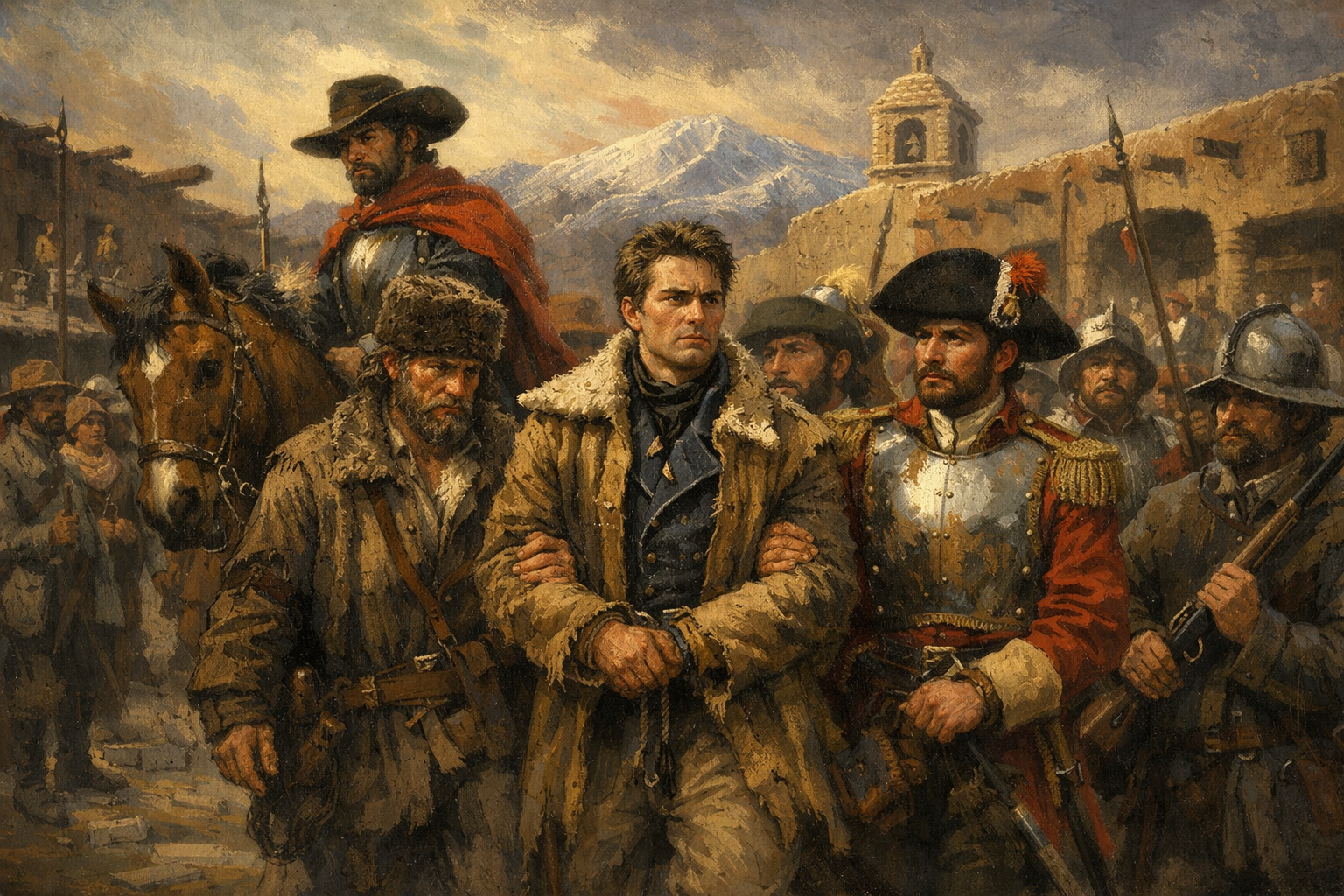
Pike and his men were taken first to Santa Fe, then marched farther south to Chihuahua.
That part of the story is wildly underrated.
Most people imagine American explorers moving steadily west toward glory. Pike’s men instead were escorted as prisoners through the Spanish borderlands, getting a firsthand look at territory, settlements, roads, military presence, and infrastructure that Americans knew little about. Even in captivity, Pike was gathering observations. In that sense, the failed expedition still produced one of the earliest American descriptions of the northern provinces of New Spain. He was eventually released and expelled back to American territory in 1807.
It is one of the great ironies of early U.S. exploration.
Pike went west trying to map America’s edge and came home after being hauled through Spain’s frontier empire.
Why the Pike Expedition Mattered
So why does the Pike Expedition matter?
Because it helped expose the shape, danger, and scale of the American Southwest at a crucial moment in U.S. history.
Pike’s published account, which appeared in 1810, gave Americans some of the earliest descriptions of the southern plains, the Rocky Mountain frontier, and the Spanish borderlands beyond. His journey also underscored how little the United States actually knew about its new western claims. The expedition revealed the difficulty of overland travel, the strategic importance of rivers, the power and presence of Native nations, and the continuing influence of Spain across the region. In a very real sense, Pike helped transform the West from an abstraction into a place.
He also became part of a larger American pattern.
The early republic did not simply inherit the West. It probed it, stumbled through it, misread it, and slowly learned it by sending men into it at enormous human cost. Pike was one of those men. Unlike the smooth, polished textbook version of exploration, his story preserves the chaos of the process. That is why it feels real.
He was cold. He was under-informed. He was ambitious. He was probably sometimes wrong. He was definitely tough.
And he kept going.
More Than a Mountain Name
Today, most people know Pike only because Pikes Peak is on the map.
That sells him short.
Zebulon Pike was one of the key figures in the early American push into the interior of North America. He was part soldier, part explorer, part symbol of a republic trying to understand the size of its own ambitions. His southwestern expedition was messy, dangerous, and incomplete — which is exactly why it belongs in the front rank of great American adventure stories.
Lewis and Clark often get the glory. Pike gets the frostbite.
But if Lewis and Clark gave America a triumphant saga of western discovery, Zebulon Pike gave it something grittier: the story of a frontier that could humble you, confuse you, freeze you, and still pull you forward.
That story matters.
Because the American West was not won by clean legends alone. It was shaped by men walking into the unknown with bad maps, weak supplies, and enough nerve to keep moving when the horizon stopped making sense.
Pike and his boys did exactly that.
They crossed plains that seemed endless. They pushed into the mountains. They stared down hunger and winter. They wandered into an international border crisis. They got captured, marched across New Spain, and came back with a story the young republic could not ignore.
That is not a side note.
That is American history at full volume.
Final Thought
The next time you hear the name Zebulon Pike, do not just think of a mountain.
Think of a young officer in buckskin and military wool, pushing west with a small party of hard men into a country no American truly understood.
Think of the plains, the cold, the mountain that beat him, the snow, the dunes, the wrong river, the Spanish cavalry, the long march south.
Think of an expedition that looked half-broken and still changed history.
Because that is the real power of the Pike story.
Not perfection.
Endurance.
Not a clean victory.
A brutal entrance into the American West.