

Fort Necessity, Lawrence Washington, and the Making of George Washington
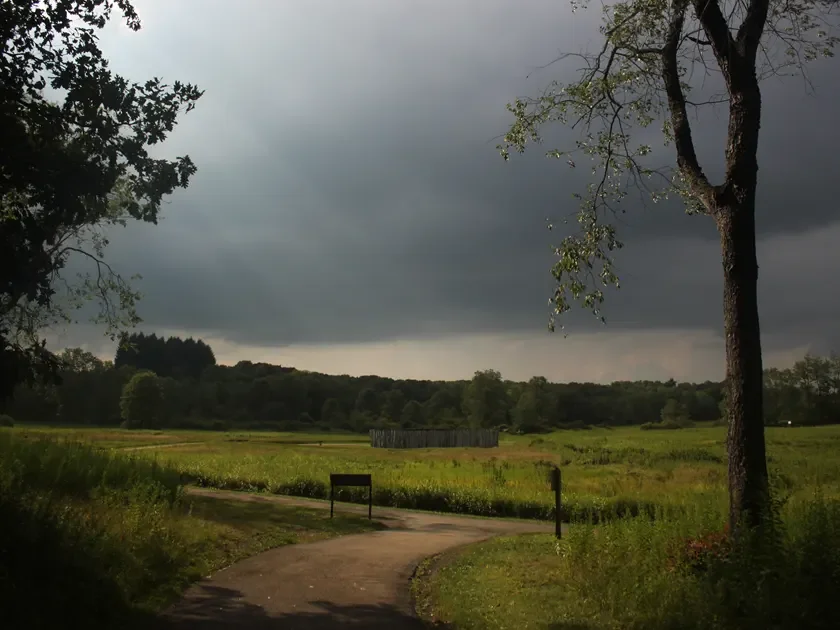
Before George Washington became the face of American independence, before he crossed the Delaware, before Yorktown, before the presidency, and before the marble statues turned him into something almost untouchable, he was a young man standing in the rain, surrounded by enemies, trapped inside a badly placed frontier fort.
That place was Fort Necessity.
It was not glorious. It was not elegant. It was not the kind of moment that looks good on a monument. It was muddy, chaotic, embarrassing, and dangerous. On July 3, 1754, a 22-year-old George Washington surrendered to French forces in the wilderness of western Pennsylvania. It would be the only military surrender of his life.
And yet, in many ways, Fort Necessity helped make George Washington.
To understand why, we have to go back before the battle. Before the French and Indian War. Before the Ohio frontier. Before George Washington was a commander. We have to look at the man who opened the door for him: his older half-brother, Lawrence Washington.
Lawrence Washington was more than George’s brother. He was his model, mentor, social connection, and living example of what a Virginia gentleman could become. Lawrence had served in the British military, moved in elite colonial circles, married into the powerful Fairfax family, and helped connect the Washington name to ambition, land, influence, and empire.
George Washington wanted that world.
And Fort Necessity was where that dream met reality.
Lawrence Washington: The Brother Who Shaped George’s Ambition
George Washington was born in 1732 into a respectable Virginia family, but he was not born into the highest ranks of colonial power. His father, Augustine Washington, died when George was only 11 years old, leaving the family’s future uncertain. George did not receive the polished English education that many wealthy colonial sons enjoyed. He was not sent overseas to study. He was not automatically guaranteed a place among Virginia’s ruling class.
Lawrence Washington helped change that.
Lawrence, George’s older half-brother, had advantages George did not. According to George Washington’s Mount Vernon, Lawrence Washington served in the British military and became an important early influence in George’s life. He inherited and developed the plantation that became known as Mount Vernon. He married Anne Fairfax, linking himself to one of the most powerful families in Virginia. Through Lawrence, George came into contact with men of land, rank, wealth, and political influence.
For a fatherless younger brother, Lawrence represented possibility.
George saw in Lawrence a version of the life he wanted: respected landowner, military man, gentleman, and public figure. Lawrence’s world gave George access to the Fairfax family, surveying opportunities, military conversations, and a broader vision of the American frontier.
This mattered deeply.
In colonial Virginia, land was power. Land meant wealth, status, and independence. The frontier was not simply wilderness; it was opportunity. Men who could survey it, claim it, defend it, and profit from it could rise quickly. George Washington understood this early. As a teenager, he became a surveyor, traveling through the rugged backcountry and learning how to read terrain, measure land, endure hardship, and move through dangerous country.
That experience would become crucial later. But the spark behind much of Washington’s ambition came from Lawrence’s example.
Lawrence was also connected to the Ohio Company, a land speculation venture formed by influential Virginians who had their eyes on the Ohio Country. This region, stretching around the forks of the Ohio River, was claimed by both Britain and France. It was rich, strategic, and contested. Whoever controlled it could dominate the interior of North America.
George Washington’s path to Fort Necessity began with this world of land, empire, and family influence.
The Ohio Country: Where Ambition Became War
By the early 1750s, tensions between Britain and France were rising fast in the Ohio Valley. The French were building forts to secure their claim. British colonial leaders, especially in Virginia, believed the land belonged to them. The Ohio Company had financial interest in the region, and Virginia’s leaders wanted someone bold enough to challenge the French presence.
George Washington wanted a military career. He wanted status. He wanted recognition. And thanks in part to the social world Lawrence had helped introduce him to, Washington was positioned for opportunity.
In 1753, Virginia Lieutenant Governor Robert Dinwiddie sent Washington on a dangerous mission to deliver a message to the French demanding they leave the Ohio Country. Washington was only 21 years old. It was a brutal journey through forests, rivers, snow, and enemy territory. But he completed it.
Even though the French refused to leave, Washington returned with something valuable: a reputation.
His journal from the expedition was published, making him known in Virginia and even across the Atlantic. Suddenly, George Washington was not just a young surveyor with ambition. He was a rising colonial officer who had faced the wilderness and carried himself with courage.
But fame can be dangerous when it arrives before wisdom.
In 1754, Washington returned to the Ohio frontier, this time with military force. His mission was to help assert British claims and push back against the French. What followed would ignite one of the most important conflicts of the 18th century: the French and Indian War, which later became part of the larger global struggle known as the Seven Years’ War.
Jumonville Glen: The Spark Before Fort Necessity
Before Fort Necessity came Jumonville Glen.
In May 1754, Washington and his men encountered a small French party led by Joseph Coulon de Jumonville. The details of what happened remain debated, but the result was clear: Jumonville was killed, along with several other Frenchmen. The French claimed Jumonville had been on a diplomatic mission. Washington viewed the French party as a military threat.
Either way, the incident had massive consequences.
The death of Jumonville lit the fuse that helped start the French and Indian War, the North American theater of the larger Seven Years’ War. In other words, a young George Washington, chasing honor and advancement on the frontier, found himself at the center of a global crisis.
The National Park Service’s history of Jumonville Glen shows just how quickly this frontier skirmish escalated into something far larger than Washington could have imagined.
After Jumonville Glen, Washington knew the French would respond. He pulled his men back to a place called the Great Meadows, an open clearing in what is now southwestern Pennsylvania. There, he ordered the construction of a small defensive structure.
They called it Fort Necessity.
The name itself tells the story. It was not Fort Glory. Not Fort Victory. Not Fort Washington.
Fort Necessity.
It was built because Washington had no better option.
Fort Necessity: Washington’s First Great Failure
Fort Necessity was a poor defensive position. The fort sat in an open meadow, surrounded by higher ground and tree lines that gave attackers cover. The structure itself was small and hastily built. When the French and their Native allies arrived on July 3, 1754, they had the advantage.
The weather made everything worse.
Rain fell heavily. Trenches filled with water. Gunpowder became difficult to manage. Washington’s men were exhausted, exposed, and increasingly desperate. The French and their Native allies fired from the surrounding woods, while Washington’s force struggled to respond effectively.
This was not the clean, heroic battlefield scene many people imagine when they think of early American warfare. It was wet, smoky, confusing, and brutal. Men were wounded and killed. Morale collapsed. Supplies ran low. Some soldiers reportedly got into the rum supply. Washington, still barely into his twenties, was learning in real time what command actually meant.
Command was not a title.
It was responsibility.
By evening, Washington agreed to surrender. The National Park Service account of the Battle of Fort Necessity describes the surrender as the beginning of Washington’s first major military lesson — and one of the most important failures of his life.
The surrender terms were written in French. Washington, who did not speak the language fluently, relied on translation. One clause stated that he had been responsible for the “assassination” of Jumonville. Washington later denied that he understood the wording that way, believing the phrase meant something closer to the killing or death of Jumonville. But the damage was done.
The French used the document as propaganda.
Washington had lost the fort. He had surrendered. He had been connected, in writing, to a politically explosive death. His first major command had ended in humiliation.
And that is exactly why Fort Necessity matters.
The Gift Hidden Inside Humiliation
Most leaders are not formed by their victories first. They are formed by the moments that expose them.
Fort Necessity exposed George Washington.
It exposed his youth. It exposed his hunger for advancement. It exposed his lack of experience. It exposed the difference between courage and judgment. It exposed the danger of overconfidence. It exposed the brutal truth that the frontier did not care about reputation, family connections, or ambition.
This was the wilderness. This was war. This was empire.
But Washington did not disappear after Fort Necessity. He did not allow failure to define him permanently. Instead, he absorbed the lesson.
That became one of the defining patterns of his life.
Washington was not a flawless military genius. That version of him is too simple and too polished. The real Washington was more interesting. He made mistakes. He misread situations. He could be ambitious, sensitive to criticism, and deeply concerned with honor. But he learned. He adapted. He endured embarrassment without being destroyed by it.
Fort Necessity taught him that bravery was not enough. A leader needed patience, preparation, discipline, logistics, alliances, intelligence, and humility. He learned that terrain mattered. He learned that communication mattered. He learned that political consequences could be just as dangerous as battlefield losses.
Years later, during the American Revolution, those lessons became priceless.
Washington would lose battles again. He would retreat from New York. He would endure criticism. He would watch his army suffer through hunger, disease, desertion, and freezing winters. But he would not break.
Fort Necessity helped teach him how not to break.
Lawrence Washington’s Shadow and George Washington’s Rise
Lawrence Washington did not live to see Fort Necessity. He died in 1752, just two years before George’s surrender. But his influence was everywhere in George’s early life.
Through Lawrence, George inherited more than family ties. He inherited a vision of manhood and leadership tied to land, military service, British identity, and elite status. Lawrence’s connections helped bring George into the orbit of powerful Virginians. His example encouraged George’s interest in military life. His place at Mount Vernon eventually became George’s own.
After Lawrence’s death, George began moving more fully into the role his older brother had once occupied.
That transition mattered psychologically as much as socially. George was no longer simply the younger brother looking upward. He was becoming the man responsible for carrying the Washington name forward.
Fort Necessity tested that transition.
It showed that stepping into leadership was not the same as being ready for it. Lawrence had opened the door to ambition, but George had to walk through failure to become worthy of command.
That is what makes this story so powerful.
George Washington did not become a leader because everything went right. He became a leader because things went wrong early, publicly, and painfully, and he kept going.
From Fort Necessity to the American Revolution
The French and Indian War became Washington’s first real school of leadership. After Fort Necessity, he later served under British General Edward Braddock during the disastrous 1755 campaign against Fort Duquesne. Braddock was killed, and Washington gained attention for his courage under fire. He eventually commanded Virginia forces and continued to develop the habits that would later define him: discipline, persistence, attention to supply lines, concern for reputation, and a deep understanding of how fragile armies could be.
He also learned something else.
British officers often looked down on colonial officers. Washington experienced the arrogance of the imperial military system firsthand. He wanted a royal commission and never received the recognition he believed he deserved. That resentment did not instantly make him a revolutionary, but it planted seeds.
By the time the American colonies moved toward rebellion two decades later, Washington was not an inexperienced planter playing soldier. He was a man who had seen war on the frontier. He had known defeat. He had managed men. He had dealt with British command. He had watched empires fight over land. He had learned that survival sometimes mattered more than immediate victory.
That lesson became central to the American Revolution.
When George Washington was chosen to command the Continental Army, he brought more than status to the role. He brought the memory of failure, the pain of hard lessons, and the patience of a man who understood that winning a war did not always mean winning every battle.
Washington’s greatest achievement as commander of the Continental Army was not that he won every battle. He did not. His genius was that he kept the army alive. He understood that as long as the army survived, the cause survived. That kind of patience may have been born, in part, from the mud and misery of Fort Necessity.
Years later, that patience would help carry him from frontier defeat to Washington’s victory at Yorktown, where the surrender of Cornwallis changed the course of world history.
Why Fort Necessity Still Matters
Fort Necessity is one of the most important places in George Washington’s life because it reveals the man before the myth.
Here we see Washington before the powdered portraits and presidential legends. We see him young, ambitious, flawed, and vulnerable. We see a man chasing honor and finding humiliation. We see a future founding father learning that leadership is not built on image alone.
The story also fits into the larger sweep of major July history events, where moments of war, rebellion, leadership, and independence shaped the future of nations.
Lawrence Washington helped give George access to the world he wanted to enter. He showed him the power of military service, land ownership, elite connection, and public reputation. But Fort Necessity gave George something Lawrence could not give him.
It gave him failure.
And failure, handled correctly, can become a brutal kind of education.
The story of Fort Necessity is not just the story of a lost battle. It is the story of a young man being stripped down and rebuilt. It is the story of how ambition becomes discipline. It is the story of how a future commander learned that leadership requires more than courage. It requires endurance, humility, judgment, and the ability to rise after public defeat.
George Washington’s road to greatness did not begin with victory. Although he would shape American history, his first steps into his legacy was failure and endurance.
It began in a wet meadow, behind a fragile wooden fort, with surrender papers in his hand.
And maybe that is why he became the leader America needed.
Not because he never failed.
Because he failed early, learned deeply, and never stopped moving forward.
If you enjoyed this story, share it, repost it, or send it to a friend who loves American history. The rise of George Washington did not begin with perfection — it began with pressure, failure, and the hard road toward becoming a leader.
Fort Necessity FAQ
What was Fort Necessity?
Fort Necessity was a small defensive fort built by George Washington and his men in 1754 at Great Meadows in present-day Pennsylvania. It became the site of Washington’s first major military defeat and the only surrender of his military career.
Why was Fort Necessity important?
Fort Necessity was important because it helped spark the French and Indian War and gave young George Washington one of his earliest and most painful lessons in leadership. The defeat exposed his inexperience, but it also helped shape the patience, discipline, and resilience he later showed during the American Revolution.
How did Lawrence Washington influence George Washington?
Lawrence Washington, George’s older half-brother, influenced him through military service, social connections, land ownership, and access to Virginia’s elite circles. Lawrence helped introduce George to the world of ambition, status, and frontier opportunity that shaped his early career.
Did George Washington surrender at Fort Necessity?
Yes. George Washington surrendered at Fort Necessity on July 3, 1754, after French forces and their Native allies surrounded his position. It was the only military surrender of Washington’s career.
How did Fort Necessity shape George Washington as a leader?
Fort Necessity taught Washington that courage alone was not enough. He learned the importance of preparation, terrain, logistics, discipline, communication, and humility. Those lessons helped prepare him for later leadership during the American Revolution.