

Who Were Ashley’s Hundred? The Men Who Created the Mountain Man Era
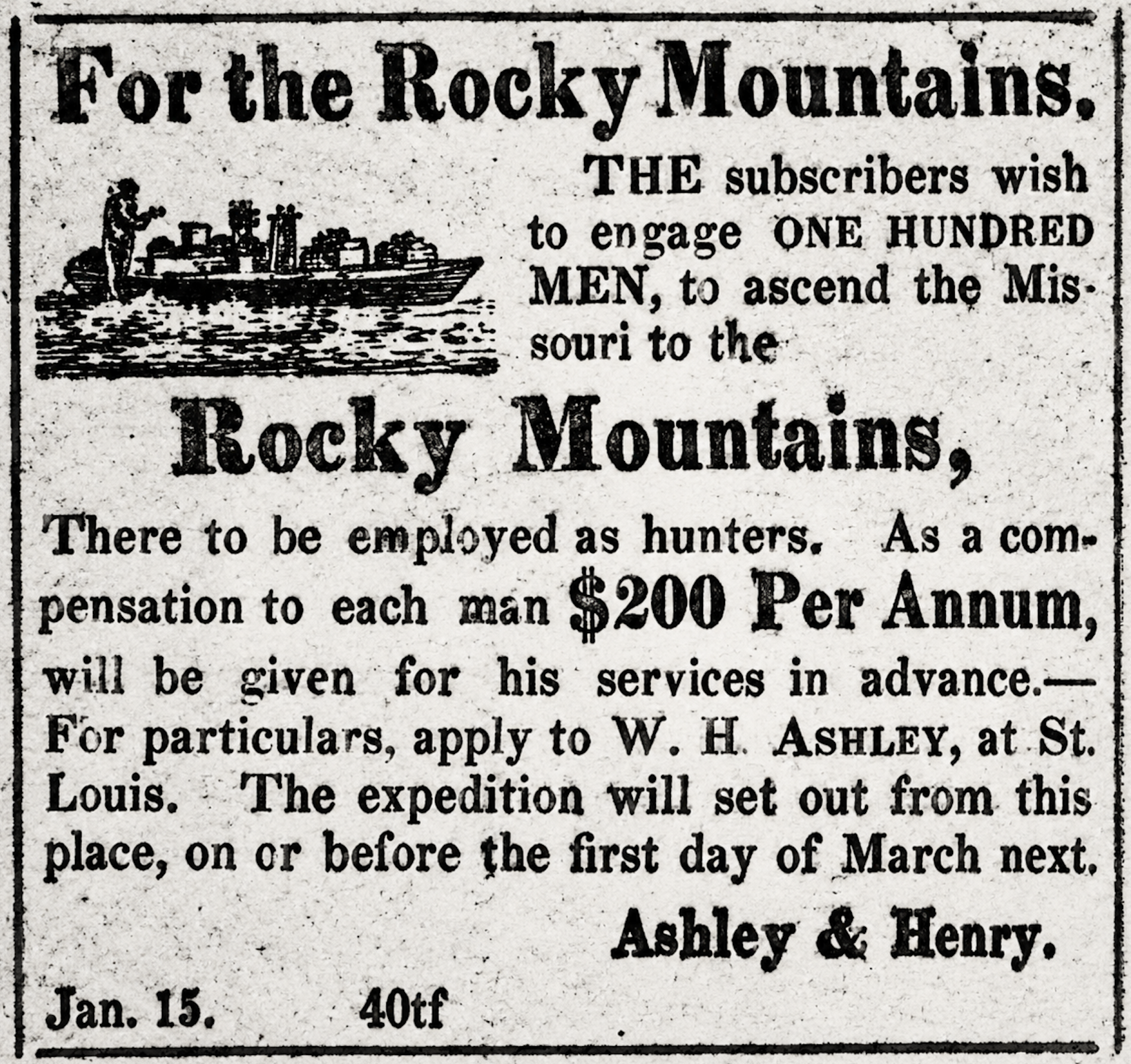
In 1822, a newspaper advertisement appeared in St. Louis, Missouri.
It wasn't particularly remarkable. No grand promises of fame. No declarations about changing American history. Just a businessman looking for one hundred ambitious young men willing to venture into the wilderness.
But the men who answered that advertisement would become legends.
Jedediah Smith. Jim Bridger. Hugh Glass. William Sublette. Thomas Fitzpatrick.
Names that would eventually become inseparable from the American West.
They crossed mountains few Americans had mapped. Survived brutal winters. Encountered grizzly bears, hostile conditions, and deadly conflicts. They traveled thousands of miles through country that demanded everything from those who entered it.
Some became wealthy.
Others disappeared into the wilderness.
Many never returned.
Together, they helped create one of the most fascinating chapters in American history.
They became known as Ashley's Hundred.
And their story helped define the golden age of the American mountain man.
Who Were Ashley's Hundred?
Ashley's Hundred was the name given to the group of fur trappers, hunters, and explorers recruited beginning in 1822 by Missouri businessmen William Henry Ashley and Andrew Henry.
Their objective was straightforward: travel into the Rocky Mountains, trap beavers, and bring valuable furs back to eastern markets.
Their impact was anything but ordinary.
The enterprise helped establish the American Rocky Mountain fur trade and popularized a new way of doing business in the West.
Instead of relying entirely on permanent trading posts, mountain men increasingly worked deep in the wilderness, trapping animals and gathering periodically to exchange their furs for supplies.
This approach eventually developed into the famous Rocky Mountain rendezvous system.
The men associated with Ashley and Henry's expeditions included some of the most recognizable figures in frontier history.
But the name can be misleading.
Ashley's Hundred was not necessarily a fixed roster of exactly one hundred men who all departed together. It originated from a recruitment effort seeking that number, and the company's personnel changed as expeditions departed, returned, and reorganized.
Nevertheless, the name endured.
According to the National Park Service's history of William Ashley, the venture launched in 1822 helped establish the fur-trading enterprise that would become central to the mountain man era.
The American West would never be quite the same.
The Advertisement That Helped Change the American West
Imagine St. Louis in 1822.
The city was growing into one of America's most important gateways to the western frontier.
Steamboats moved along the Mississippi. Traders exchanged goods arriving from distant territories. Merchants talked about fortunes waiting beyond the Missouri River.
Sixteen years had passed since Lewis and Clark returned from their expedition to the Pacific.
Their journey had expanded American knowledge of the continent, but enormous portions of the West remained poorly understood by American officials and mapmakers.
Native nations had lived, traveled, hunted, and traded across these landscapes for generations.
The country was not unknown.
It was simply unfamiliar to the expanding United States.
And ambitious businessmen saw opportunity.
William Henry Ashley was already successful in Missouri. He had made money in manufacturing and mining, served in the state militia, and entered politics.
But Ashley wanted something bigger.
He joined forces with Andrew Henry, an experienced frontier trader who understood the opportunities and dangers of the upper Missouri River.
Together, they organized a new fur-trading venture.
Their famous advertisement sought:
"Enterprising young men to ascend the Missouri River to its source."
The offer involved employment in the fur trade for as long as three years.
For young men with few prospects in the settled East, it was an extraordinary proposition.
Adventure.
Money.
Independence.
The possibility of building a future through courage and hard work.
But the advertisement left out something important.
The Rocky Mountains were not interested in anyone's ambitions.
And surviving them would require far more than enthusiasm.
Why Were Beaver Pelts So Valuable?
To understand Ashley's Hundred, you first need to understand the beaver.
Today, beavers are often associated with dams, ponds, and wildlife conservation.
In the early nineteenth century, they represented serious money.
Beaver fur was particularly valuable because its fine underfur could be processed into felt.
That felt was used to manufacture fashionable hats, especially in European and American markets.
For decades, beaver hats were symbols of status and respectability.
Demand created a powerful commercial incentive to push trapping operations farther west.
A single successful trapping season could produce valuable cargo.
A particularly productive expedition could generate enormous profits for merchants who supplied the trappers and marketed their furs.
But this was not easy money.
Mountain men needed traps, ammunition, horses, food, blankets, and trading goods.
They faced unpredictable weather, difficult terrain, disease, accidents, and the constant possibility of losing their supplies.
They also operated within territories controlled by Native nations whose relationships with American traders ranged from cooperation and commerce to competition and armed conflict.
Success depended on far more than knowing how to set a trap.
It required navigation, negotiation, endurance, and an understanding of the people who already knew the country.
The men who mastered those skills could become indispensable.
A few would become famous.
Jedediah Smith: The Man Who Helped Redraw the American West
Of all the men associated with Ashley's Hundred, few left a greater mark on American exploration than Jedediah Strong Smith.
Smith joined Ashley's enterprise as a young man.
He was not the stereotypical mountain man of popular imagination.
He was deeply religious, serious-minded, disciplined, and unusually interested in geography.
Yet he possessed an extraordinary willingness to venture into dangerous and unfamiliar country.
Smith would eventually travel through vast portions of the Rocky Mountains, Great Basin, and Pacific Coast.
His expeditions helped improve American geographical knowledge of the Far West.
He also became one of the leading figures in the fur trade.
Smith's journeys were filled with hardship.
He survived a devastating grizzly bear attack that left his face badly injured.
He crossed deserts, endured severe shortages of food and water, and led expeditions through territories where relations with Native communities could become deadly.
His life was not defined by a single adventure.
It was a relentless series of them.
Smith eventually became associated with several major milestones in western exploration, including early American overland routes into California.
But his accomplishments were built upon the opportunity created by Ashley's recruitment effort.
He entered the wilderness as a young employee.
He emerged as one of the most consequential explorers of his generation.
For a deeper look at his remarkable life, read Jedediah Smith: The Mountain Man Who Crossed the West Before the Maps Were Finished.
Smith represents something essential about Ashley's Hundred.
These men were not simply trapping animals.
Their journeys were expanding the geographical knowledge that would later help reshape the continent.
Hugh Glass: The Mountain Man Who Refused to Die
If Jedediah Smith represents exploration, Hugh Glass represents survival.
Glass became one of the most legendary figures associated with Ashley's enterprise.
His story unfolded in 1823.
While traveling through the upper Missouri region, Glass encountered a grizzly bear.
The animal attacked.
The injuries were catastrophic.
Glass was left severely wounded, and his companions believed he had little chance of surviving.
Two men were reportedly assigned to remain with him.
According to the traditional account, they eventually abandoned Glass, taking essential equipment and leaving him behind.
What followed became one of the most famous survival stories in American frontier history.
Glass somehow remained alive.
Unable to walk normally, he began an agonizing journey toward safety.
Accounts describe him crawling, dragging himself across the ground, and surviving on whatever food he could obtain.
The distance he traveled is commonly estimated at roughly 200 miles, although the precise route and details remain debated.
Eventually, Glass reached Fort Kiowa.
His survival became the stuff of legend.
And like many frontier legends, the story grew more dramatic with each retelling.
Historians continue to debate elements of the traditional account, particularly the details surrounding his abandonment and subsequent journey.
Nevertheless, Glass was a real frontiersman, and the bear attack became a defining event in his life.
His story later inspired books and films, including The Revenant.
But the real Hugh Glass deserves attention beyond Hollywood.
He was part of a generation that accepted extraordinary physical risks in pursuit of opportunity.
Men like Glass discovered that the wilderness could strip away everything they possessed.
Sometimes, survival itself became their greatest achievement.
Jim Bridger: From Young Trapper to Frontier Legend
Another remarkable figure connected to Ashley's Hundred was Jim Bridger.
Bridger entered the fur trade while still a teenager.
He would eventually become one of the most famous mountain men in American history.
Unlike men who made their reputations through one spectacular expedition, Bridger built his through decades of experience.
He became an accomplished trapper, guide, trader, and interpreter of western geography.
He developed an extraordinary knowledge of mountain passes, rivers, and travel routes.
Bridger was also famous for his storytelling.
Some of his tales were true.
Others were embellished.
A few were almost certainly designed to entertain anyone willing to listen.
But behind the colorful personality stood a man whose practical knowledge of the West was exceptional.
Bridger traveled extensively throughout the Rocky Mountain region and became closely associated with the exploration and development of routes through the interior West.
He later helped establish Fort Bridger in present-day Wyoming.
The trading post became an important stopping point for emigrants traveling west.
By then, the fur trade had begun giving way to a different era.
Families, wagons, and emigrant parties increasingly followed routes once traveled primarily by Native peoples, traders, and explorers.
Bridger had witnessed the transformation firsthand.
He entered the mountains seeking beaver.
He lived long enough to see the West transformed by migration, military expansion, and settlement.
William Sublette and Thomas Fitzpatrick: The Men Who Made the Fur Trade Work
Not every influential mountain man became famous through dramatic survival stories.
Some changed history through organization, leadership, and business.
William Sublette and Thomas Fitzpatrick were two such men.
Both became prominent figures in the Rocky Mountain fur trade.
Sublette developed a reputation as an effective trader and businessman.
He understood that trapping success meant little without the ability to transport supplies, organize expeditions, and sell valuable furs.
Fitzpatrick became an experienced mountain man, expedition leader, and guide.
He was closely associated with the Rocky Mountain trade and later played important roles in western travel and federal Indian affairs.
Together with men such as Jedediah Smith, they helped carry the enterprise beyond its original founders.
These men understood something that is often lost in romantic depictions of the frontier.
The mountain man era was not simply an endless series of adventures.
It was an industry.
Someone had to purchase supplies.
Someone had to organize transportation.
Someone had to negotiate trade.
Someone had to manage the financial risks.
And someone had to get the furs back to market.
Without men who understood the business, even the greatest trappers could find themselves stranded with valuable pelts and no practical way to sell them.
The fur trade demanded both courage and commerce.
Ashley's enterprise brought those worlds together.
The Arikara Conflict of 1823: A Brutal Turning Point
The early years of Ashley's enterprise were marked by violence.
In June 1823, Ashley's men became involved in a deadly confrontation with the Arikara along the Missouri River in present-day South Dakota.
The Arikara were an established Native nation with communities, agricultural traditions, and longstanding commercial relationships along the river.
Their territory was not an empty corridor available for American commercial expansion.
It was their homeland.
Relations between American traders and the Arikara had become increasingly strained.
Competition, previous disputes, and the growing pressure of the fur trade contributed to the hostility.
On June 2, 1823, fighting erupted near the Arikara villages.
Ashley's expedition suffered heavy casualties.
Historical accounts commonly report thirteen men killed and approximately ten wounded.
The attack was devastating.
It also triggered a United States military response.
Later that summer, Colonel Henry Leavenworth led an expedition against the Arikara, accompanied by allied Native warriors and fur-trading interests.
The confrontation became one of the early examples of American military intervention connected to expanding commercial activity on the northern Plains.
For Ashley's men, the consequences were immediate.
The Missouri River route had become increasingly dangerous.
The company needed to reconsider how it reached the valuable trapping grounds farther west.
The conflict helped accelerate a shift toward overland routes and a different system of conducting the fur trade.
It also exposed the violent realities beneath the romantic image of western exploration.
The expansion of American commerce brought opportunity for some and devastating consequences for others.
Any honest history of the mountain man era must acknowledge both.
South Pass: The Gateway Through the Rocky Mountains
One of the most consequential geographical features associated with the mountain man era was South Pass.
Located in present-day Wyoming, South Pass provided a relatively gradual crossing of the Continental Divide.
Unlike the steep mountain routes that made travel difficult, South Pass offered a more practical corridor through the Rockies.
Native peoples had known and used the region long before American fur traders arrived.
Earlier Euro-American travelers had also crossed the area.
But expeditions associated with Ashley's enterprise helped bring renewed attention to the route and its commercial possibilities during the 1820s.
Jedediah Smith and other mountain men traveled through the region as they searched for productive trapping grounds.
Their experience contributed to growing American knowledge of routes connecting the Missouri River country with the interior West.
The importance of South Pass would extend far beyond the fur trade.
In later decades, emigrants traveling the Oregon, California, and Mormon trails would pass through the same general corridor.
What began as a practical route for traders eventually became part of one of the great migration networks in American history.
This is where the mountain man era connects directly to the larger story of westward expansion.
The trappers did not invent the routes.
But their journeys helped transmit geographical knowledge into the growing American transportation and migration system.
And that knowledge would have lasting consequences.
The Rocky Mountain Rendezvous: Ashley's Greatest Innovation
Perhaps the most enduring contribution of Ashley's enterprise was the development of the Rocky Mountain rendezvous system.
Before this system became established, fur-trading companies often relied heavily on permanent posts and long-distance transportation routes.
Ashley and his associates increasingly adopted a different approach.
Instead of requiring trappers to return all the way to St. Louis, supply caravans could travel west to predetermined meeting places.
There, mountain men exchanged accumulated beaver pelts for equipment and merchandise.
The system reduced the need for repeated journeys back to eastern markets.
It allowed trappers to spend more time working in productive mountain country.
And it created one of the most distinctive traditions of the American frontier.
The first major Rocky Mountain rendezvous associated with Ashley's system took place in 1825 near Henry's Fork of the Green River in present-day Wyoming.
The gathering became a model for subsequent meetings.
Rendezvous events combined commerce with social activity.
Trappers arrived carrying valuable furs.
Merchants brought ammunition, blankets, traps, tools, tobacco, and other supplies.
Native traders participated in commercial exchanges.
Old acquaintances reunited.
Stories circulated.
Business arrangements were negotiated.
And men who had spent months isolated in the wilderness finally had an opportunity to gather.
The rendezvous became an annual institution during much of the mountain man era.
According to the National Park Service's account of the Rocky Mountain mountain men, the trade routes and gathering places associated with these men connected remote trapping grounds to wider commercial networks.
The rendezvous was more than a frontier celebration.
It was a logistical innovation that helped sustain an entire industry.
The Mountain Men Did Not Discover an Empty Wilderness
There is an important distinction that deserves attention.
Popular western history often describes mountain men as entering an untouched wilderness.
That description is misleading.
The Rocky Mountains, Great Basin, and surrounding territories were already home to Native nations with sophisticated knowledge of the land.
Shoshone, Crow, Blackfeet, Ute, Nez Perce, and numerous other peoples maintained extensive cultural, political, and commercial relationships across the region.
They knew the rivers.
They understood seasonal migration patterns.
They recognized mountain passes.
They possessed knowledge of food sources, weather conditions, and survival techniques that newcomers often lacked.
Mountain men depended heavily on that knowledge.
They traded with Native communities, formed alliances, learned languages, adopted equipment and practices, and sometimes married into Native families.
At other times, relationships deteriorated into violent conflict.
The fur trade was not a simple story of Americans conquering nature.
It was a complicated collision of cultures, commercial ambitions, and competing claims to land and resources.
The earlier Lewis and Clark Expedition demonstrated how essential Native assistance could be.
Sacagawea and her brother Cameahwait played important roles in helping the expedition navigate diplomatic and logistical challenges.
The Shoshone supplied horses that proved critical to the expedition's progress.
Read more about Cameahwait, the Shoshone chief who helped save Lewis and Clark.
The mountain men entered a world shaped by relationships and knowledge that existed long before Ashley's advertisement appeared.
Recognizing that reality does not diminish their accomplishments.
It makes the history more complete.
What Was Life Really Like for a Mountain Man?
Forget the polished paintings.
Forget the heroic poses.
The daily life of a mountain man was usually exhausting.
Trappers worked in cold rivers and streams, setting traps and checking them repeatedly.
They traveled with heavy equipment.
They repaired clothing and weapons.
They hunted for food.
They cared for horses and pack animals.
They endured insects, freezing temperatures, unpredictable storms, and long periods of isolation.
A successful trapper needed an extraordinary range of practical skills.
He had to understand animal behavior.
He needed to recognize tracks and signs.
He had to navigate unfamiliar terrain.
He needed to preserve food, maintain equipment, and protect valuable supplies.
And he had to make decisions quickly when conditions changed.
A mistake could be fatal.
A broken weapon, injured horse, sudden flood, or early winter storm could turn a promising expedition into a desperate struggle for survival.
There was also the psychological burden.
Many men spent months separated from familiar communities.
Letters were rare.
Medical care was limited.
Help could be hundreds of miles away.
The romantic mountain man existed in paintings and stories.
The real mountain man lived with wet boots, worn clothing, aching muscles, and the constant uncertainty of what tomorrow might bring.
Yet many continued returning to the mountains.
Why?
For some, it was money.
For others, it was freedom.
And for a few, life beyond the settlements offered something they could not find anywhere else.
How Ashley's Hundred Connected Lewis and Clark to the Oregon Trail
One of the most fascinating aspects of Ashley's Hundred is its place in the larger timeline of American expansion.
Lewis and Clark returned from the Pacific in 1806.
Ashley's enterprise began in 1822.
The Rocky Mountain rendezvous system emerged in 1825.
Large-scale migration along the Oregon Trail expanded during the following decades.
These events were connected.
Lewis and Clark helped expand American geographical knowledge of the Louisiana Purchase and the Pacific Northwest.
The mountain men built upon existing Native routes and earlier exploration while developing practical knowledge of western travel.
Later emigrants benefited from increasingly familiar corridors through the Rockies.
The relationship between these generations is especially visible in the life of Jean Baptiste Charbonneau.
Born during the Lewis and Clark Expedition, the son of Sacagawea later became a mountain man, guide, interpreter, and scout.
His life connected the age of exploration to the age of the fur trade and eventually to the expanding American West.
Explore his extraordinary story in Jean Baptiste Charbonneau: What Happened to Sacagawea's Son?.
The broader transformation also raises fascinating questions about what happened to the Native people whose assistance made earlier expeditions possible.
One of those questions concerns Sacagawea herself.
Her later life remains the subject of historical debate, including competing accounts of when and where she died.
Our investigation into what happened to Sacagawea after Lewis and Clark explores those competing traditions and the extraordinary changes that occurred across the nineteenth-century West.
The mountain man era was one chapter in a much larger transformation.
And Ashley's Hundred helped accelerate it.
What Happened to William Ashley and His Fur Company?
William Ashley did not remain a mountain man indefinitely.
His primary interest was business.
By 1826, he had built a profitable enterprise and sold his interests in the Rocky Mountain fur trade to Jedediah Smith, William Sublette, and David Jackson.
The transition was significant.
The men who had once worked within Ashley's enterprise were now assuming control of major commercial operations.
Ashley returned his attention to politics and other business interests.
He later served in the United States House of Representatives.
Meanwhile, the fur trade continued under changing ownership and partnerships.
The enterprise Ashley helped launch evolved into the business world associated with the Rocky Mountain Fur Company.
But the industry would not remain profitable forever.
By the late 1830s and early 1840s, the Rocky Mountain beaver trade was declining.
Changing fashion reduced demand for beaver-felt hats.
Overtrapping depleted populations in important regions.
Commercial competition and rising costs created additional pressure.
The famous rendezvous era came to an end.
The last major Rocky Mountain rendezvous was held in 1840.
The mountain man era, at least in its classic beaver-trapping form, was fading.
But the men themselves did not simply disappear.
Some became guides.
Others became merchants, scouts, interpreters, soldiers, and settlers.
Their knowledge remained valuable as American migration expanded.
The industry declined.
Its influence endured.
For additional historical context, the National Park Service's history of trappers and traders at Dinosaur National Monument documents the role of Ashley's enterprise in the Green River region and the broader fur trade.
Why Ashley's Hundred Still Matters Today
It is tempting to remember Ashley's Hundred only through the extraordinary men who emerged from its ranks.
Jedediah Smith crossing deserts.
Hugh Glass surviving a grizzly attack.
Jim Bridger navigating the mountains.
Those stories deserve to be remembered.
But their collective significance is greater than any individual adventure.
Ashley's Hundred helped transform the American fur trade.
Its members contributed to the development of overland commercial networks.
Their journeys expanded American geographical knowledge of the Rocky Mountains and surrounding regions.
The rendezvous system created a new model for operating deep in the interior West.
And the experience of these men helped connect the age of Lewis and Clark to the later era of mass westward migration.
Their story also reveals the contradictions of American expansion.
Opportunity and exploitation.
Courage and violence.
Discovery and displacement.
Independence and dependence on Native knowledge.
The mountain men were products of their time.
They were ambitious, imperfect, resourceful, and often extraordinarily tough.
Some pursued wealth.
Some sought adventure.
Others simply wanted a life beyond the boundaries of the familiar.
They helped create the image of the American mountain man that still occupies such a powerful place in the national imagination.
But their real history is more complicated, and ultimately more interesting, than the legend.
The Legacy of Ashley's Hundred: A Generation That Changed the West
In 1822, William Ashley needed men.
He offered them employment in the wilderness.
What followed became something far larger than a business venture.
The young men who answered his advertisement helped establish an era defined by exploration, danger, enterprise, and extraordinary endurance.
Some survived to become legends.
Others died far from home.
Most would never receive the recognition given to Smith, Bridger, or Glass.
But together, they helped shape the world that followed.
The mountain passes they traveled became increasingly important routes.
The trading networks they developed connected distant regions.
The geographical knowledge they accumulated influenced generations of travelers.
And the stories they left behind became part of America's enduring frontier mythology.
They did not create the mountains.
They did not discover a land without people.
And they certainly did not accomplish everything alone.
But they helped usher in a new era of American activity in the West.
One advertisement. One hundred sought-after recruits. A generation of extraordinary lives.
The men became known as Ashley's Hundred.
And the mountain man era would never be forgotten.
Frequently Asked Questions About Ashley's Hundred
Who were Ashley's Hundred?
Ashley's Hundred was the name associated with fur trappers and explorers recruited by William Henry Ashley and Andrew Henry beginning in 1822. The group helped establish the Rocky Mountain fur trade and included notable figures such as Jedediah Smith, Jim Bridger, and Hugh Glass.
Why were they called Ashley's Hundred?
The name originated from an 1822 recruitment advertisement seeking approximately one hundred enterprising young men for an expedition up the Missouri River. The term later became associated with the men who participated in Ashley and Henry's fur-trading operations.
Who were the most famous members of Ashley's Hundred?
The best-known figures associated with Ashley's enterprise include Jedediah Smith, Jim Bridger, Hugh Glass, William Sublette, and Thomas Fitzpatrick. Their involvement occurred across different expeditions and stages of the company's development.
When did Ashley's Hundred begin?
Ashley's Hundred originated in 1822, when William Ashley and Andrew Henry began recruiting men for their Rocky Mountain fur-trading venture.
What was the purpose of Ashley's Hundred?
The primary purpose was to trap beavers and obtain valuable furs for sale in eastern American and international markets. The expeditions also contributed to American exploration and geographical knowledge of the Rocky Mountains.
What was the Rocky Mountain rendezvous?
The Rocky Mountain rendezvous was a gathering where fur trappers, traders, and Native participants exchanged furs, supplies, and merchandise. Ashley's enterprise helped establish the system, with its first major rendezvous taking place in 1825.
Did Ashley's Hundred discover South Pass?
No. Native peoples knew and used South Pass long before Ashley's men arrived, and earlier Euro-American travelers had crossed the region. Expeditions associated with Ashley helped increase American awareness of the route during the 1820s.
What happened to Ashley's Hundred?
The original enterprise evolved as its personnel and ownership changed. William Ashley sold his fur-trading interests in 1826 to Jedediah Smith, William Sublette, and David Jackson. The broader Rocky Mountain fur trade continued for years before declining, with the final major rendezvous taking place in 1840.
Why were mountain men important to American history?
Mountain men contributed to western trade networks, geographical knowledge, and the development of routes later used by emigrants. Their activities also intensified American commercial involvement in Native territories and helped shape the economic and political transformation of the nineteenth-century West.
Continue Exploring American History
The story of Ashley's Hundred is only one chapter in the larger history of the American frontier.
Discover more of the people, expeditions, conflicts, and remarkable events that shaped the nation in our Chronicles of History American History collection.
History isn't just about remembering what happened.
It's about understanding the people who lived it, the decisions they made, and the consequences that followed.
Make History Cool Again.