

William Henry Ashley: The Fur Trader Who Changed the American West
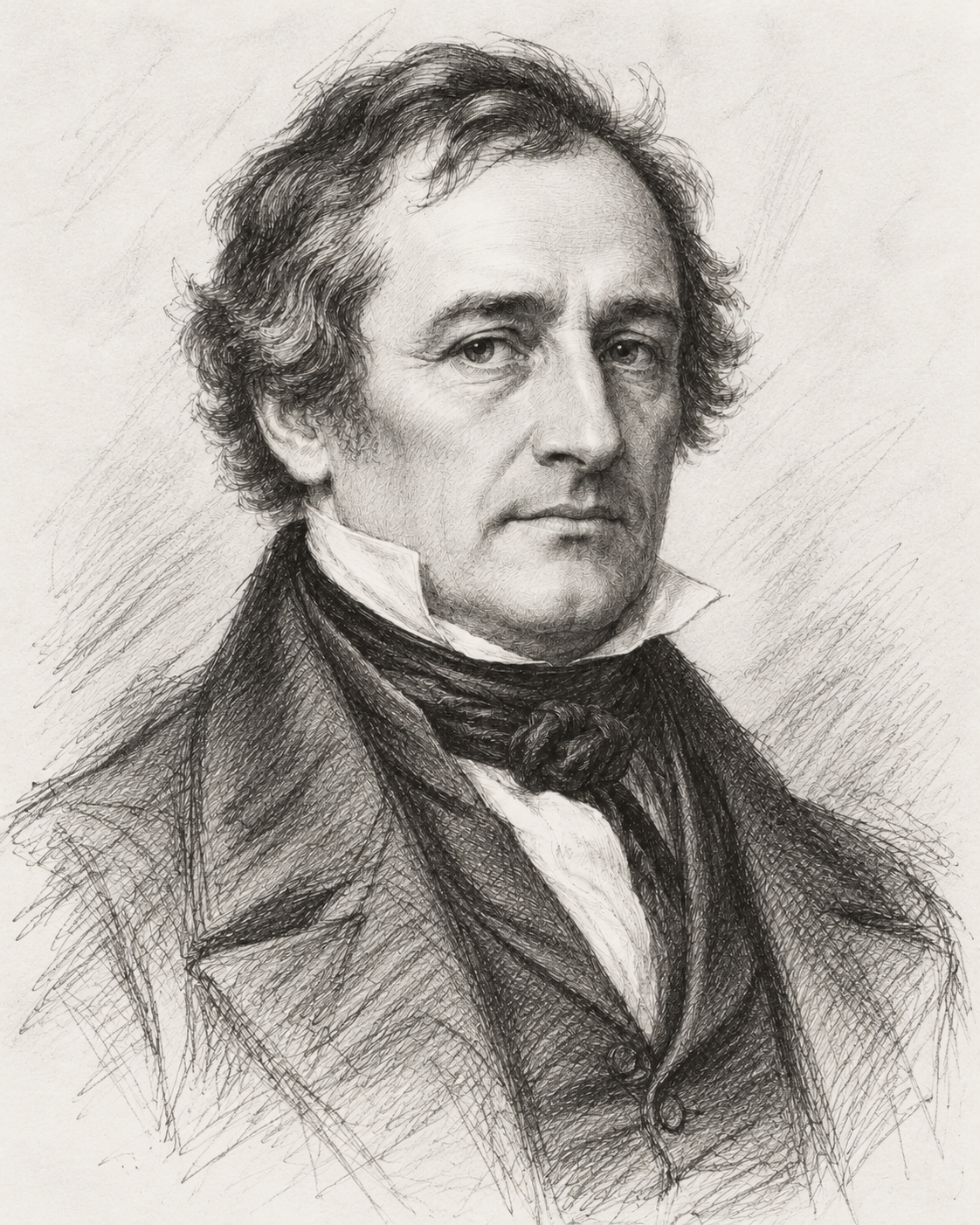
*This is a digitally rendered picture drawing of William Henry Ashley. There are no known ‘actual’ sketches or photos.
How William Henry Ashley Shaped The American West.
In 1822, a Missouri businessman placed a small newspaper advertisement calling for one hundred adventurous young men willing to disappear into the American wilderness.
He promised employment.
He offered opportunity.
He said almost nothing about the danger.
Within a few years, some of those young men would become legends. Jedediah Smith would cross deserts and mountains few Americans had ever traveled. Jim Bridger would become one of the most recognized frontiersmen of the nineteenth century. Hugh Glass would survive a grizzly bear attack and enter American folklore.
But behind those famous names stood a man whose own story has largely faded from popular memory.
William Henry Ashley.
He was not born a mountain man. He was a businessman, militia officer, politician, and relentless entrepreneur who understood something extraordinary about the American West.
There was money to be made beyond the Missouri River.
And the men willing to risk their lives pursuing it might become incredibly valuable.
Ashley would lose men, money, and entire expeditions before discovering a system that transformed the Rocky Mountain fur trade. His enterprise helped establish the legendary mountain man era, developed commercial routes across the continent, and introduced a gathering known as the Rocky Mountain rendezvous.
Then, after helping build one of the most influential businesses on the frontier, he sold his interests and returned to politics.
His name would never become as famous as those of the men who worked for him.
Yet without William Henry Ashley, the history of the American West might have unfolded very differently.
Who Was William Henry Ashley?
William Henry Ashley (1778–1838) was an American businessman, fur trader, militia general, and politician best remembered for establishing a major Rocky Mountain fur-trading enterprise with Andrew Henry in 1822.
Born in Virginia, Ashley moved west to Missouri Territory in the early nineteenth century, where he built business interests in manufacturing, mining-related enterprises, trade, and land.
He became Missouri's first lieutenant governor in 1820 and later served three terms in the United States House of Representatives.
But his most enduring legacy came from the fur trade.
Ashley helped organize the expeditions associated with Ashley's Hundred, the legendary group of mountain men who helped shape the early American West.
His business attracted ambitious trappers and explorers, including Jedediah Smith, Jim Bridger, William Sublette, and Thomas Fitzpatrick.
He also helped establish the Rocky Mountain rendezvous system, a practical method of gathering furs and supplying trappers deep in the mountains without requiring them to return to civilization every season.
In a relatively short period, Ashley changed how the American fur trade operated.
The consequences lasted long after he left the mountains.
From Virginia to Missouri: The Making of an Ambitious American
William Henry Ashley was born in 1778 in Powhatan County, Virginia, as the American Revolution was reshaping the young nation's future.
Little is firmly documented about his childhood. He received a basic education, but the surviving historical record reveals far more about his adult ambitions than his upbringing.
By 1803, Ashley had moved west to the settlement of Sainte Genevieve in what was then Upper Louisiana.
This was a remarkable moment in American history.
The United States had just acquired the vast Louisiana Territory from France. President Thomas Jefferson was preparing to send Meriwether Lewis and William Clark across the continent to investigate its geography, resources, and commercial possibilities.
For ambitious Americans, the western territories represented opportunity on a scale that was difficult to imagine.
Ashley understood that opportunity.
He became involved in the production of saltpeter, an important ingredient in gunpowder, before expanding into merchant activities, surveying, and other commercial ventures.
In 1808, he moved to St. Louis.
The town sat near the meeting of the Mississippi and Missouri rivers, making it a natural center for the growing western trade.
Goods arrived from the East.
Furs came down from distant waterways.
Merchants, trappers, Native traders, soldiers, and adventurers passed through its streets.
Information itself became valuable. A traveler returning from the upper Missouri might carry news of profitable hunting grounds, difficult river passages, or opportunities that had not yet reached eastern markets.
Ashley established himself in this expanding economy.
He was not simply interested in adventure.
He was interested in building businesses.
And he quickly became involved in public life as well.
During the War of 1812, Ashley served in the Missouri militia and rose to the rank of brigadier general.
In 1820, when Missouri organized its first state government, he was elected lieutenant governor.
He was already a man of means, influence, and political ambition.
But his greatest business undertaking was still ahead of him.
The American West After Lewis and Clark
To understand Ashley's decision to enter the fur trade, we need to understand the America he inhabited.
In 1806, Lewis and Clark returned from their expedition to the Pacific Ocean.
Their journey expanded the United States government's knowledge of western geography, waterways, Native nations, and possible commercial routes.
But their expedition did not reveal an empty continent.
The West was home to numerous Indigenous nations with their own territories, trade networks, diplomatic relationships, and deep geographical knowledge.
The Corps of Discovery had survived in large part because of that knowledge.
The Shoshone, for example, provided crucial assistance as the expedition approached the Rocky Mountains. The encounter involving Sacagawea and her brother, Chief Cameahwait, became one of the most remarkable moments of the entire journey.
By the early 1820s, American merchants were increasingly interested in converting this growing geographical understanding into commercial activity.
One commodity stood above almost everything else.
Beaver.
Beaver fur was in enormous demand, especially for the manufacture of fashionable felt hats. European and American markets created a strong incentive to trap animals in distant river valleys.
A successful expedition could return with furs worth a considerable sum.
But getting those pelts out of the wilderness was another matter.
Rivers were dangerous. Transportation was expensive. Permanent trading posts required considerable investment. Competing companies fought for access to valuable resources and relationships.
The business offered great rewards.
It also destroyed fortunes.
Ashley was about to discover both sides.
1822: William Henry Ashley and Andrew Henry Make Their Move
Ashley did not enter the Rocky Mountain fur trade alone.
His partner was Andrew Henry, a man with far more direct experience in the western wilderness.
Henry had participated in earlier fur-trading ventures and understood the challenges of operating in the upper Missouri country.
The two men brought different strengths to the partnership.
Ashley possessed business experience, political connections, capital, and organizational ability.
Henry understood the frontier.
Together, they organized an enterprise commonly known as Ashley and Henry.
Their ambition was straightforward: recruit men, send them into the western trapping country, and return with valuable furs.
But finding enough men willing to undertake such an expedition was no simple task.
The work was dangerous, exhausting, and physically demanding.
A trapper might spend months far from settlements, navigating freezing streams, difficult mountain passes, uncertain supplies, and encounters that could become deadly.
The partners needed men who were willing to risk nearly everything.
Ashley decided to advertise.
The Advertisement That Helped Launch the Mountain Man Era
On February 13, 1822, William Henry Ashley placed an advertisement in the Missouri Gazette & Public Advertiser.
Its opening words were simple:
"TO ENTERPRISING YOUNG MEN"
The notice sought one hundred men willing to ascend the Missouri River toward its source and work for one, two, or three years.
The advertisement was brief, practical, and almost astonishingly understated.
There were no elaborate descriptions of adventure.
No promises of fame.
No warnings about the hardships ahead.
Ashley was recruiting workers for a commercial venture.
Yet the advertisement eventually became one of the most famous recruitment notices in the history of the American frontier.
The Museum of the Mountain Man preserves the wording and history of Ashley's original 1822 advertisement, including a second recruitment notice published in 1823.
That later advertisement offered qualified hunters an annual wage of $200.
For some men, the prospect of steady pay, adventure, and a new beginning was enough.
Others undoubtedly saw the wilderness as an escape from ordinary life.
What emerged from these recruiting efforts became known to history as Ashley's Hundred.
The title can be misleading. It did not describe one permanently fixed company of exactly one hundred men. Personnel changed as expeditions departed, returned, suffered losses, and recruited replacements.
But the name endured.
And so did the reputations of the extraordinary men associated with the enterprise.
The Men Who Would Become Legends
One of the most remarkable aspects of William Henry Ashley's career is the talent that emerged from his fur-trading business.
His enterprise provided opportunities for men who would later become some of the most famous figures in the history of western exploration.
Jedediah Strong Smith became one of the most accomplished explorers of the era. Serious-minded, deeply religious, and extraordinarily determined, Smith ventured through the Rockies, Great Basin, and toward the Pacific Coast.
His journeys expanded American geographical knowledge of the Far West.
The full story of Jedediah Smith, the mountain man who crossed the West before the maps were finished, reveals how far one of Ashley's young recruits eventually traveled.
Jim Bridger became legendary for his experience in the mountains, his knowledge of western geography, and his later role as a guide and trader.
Hugh Glass entered frontier folklore after surviving a catastrophic grizzly bear attack in 1823. His ordeal became one of the most famous survival stories associated with the mountain man era.
Thomas Fitzpatrick developed into an influential trapper, guide, trader, and later government Indian agent.
William Sublette became a significant figure in the Rocky Mountain fur trade, helping organize supply caravans and later commercial enterprises.
David Jackson also emerged as an important trader and eventually joined Smith and Sublette in acquiring Ashley's fur-trading interests.
These men were not identical.
Some were explorers.
Some were businessmen.
Some were extraordinary woodsmen.
Others possessed a combination of ambition, endurance, intelligence, and unusual adaptability.
Ashley did not personally teach every man how to survive in the wilderness, nor did he create their individual abilities.
But his enterprise gave many of them an opportunity to enter the western fur trade.
That opportunity would change their lives.
For some, it would also lead to an early death.
The Early Expeditions: A Business Built on Danger
It is easy to look backward at Ashley's eventual success and imagine that his company was destined for greatness.
The reality was very different.
His earliest expeditions were plagued by setbacks.
Men struggled with the demands of river travel. Boats and supplies were vulnerable to accidents. Expeditions operated at enormous distances from reliable support.
The business required transporting people, equipment, weapons, ammunition, and trade goods through country where even relatively minor problems could become disastrous.
And the Missouri River presented difficulties that no businessman sitting in St. Louis could fully control.
The upper river was not merely a transportation route.
It passed through lands controlled by Native nations with their own political interests, trading relationships, and reasons to oppose American expansion.
Ashley and Henry were entering an established and contested commercial world.
The fur trade was already shaped by Indigenous diplomacy, European and American competitors, and decades of changing economic relationships.
Ashley would soon experience the consequences firsthand.
June 1823: The Arikara Attack That Nearly Destroyed Everything
In June 1823, Ashley's expedition suffered one of the most devastating setbacks in the early history of his company.
Near the Arikara villages on the Missouri River, in present-day South Dakota, violence erupted between Ashley's men and Arikara warriors.
The confrontation was not an isolated encounter in an otherwise peaceful wilderness.
Relations between American traders and the Arikara had deteriorated amid commercial competition, disputed access, earlier violence, and growing pressure on Native communities.
The Arikara were defending their own interests and territory.
Ashley's men were attempting to move deeper into the upper Missouri trade.
The results were catastrophic.
On June 2, an attack on Ashley's party left approximately fifteen Americans dead, although historical accounts differ on the precise number.
Others were wounded.
The survivors were forced to retreat.
For the company, the losses were devastating.
Men had been killed.
Supplies and plans had been disrupted.
The expedition could no longer proceed as intended.
Ashley appealed for military assistance, and the United States Army subsequently mounted a campaign against the Arikara under Colonel Henry Leavenworth.
The campaign, which also involved American fur traders and Native allies, became an important and troubling episode in the expansion of U.S. military power along the Missouri River.
It did not resolve the deeper conflicts between American commercial expansion and Native sovereignty.
For Ashley personally, the experience revealed how vulnerable his business model had become.
He could continue investing money and lives in difficult river expeditions.
Or he could find another way.
Eventually, he chose another way.
That decision would prove far more important than his original advertisement.
The Business Problem That Changed the Fur Trade
In the early nineteenth century, fur-trading companies often relied heavily on permanent posts, long river journeys, and extensive commercial exchanges with Native trappers and hunters.
These systems could be profitable, but they also imposed serious limitations.
Maintaining posts was expensive.
Transporting supplies required manpower.
Traveling along waterways exposed expeditions to unpredictable conditions and competition.
Ashley increasingly recognized a different possibility.
What if experienced trappers could remain in the mountains for extended periods, operate in smaller groups, and gather their furs at an agreed location?
What if the company transported supplies to them rather than requiring every trapper to return to St. Louis?
And what if the entire system could be organized around seasonal gatherings?
The idea was not without precedent. Indigenous trading gatherings and earlier European and American fur-trading practices had already demonstrated forms of mobile commerce and organized exchange.
But Ashley helped turn these principles into a commercially successful system tailored to the American Rocky Mountains.
Instead of requiring trappers to operate exclusively from fixed posts, the company could support men working across widely dispersed valleys and rivers.
The trappers would pursue beaver.
The supply caravans would bring goods.
The furs would be collected at a central gathering point.
The logistical challenges remained enormous.
But the potential advantages were significant.
Ashley was gradually transforming the business.
South Pass, the Green River, and the Opening of a New Commercial Route
The transformation depended upon geography.
The Rocky Mountains presented an enormous barrier to east-west travel, but certain passages offered practical routes through the Continental Divide.
One of the most important was South Pass, in present-day Wyoming.
Indigenous peoples had used the region's travel routes long before American fur companies arrived. Earlier Euro-American travelers had also crossed or identified the pass.
But the expeditions associated with Ashley's enterprise helped make South Pass increasingly familiar to American traders.
Jedediah Smith and other mountain men played significant roles in this process during the 1820s.
Beyond the divide lay the Green River country, with waterways supporting valuable beaver populations.
For a fur-trading entrepreneur, the region represented extraordinary commercial potential.
The question was no longer simply how to reach the mountains.
It was how to move people, supplies, and furs between the Rocky Mountains and eastern markets on a dependable basis.
The answer would emerge in 1825.
And this time, Ashley himself would undertake the journey.
1824–1825: William Henry Ashley Goes Into the Mountains
By late 1824, Andrew Henry had withdrawn from the enterprise.
Ashley now faced the challenge of directing the business through one of its most consequential periods.
He organized an expedition that would travel toward the Rocky Mountains and support the trappers operating in the Green River region.
He left the Missouri frontier in November 1824 and journeyed west through the winter and spring.
The expedition traveled through country that demanded extraordinary logistical preparation.
Pack animals had to be managed.
Supplies had to be protected.
Weather could interrupt progress.
Rivers and mountainous terrain could turn a seemingly straightforward route into a prolonged ordeal.
Ashley's surviving records provide an invaluable glimpse into this journey.
His field diary covers March 25 through June 27, 1825, while a later narrative describes a broader portion of the expedition.
Both documents are preserved in the collection of William H. Ashley's 1825 Rocky Mountain papers and expedition records.
These writings reveal a businessman personally involved in the difficult practical work of moving men and merchandise across the frontier.
He was not merely financing the expedition from a distant office.
He was traveling through the country himself.
The journey also demonstrated the difficulty of bringing furs out of the interior West.
Ashley and his men experimented with moving down stretches of the Green River in bullboats, lightweight craft that could be constructed using local materials.
Transportation decisions could determine whether an expedition returned with profits or lost its valuable cargo.
By the summer of 1825, Ashley was approaching the achievement that would define his business career.
The First Rocky Mountain Rendezvous: Ashley's Greatest Innovation
In July 1825, fur trappers and traders associated with Ashley's enterprise gathered near Henry's Fork of the Green River in present-day southwestern Wyoming.
The gathering is generally recognized as the first major Rocky Mountain fur-trade rendezvous in the system that would become famous during the following fifteen years.
It was a simple idea with remarkable consequences.
Rather than return hundreds of miles to established settlements, trappers could bring their furs to a predetermined meeting place.
Supply caravans would arrive with merchandise.
Pelts could be exchanged for ammunition, traps, blankets, clothing, food, and other necessities.
The men could settle accounts and prepare for another season.
For men who had spent months scattered across the wilderness, the rendezvous also became a rare opportunity for companionship.
Later gatherings developed a reputation for trading, storytelling, contests, celebrations, and occasionally disorder.
But at its core, the rendezvous was a business solution.
It reduced the need to maintain extensive permanent infrastructure in every trapping region.
It helped keep trappers in productive country longer.
And it allowed supplies and pelts to move along increasingly established overland routes.
The National Park Service's history of William Ashley and the Rocky Mountain fur trade describes how the 1825 expedition helped establish the rendezvous system and why its influence endured.
The first gathering was not an invention created from nothing. It drew on existing trading practices and the experience of men who understood the mountains.
But Ashley's achievement was bringing the pieces together into a commercially effective enterprise.
It was the breakthrough his company had needed.
And the results would soon become obvious.
The $50,000 Return That Proved Ashley's System Worked
When Ashley returned to St. Louis in October 1825, he brought evidence that the new system could succeed.
His expedition delivered approximately one hundred packs of beaver pelts valued at around $50,000.
The figure was substantial for the period.
It represented the accumulated work of trappers, hunters, guides, suppliers, and traders operating across an immense geographical region.
It also demonstrated that the Rocky Mountain fur trade did not need to depend entirely upon the traditional river-based commercial model.
Ashley had found a way to move valuable merchandise from remote mountain country to eastern markets.
He was not the first American to trade for furs in the West.
He was not the first to recognize the value of beaver.
And he certainly was not the first to use seasonal gatherings for trade.
His achievement lay in organizing a profitable system that could be repeated.
For an entrepreneur who had endured years of expensive setbacks, the success was extraordinary.
Yet perhaps the most revealing part of Ashley's story came next.
After building a business that had finally demonstrated its enormous potential, he prepared to leave it.
Why William Henry Ashley Sold His Fur Company in 1826
In 1826, Ashley sold his interests in the Rocky Mountain trapping enterprise to Jedediah Smith, David Jackson, and William Sublette.
The transaction marked a major turning point in the business.
Three men whose careers had developed within Ashley's enterprise were now positioned to direct their own operations.
The business continued evolving, and the rendezvous system became a central institution of the mountain man era.
Ashley did not disappear completely from the fur trade. He remained involved in supplying goods and facilitating commercial transactions after relinquishing his direct interests in the trapping partnership.
But his most demanding period of personal involvement in the Rocky Mountains was ending.
Why sell?
His exact private motivations cannot be established with certainty.
However, the decision made considerable commercial sense.
The work was dangerous.
Competition was intense.
Profitability depended on volatile markets, unpredictable conditions, and the availability of beaver.
Ashley also had substantial political and business interests in Missouri.
He had helped build an enterprise, established a new commercial model, and created an opportunity to profit without continuing to personally direct every expedition.
For a man whose career repeatedly demonstrated an eye for opportunity, the sale was consistent with his broader ambitions.
He was not simply a wilderness adventurer.
He was an entrepreneur.
And he had other ambitions to pursue.
The Mountain Men Continue Without Ashley
The company did not collapse when Ashley left.
Instead, the men who succeeded him carried the fur trade into a new period.
Jedediah Smith, David Jackson, and William Sublette continued directing expeditions and commercial activities.
Other important figures emerged throughout the 1820s and 1830s.
The rendezvous expanded into a defining feature of Rocky Mountain life.
Trappers traveled through present-day Wyoming, Colorado, Utah, Idaho, Montana, Nevada, and beyond.
They traded with Native communities, followed established Indigenous routes, investigated unfamiliar waterways, and developed increasingly detailed practical knowledge of western geography.
The era also brought severe consequences.
Competition over trapping grounds intensified.
Commercial activity contributed to the depletion of beaver populations.
The growing presence of American traders and settlers placed mounting pressure on Native nations and their control over ancestral lands.
The mountain men themselves were not a single unified group.
They included Americans, French Canadians, Mexicans, Native Americans, and men from other backgrounds, connected by commerce rather than one common identity.
Their experiences ranged from remarkable cooperation to violence and exploitation.
Still, the generation associated with Ashley's enterprise helped create the enduring image of the American mountain man.
Resourceful.
Independent.
Persistent.
Comfortable in a world that most Americans would never experience.
The names of those men eventually became more famous than Ashley's own.
But their accomplishments remained part of the business world he had helped establish.
From Fur Trader to Congressman: Ashley Returns to Politics
William Henry Ashley had been involved in Missouri politics long before his fur-trading success.
He served as the state's first lieutenant governor from 1820 to 1824 and unsuccessfully ran for governor in 1824.
After leaving his direct trapping operations, he remained active in business and political affairs.
In 1831, he was elected to the United States House of Representatives following the death of Congressman Spencer Darwin Pettis.
Ashley subsequently won reelection in 1832 and 1834.
He served in Congress from October 31, 1831, until March 3, 1837, representing Missouri as a Jacksonian politician.
His public career placed him inside the national political debates of the 1830s.
These were the years of Andrew Jackson's presidency, fierce arguments over banking policy, expanding American settlement, and intensifying disputes about federal authority.
Ashley was a businessman operating in an increasingly partisan political environment.
His commercial interests and economic positions did not always align neatly with the preferences of every Jacksonian voter.
In 1836, he again sought the governorship of Missouri.
He lost to Lilburn Boggs.
The defeat effectively ended his pursuit of higher political office.
The former frontier entrepreneur had spent decades accumulating influence through commerce, military service, and politics.
But he would never govern Missouri.
The official U.S. House of Representatives biography of William Henry Ashley documents his political career, business background, congressional service, and final years.
William Henry Ashley's Personal Life and Final Years
Historical accounts of Ashley's life tend to emphasize his business and political accomplishments.
Comparatively little attention has been given to his private world.
He married more than once, experienced the death of a spouse, and eventually married Elizabeth Moss Wilcox in 1832.
Like many public men of his era, he lived in a society where business relationships, family connections, and political alliances often overlapped.
His surviving records provide a clearer picture of his public ambitions than of his private thoughts.
We can trace his commercial decisions.
We can examine his expeditions.
We can study his political career.
But we know considerably less about what he privately believed his greatest accomplishment to be.
By the late 1830s, his health had deteriorated.
On March 26, 1838, William Henry Ashley died near Boonville, Missouri.
He was approximately sixty years old.
He was buried near his home in Cooper County, on a Native burial mound overlooking the Missouri River near the Lamine River.
His life had begun in Virginia during the American Revolution.
It ended in Missouri as the United States was entering another period of rapid western migration.
In between, Ashley had become a manufacturer, merchant, militia general, lieutenant governor, fur trader, and congressman.
Few Americans of his generation experienced such a varied career.
Yet it was the brief period between 1822 and 1826 that would secure his lasting place in history.
How William Henry Ashley Helped Change the American West
Ashley's historical importance reaches beyond the profitability of his fur-trading company.
His enterprise helped strengthen a commercial system that connected the Rocky Mountain interior to eastern markets.
Those activities had consequences for geography, transportation, settlement, and the growing American presence in the West.
1. He helped establish the Rocky Mountain rendezvous
The rendezvous became one of the most recognizable institutions of the mountain man era.
Its effectiveness demonstrated that seasonal supply gatherings could support widespread trapping operations without requiring every man to return annually to permanent settlements.
The system continued through 1840, long after Ashley's departure from direct trapping operations.
2. His enterprise supported a generation of legendary explorers
Jedediah Smith, Jim Bridger, Thomas Fitzpatrick, William Sublette, and others developed extraordinary experience within the fur trade.
Their journeys helped build practical American knowledge of western geography.
Some became guides for later expeditions, traders, military parties, and emigrants.
3. His business helped make overland routes commercially important
The movement of people, animals, trade goods, and furs encouraged repeated travel across the Great Plains and Rocky Mountains.
Routes associated with South Pass and the Green River country later became important to emigrants traveling toward Oregon, California, and other western destinations.
These corridors were not discovered from nothing.
They had long histories of Indigenous use and knowledge.
But American commercial expeditions helped make them increasingly familiar to the expanding United States.
4. He helped transform the economics of the fur trade
Ashley's enterprise demonstrated the financial possibilities of maintaining mobile trapping operations through organized resupply and seasonal trade.
The approach influenced the commercial practices of subsequent Rocky Mountain fur companies.
5. His career connected entrepreneurship, exploration, and politics
Ashley was not simply a businessman who happened to visit the mountains.
He represented a generation of Americans whose commercial ambitions and political interests became increasingly connected to western expansion.
His career illustrates how private enterprise helped drive the transformation of the continent during the nineteenth century.
That transformation created fortunes and new transportation networks.
It also accelerated environmental change, commercial competition, and incursions on Native lands.
Both sides belong in any serious account of Ashley's legacy.
The Forgotten Connection Between Ashley and Sacagawea's World
One of the most fascinating ways to understand Ashley is to place his career within the wider history of the American West.
In 1805, Sacagawea traveled with Lewis and Clark through lands inhabited and controlled by numerous Native nations.
The expedition relied heavily upon Indigenous knowledge, trade, and diplomacy.
Seventeen years later, Ashley began recruiting men to pursue commercial opportunities in the mountains.
By the 1830s, those fur-trading operations had helped expand American familiarity with routes connecting the Mississippi Valley to the interior West.
During the following decades, these corridors became increasingly important to migrating settlers.
The lives of Sacagawea, William Clark, Jedediah Smith, and William Henry Ashley overlapped within this extraordinary period of change.
Their stories were not identical.
Sacagawea's experience was shaped by her Shoshone identity, the complicated circumstances of her life, and her role in the Corps of Discovery.
Ashley pursued commercial and political advancement.
Smith became an explorer whose journeys carried him into some of the most remote regions of the West.
But their lives reveal successive stages in the transformation of western North America.
Questions about the people who experienced these changes are especially fascinating when examining what happened to Sacagawea after Lewis and Clark returned from their expedition.
Her later life remains debated, but the world she knew was undeniably changing.
Ashley was one of the men helping to accelerate that transformation.
Was William Henry Ashley Really the Founder of the Mountain Man Era?
Ashley is frequently credited with helping launch the classic American mountain man era.
There is considerable truth to that characterization.
His recruitment efforts, fur-trading partnerships, and role in organizing the rendezvous system were enormously influential.
But historical accuracy requires an important distinction.
Ashley did not invent the fur trade.
He did not discover the Rocky Mountains.
He did not create the concept of trapping beaver or exchanging furs at seasonal gatherings.
Native nations, French Canadian traders, British commercial enterprises, and earlier American explorers had developed extensive experience in western trading long before Ashley established his company.
His achievement was commercial organization.
Ashley helped bring together capital, labor, geographical information, supplies, and transportation into a model that proved successful in the Rocky Mountain environment.
He recognized opportunities that others had also seen and found a way to pursue them through an influential enterprise.
That achievement was substantial enough without attaching inaccurate claims of discovery.
In many ways, the true story is more impressive.
Ashley was not a mythical frontier hero who single-handedly created an era.
He was a determined businessman who learned from failure, relied on experienced men, adapted to difficult circumstances, and helped transform a major industry.
His legacy survived because the business system continued working after he stepped away.
William Henry Ashley's Legacy: The Man Behind the Legends
History has a way of remembering the men who crossed the mountains while forgetting the man who helped send them there.
Jedediah Smith became famous for his journeys.
Jim Bridger became a symbol of frontier knowledge.
Hugh Glass became a symbol of survival.
William Sublette became a prominent figure in the commercial fur trade.
Their stories are filled with danger, determination, and extraordinary experiences.
Ashley certainly encountered danger himself, but his greatest historical contribution was different.
He organized.
He financed.
He recruited.
He took risks.
And when his initial plans failed, he adapted.
His early expeditions suffered devastating losses. His investments were threatened by violence, geography, and the enormous logistical challenges of operating in remote country.
Many businessmen might have abandoned the effort.
Ashley continued.
By 1825, his enterprise had helped establish a system that would define the Rocky Mountain fur trade for years to come.
Then he sold his direct interests, continued pursuing commercial opportunities, and returned to national politics.
He never became as famous as the mountain men whose careers grew from his enterprise.
Perhaps that is fitting.
Ashley was never simply trying to become a legend of the wilderness.
He was trying to build something profitable.
But in pursuing that ambition, he helped launch a generation of men whose stories would outlive the fur trade itself.
He was imperfect, ambitious, resourceful, and profoundly shaped by his era.
The American West that emerged from the nineteenth century was not built by one man, one company, or one expedition.
It was shaped by Native nations, traders, explorers, entrepreneurs, soldiers, migrants, and countless people whose names are rarely remembered.
William Henry Ashley was one of those who exerted an outsized influence on that transformation.
In February 1822, he needed one hundred enterprising young men.
What followed became one of the defining chapters of the American frontier.
The mountain men became legends.
William Henry Ashley helped make their era possible.
Frequently Asked Questions About William Henry Ashley
Who was William Henry Ashley?
William Henry Ashley (1778–1838) was an American businessman, fur trader, militia general, and politician. He is best known for establishing a major Rocky Mountain fur-trading enterprise with Andrew Henry in 1822, recruiting the men associated with Ashley's Hundred, and helping develop the Rocky Mountain rendezvous system.
Why is William Henry Ashley famous?
Ashley is remembered for his influence on the American Rocky Mountain fur trade. His expeditions helped support prominent mountain men, including Jedediah Smith and Jim Bridger, while his business popularized a system of seasonal rendezvous gatherings to exchange furs and supplies.
What was Ashley's Hundred?
Ashley's Hundred was the name associated with the men recruited beginning in 1822 to work in the western fur trade under William Henry Ashley and Andrew Henry. It was not a permanently fixed group of exactly one hundred men, but the enterprise included several of the most famous mountain men in American history.
What did William Henry Ashley accomplish in 1825?
In 1825, Ashley organized a major Rocky Mountain expedition associated with the first successful rendezvous near Henry's Fork of the Green River. His party returned to St. Louis with roughly one hundred packs of beaver pelts valued at approximately $50,000, helping establish the commercial viability of the rendezvous system.
Did William Henry Ashley discover South Pass?
No. South Pass was known to Indigenous peoples long before American fur traders reached the region, and other Euro-American travelers had crossed it earlier. Expeditions associated with Ashley's enterprise helped establish its importance to American commercial travel through the Rocky Mountains.
Was William Henry Ashley a mountain man?
Ashley personally traveled into the Rocky Mountains and participated in difficult fur-trading expeditions. However, he is more accurately described as an entrepreneur, fur trader, and political leader than as a full-time mountain man. His greatest influence came from organizing and financing the enterprise.
Who bought William Henry Ashley's fur company?
In 1826, Ashley sold his direct interests in his Rocky Mountain trapping enterprise to Jedediah Smith, David Jackson, and William Sublette. The three men continued major fur-trading operations in the American West.
Was William Henry Ashley a politician?
Yes. Ashley served as Missouri's first lieutenant governor from 1820 to 1824. He later represented Missouri in the United States House of Representatives from 1831 to 1837. He also ran unsuccessfully for governor in 1824 and 1836.
When did William Henry Ashley die?
William Henry Ashley died on March 26, 1838, near Boonville, Missouri, at approximately sixty years of age.
How did William Henry Ashley change the American West?
Ashley helped transform the Rocky Mountain fur trade through his recruitment of trappers, investment in western expeditions, and development of the commercially successful rendezvous system. His enterprise supported important explorers, expanded American commercial knowledge of western routes, and influenced the mountain man era.