

By James Harper, Chronicles of History · Last updated November 2026
St. Louis, early spring 1879.
The steamboats kept coming up the Mississippi, and the people on them kept getting off. Men and women, old and young, many with children. Most had little more than the thin, ragged clothes they stood in. The weather was bitter that spring, with ice and snow in the city.
In two weeks, close to 100 leading citizens of St. Louis wrote to Congress, at least 2,000 of them had landed. The mayor signed that letter. So did a federal judge. They had asked the newcomers where they were going and whether they would go back. The answer came back the same, without exception, the letter said. They were going to Kansas, and they wouldn't go back South, not even if somebody paid their fare.
History gave them a name borrowed from the Bible.
The Exodusters.
This is the second article in our homestead series. The first, the Homestead Act of 1862, covers how a settler claimed 160 acres and proved up. This one follows the Black families who went west to do exactly that, and the town on the Kansas plains that still stands because of them.
The Exodusters were Black Southerners who left the South for Kansas after Reconstruction ended, most of them in 1879 and 1880. They were escaping violence, debt and a sharecropping system that kept them poor. The Kansas Historical Society says nearly 20,000 came in that main wave, many hoping to homestead land of their own.
Key Facts: The Exodusters
- Who: Black families from the post-Reconstruction South, mostly from Louisiana, Mississippi, Tennessee and Kentucky
- When: The main wave came in 1879 and 1880, with smaller organized groups from the 1870s on
- How many: nearly 20,000 in 1879 and 1880 (Kansas Historical Society)
- Black population of Kansas: 17,108 in 1870, then 43,107 by 1880
- Name: taken from the Book of Exodus, the Israelites' escape from Egypt
- Best-known leader: Benjamin "Pap" Singleton of Nashville, who called himself "the father of the exodus"
- Best-known town: Nicodemus, Graham County, Kansas, settled in 1877
- Land won: 114 homestead patents covering 18,126 acres at Nicodemus by 1899 (NPS)
- Investigated by: a U.S. Senate select committee, 1880 (Senate Report 693)
- Today: Nicodemus National Historic Site, established by Congress in 1996
Who were the Exodusters?
The Exodusters were formerly enslaved people and their children who left the South for Kansas, mostly in 1879 and 1880. The name comes from the Book of Exodus. Like the Israelites leaving Egypt, they saw Kansas as a promised land, a free state where a family could own its own ground.
The Kansas Historical Society describes two different movements, and it helps to keep them apart.
The first was small and planned. All through the 1870s, organized groups came west with a plan and a place to go. Benjamin Singleton's parties from Tennessee were part of that. So were the Kentucky families who settled Nicodemus in 1877.
The second came in 1879, and nobody planned it. People arrived by the hundreds every day, most with little or no money. Most came by steamboat and landed at Missouri River towns: Wyandotte, Atchison and Kansas City. Many had traveled through river country hit by yellow fever, and some came off the boats sick.
Those are the people history remembers as the Exodusters. The river towns weren't ready for them, and shelter and food had to be found fast. Kansans helped, and some resented it. The names given to the new Black neighborhoods, the Historical Society notes, often reflected "the growing prejudice against these newcomers."
Why did the Exodusters leave the South?
They left because freedom in the South had turned out to be thin. Once federal troops pulled out of the South, Black Southerners faced terror, crushing rents and a sharecropping system that kept families in debt year after year. Most of them couldn't buy land, and the right to vote was slipping away.
The war had ended slavery. It hadn't handed anybody a farm. Many freedpeople went back to the same cotton fields they had worked in slavery, now renting land as tenant farmers. Tenant farmers, the Kansas Historical Society says, "often couldn't make enough to provide for their families." A Black Southerner who owned his own land was "quite rare."
Then the protection went away. Once federal troops were withdrawn, the Society writes, Black citizens' rights "were no longer secure," and the Ku Klux Klan "emerged to strike terror."
The refugees in St. Louis told the same story over and over. The citizens' letter to Congress, reprinted in the Senate minority report of 1880, summed it up:
"Among them all there is little said of hope in the future; it is all of fear in the past. They are not drawn by the attractions of Kansas; they are driven by the terrors of Mississippi and Louisiana."
The same letter said that the refugees named "excessive rent exacted for land" along with the murder of Black neighbors and threats of violence against themselves. Election days and Christmas, the letter said, seemed to be set aside for "killing the smart men."
Why did the Exodusters choose Kansas?
Kansas meant freedom. It was the state of John Brown and Bleeding Kansas, where settlers had fought to keep slavery out in the 1850s. It also had open public land, and under the Homestead Act a family could claim 160 acres for a $10 filing fee and five years of work.
The Kansas Historical Society lists both reasons: the state's fame for "freedom," and "the ability to homestead." For people who had worked other men's land their whole lives, the second one mattered just as much as the first.
Word traveled through letters home, mass meetings and printed circulars, the Library of Congress notes. Singleton's circulars called it "Sunny Kansas," "one of the finest countries for a poor man in the world," with "plenty of stone and water, and wood on the streams." One promised "large tracts of land, peaceful homes and firesides, undisturbed by any one."
Not all of that held up. Wood was scarce on the western Kansas plains, as the Nicodemus settlers found out. But the land was real, and so was the law. If you need a refresher on how a claim worked, the filing, the five years and the two witnesses, our Homestead Act of 1862 guide walks through it step by step.
Who was Benjamin "Pap" Singleton?
Benjamin "Pap" Singleton was a formerly enslaved undertaker from Nashville who spent the 1870s organizing Black families to move to Kansas. He was born into slavery in 1809, escaped, and came home after the war. He ran printed ads across the South and called himself "the father of the exodus."
According to the Kansas Historical Society, Singleton spent 37 years in bondage before he escaped north. He settled in Detroit and ran a secret boardinghouse for others escaping slavery. After emancipation he went home to Tennessee.
Back in Nashville, he worked as an undertaker. That job is how the trouble reached him. He told the Senate he would bury a man, and the next morning the landlord would tell the widow, "Well, your husband owed me before he died," and turn her and her children out.
Singleton and his partners first tried to buy farmland in Tennessee. The Library of Congress says white landowners wouldn't sell good land to them. So he looked west. In 1874, he and his associates formed the Edgefield Real Estate and Homestead Association to find sites for Black settlements in Kansas.
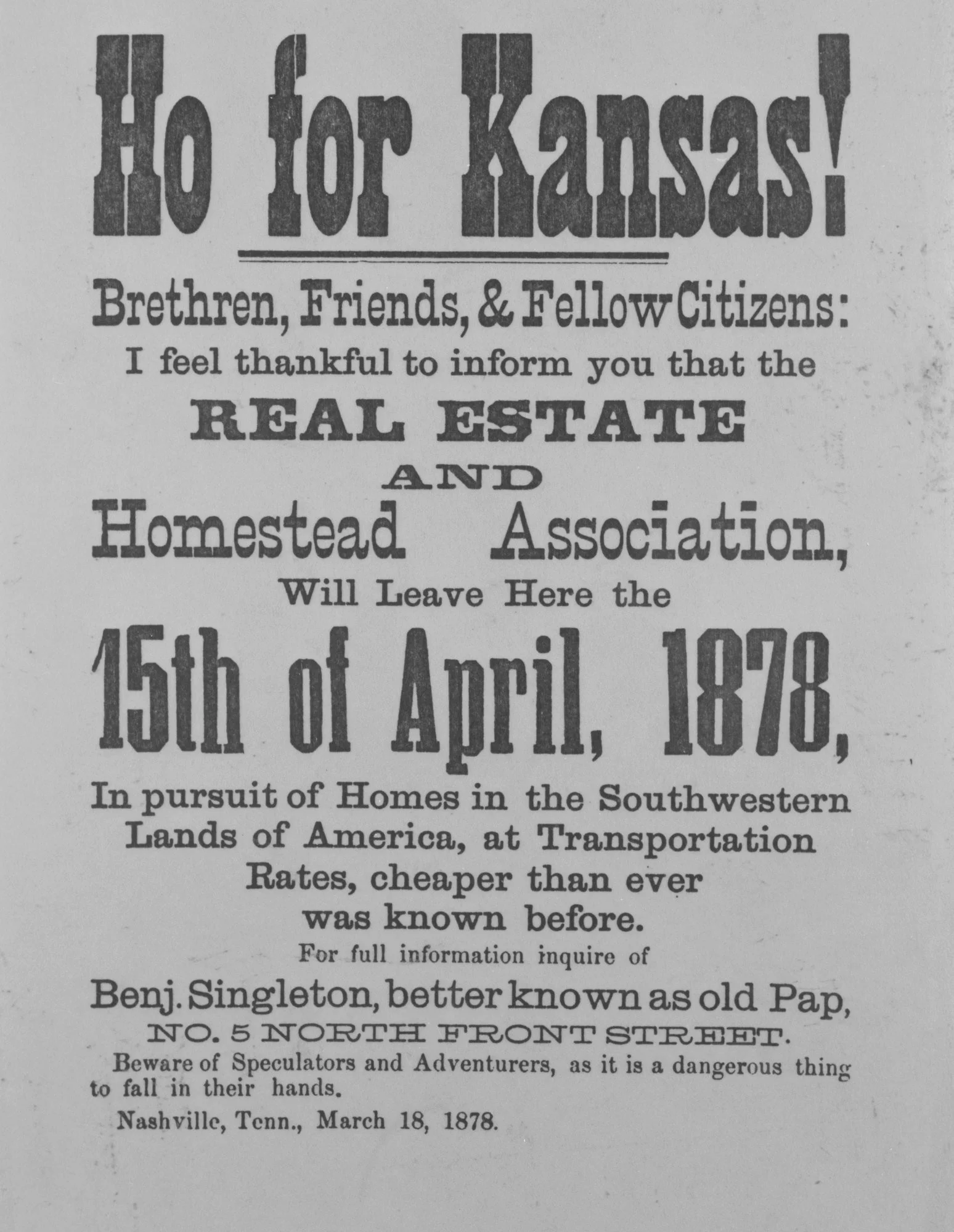
One of their handbills survives. Dated Nashville, March 18, 1878, it reads:
"Ho for Kansas! Brethren, Friends, & Fellow Citizens: I feel thankful to inform you that the Real Estate and Homestead Association, will leave here the 15th of April, 1878, In pursuit of Homes in the Southwestern Lands of America, at Transportation Rates, cheaper than ever was known before."
At the bottom, a warning: "Beware of Speculators and Adventurers, as it is a dangerous thing to fall in their hands."
Singleton's people settled in Cherokee County near Baxter Springs, and in the Dunlap Colony in Morris County. The Kansas Historical Society says nearly 300 people followed him to Kansas between 1877 and 1879.
He had a firm rule about who went. "I never carried none there without means," he told the Senate. He wanted families to bring "some money to start with and go on with a while." He also told senators that his colony had bought about a thousand acres. So not every Exoduster family homesteaded. Some bought land outright.
Did Pap Singleton found Nicodemus?
No. This gets mixed up a lot. Nicodemus was organized by the Nicodemus Town Company. The National Park Service says six Black businessmen in Topeka and one white developer formed it in 1877. The Library of Congress's Historic American Buildings Survey record says Singleton's promotional literature helped draw settlers there, and that the white promoter W. R. Hill led the effort. Even one Kansapedia entry credits Singleton with organizing the Nicodemus colony, but the Society's own Nicodemus entry, the Park Service and the HABS record all name the town company and Hill. Singleton inspired people. He didn't found the town.
What was the Exodus of 1879?
The Exodus of 1879 was the sudden, mostly leaderless rush of Black Southerners to Kansas that started that spring. Unlike the earlier organized colonies, these families often came with no money at all. The Kansas Historical Society says nearly 20,000 came in 1879 and 1880.
The Library of Congress puts it simply: Singleton tried to keep the movement planned and organized, but by 1879 "the unruly, mass Exodus had overwhelmed his efforts."
Kansas had to scramble. On May 8, 1879, Governor St. John formed the Freedmen's Relief Association to care for the new arrivals. Its job, the Kansas Historical Society says, was "to collect and distribute resources" to families who had come with nothing. The association set up farm colonies in Wabaunsee, Chautauqua and Coffey counties.
Many families never made it to a claim. They settled in the cities instead, and Black neighborhoods grew up in Topeka and Kansas City. People called them Tennessee Town, Mississippi Town, Mudtown, Jordan Town and Rattlebone Hollow.
Did 40,000 Exodusters come to Kansas?
That number gets repeated, but it doesn't hold up. The Kansas Historical Society says nearly 20,000 came in the main wave of 1879 and 1880. The 40,000 figure is close to a different number. By 1880, Kansas had 43,107 Black residents, but that count includes everyone who was already there. In 1870 the state already had 17,108. The total population isn't the same thing as the exodus.
Even the senators who studied the exodus in 1880 were guessing. The minority report used the round figure "twenty-five thousand." Treat any number from the time as an estimate.
What was Nicodemus, Kansas?
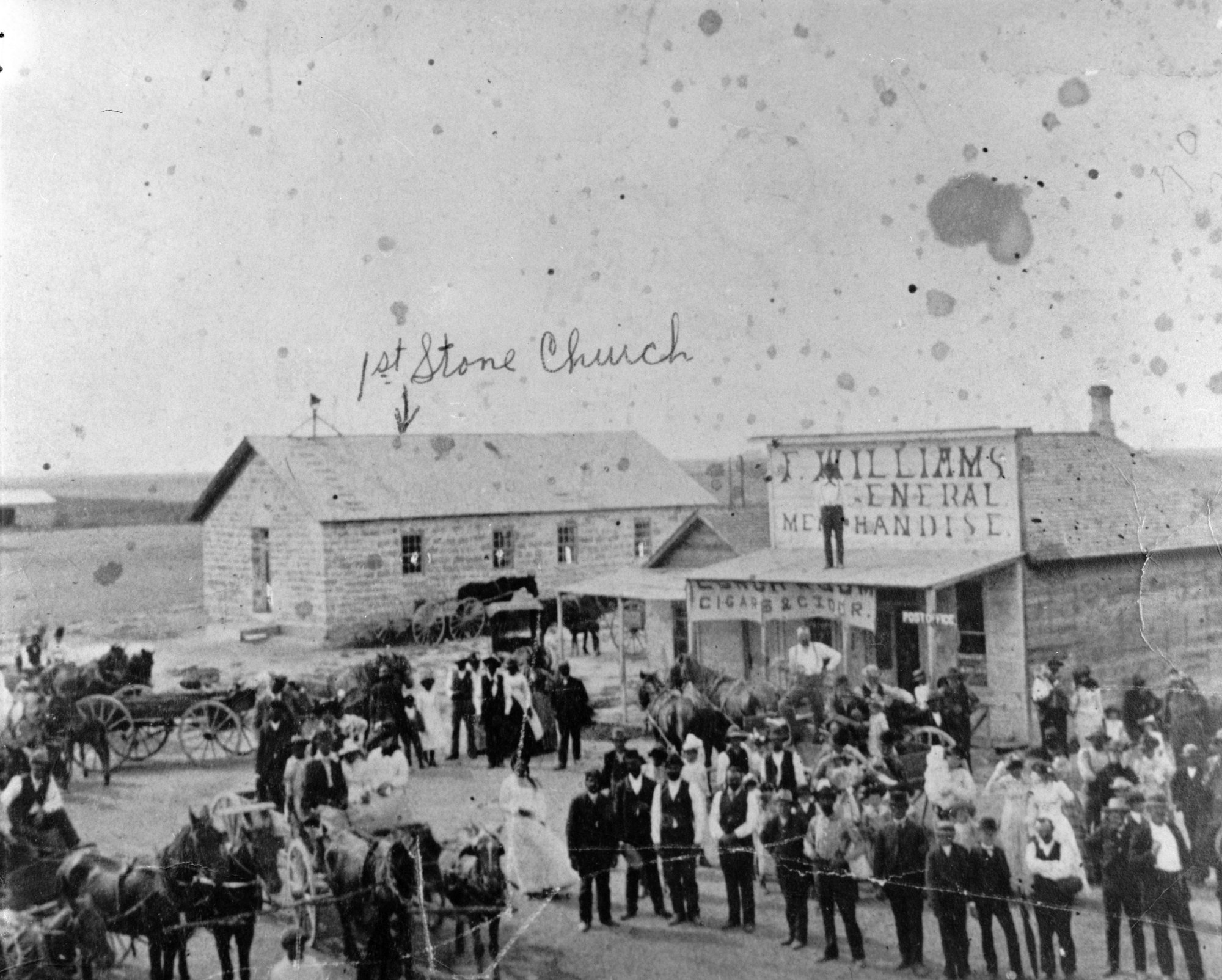
Nicodemus is a town in Graham County, Kansas, founded in 1877 by Black settlers, most of them from Kentucky. They went there to homestead. The Park Service calls it the only remaining western town established by African Americans during Reconstruction, and since 1996 it has been a National Historic Site.
The town got its name from a song. The National Park Service traces it to "Wake Nicodemus," published in 1864 by the abolitionist songwriter Henry Clay Work, about an African-born enslaved man who asked to be woken "for the Great Jubilee" when freedom came. A town company broadside dated July 2, 1877, called the Solomon Valley site "the finest country we ever saw." It sat 240 miles west of Topeka, on "Government Land" waiting to be claimed.
The town company had advertised in Lexington and Georgetown, Kentucky, calling Nicodemus "The Largest Colored Colony in America." People believed it. On September 17, 1877, the first wave arrived, 350 people strong. The Kansas Historical Society tells what they found: not a town, but "a series of tiny earthen dugouts." The ads had promised "plenty of timber." There wasn't enough of it to build with.
Some turned around and went home. The ones who stayed moved into the dugouts and went to work.
The town's first institutions started in those holes in the prairie. The First Baptist Church began in a dugout in 1877. Its congregation still holds services today. The first school met in the dugout of Zachary T. and Jenny Fletcher. Their place later became the St. Francis Hotel, which also served as the town's first post office and a stagecoach station. In 1879, residents set up School District No. 1, the first official school in Graham County, the Park Service notes.
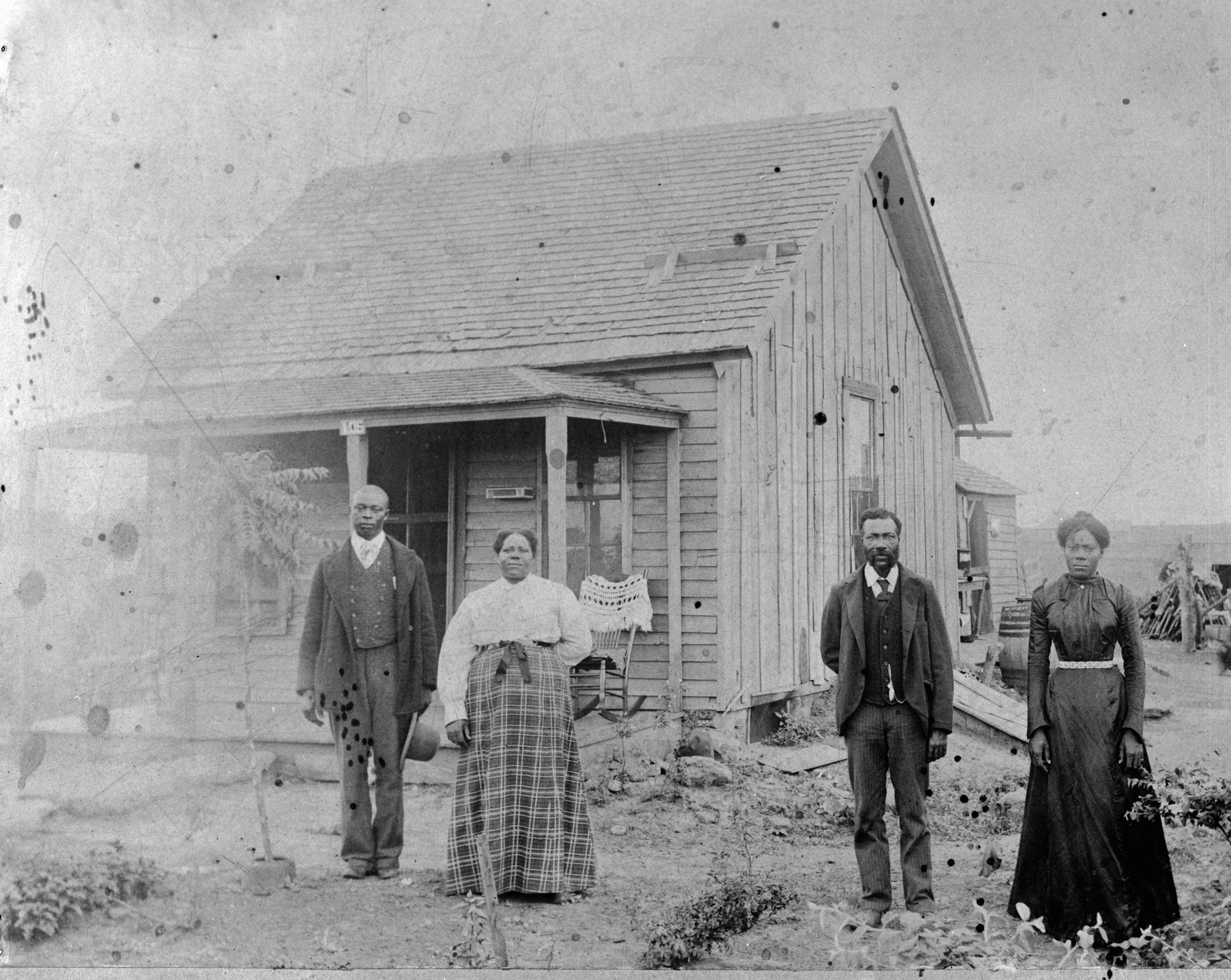
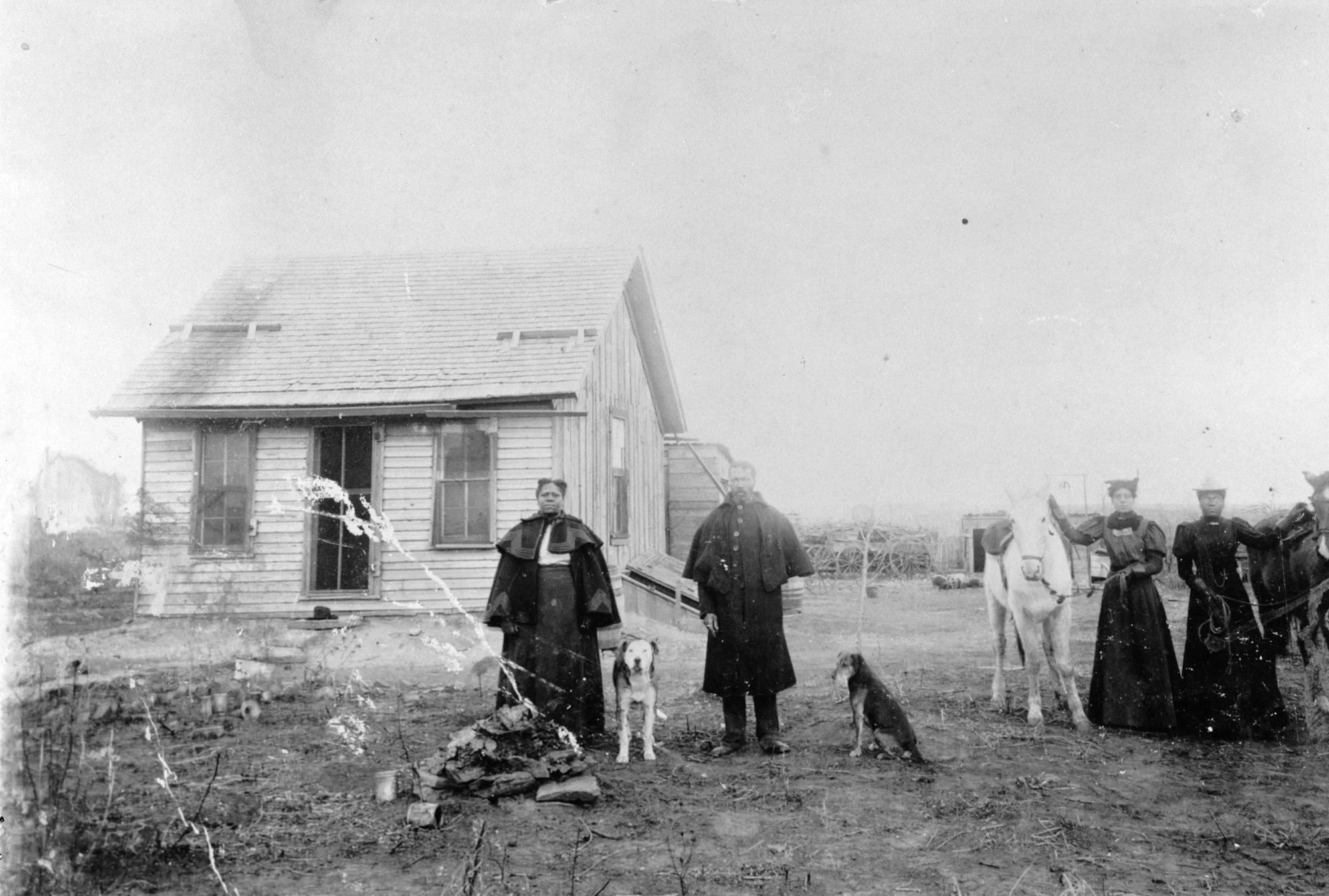
Look closely at the photograph above. That isn't a dugout anymore. It's a framed house with a porch and glass windows. The record doesn't give the family's name or the year. It does show what a claim on the Kansas plains could become.
By 1879, the Park Service says, Nicodemus had a general store, a hotel, churches, livery stables, a post office and a real estate office. Good harvests in the mid-1880s brought real money. Stone buildings started replacing the dugouts. In 1886 alone, the Kansas Historical Society counts, the town put up 30 new buildings.
Why did Nicodemus decline?
The railroad passed it by. Nicodemus failed to land the Missouri Pacific in 1887 and the Union Pacific in 1888. The Union Pacific built through nearby Bogue instead, and many of the town's merchants moved there, some hauling their buildings with them. The hard times of the 1890s finished the boom.
The town shrank, but the farmers stayed on their land. By 1910, 600 people lived in Nicodemus, most of them Black, according to the Kansas Historical Society. Residents have held an Emancipation celebration every year since 1878. Today it's called Homecoming, and it's held in late July.
Did the Exodusters actually get land?
Many did. At Nicodemus alone, homesteaders had received 114 homestead patents covering 18,126 acres by 1899, the National Park Service reports. Others bought land, the way Singleton's colony did, or settled in Kansas towns and cities. Not every family that came west ended up with a farm.
A patent was the deed itself, the paper that said the United States had transferred the land to you. Each of those 114 patents stood for years on the claim, a home built, ground broken, two neighbors willing to swear to it, and a file sent to Washington. That's the same process every homesteader went through, Black or white, and it's laid out in our Homestead Act article.
The Park Service says the Nicodemus founders used two federal laws: the Townsite Preemption Act of 1844, a law for laying out town sites, and the Homestead Act of 1862. Corn and wheat were the main crops.
What did the land give them? The Park Service answers in one line: Nicodemus "provided safety from the violence experienced by many in the South," along with the chance "to own land, build farms and a community, educate their children, and govern their own affairs."
What did the 1880 Senate investigation find?
In December 1879 the U.S. Senate set up a five-member select committee to find out why Black Southerners were leaving. It examined more than 150 witnesses in 1880. The majority blamed Northern politicians and railroad agents. The minority said the cause was violence and injustice in the South.
The committee was chaired by Senator Daniel W. Voorhees. Its other members were Zebulon B. Vance, George H. Pendleton, William Windom and Henry W. Blair. It started taking testimony on January 19, 1880. Its report, Senate Report No. 693, was ordered printed on June 1, 1880, and filled three volumes.
The majority report argued that the move had been stirred up by circulars, false promises and politics. It said some backers wanted to shift Black voters into closely divided Northern states.
The minority, Senators Windom and Blair, called that theory an "utter absurdity." They said the committee had spent six months and "over $30,000" trying to prove it. They pointed instead to violence and injustice in the South, and they reprinted the St. Louis letter saying the refugees were "driven by the terrors" of the places they had fled.
What did Pap Singleton tell the Senate?
Benjamin Singleton testified in Washington on April 17, 1880. The transcript survives in the committee's printed testimony. Asked how many people he had brought to Kansas, he said, "I believe I fetched out 7,432 people." He said he had spent "nearly six hundred dollars flooding the country with circulars."
Asked why he did it, he answered:
"Well, my people, for the want of land—we needed land for our children—and their disadvantages—that caused my heart to grieve and sorrow; pity for my race, sir, that was coming down, instead of going up—that caused me to go to work for them."
Asked whether Kansas politicians had put him up to it, he said no: "This was gotten up by colored men in purity and confidence." And when Senator Windom asked whether he considered himself the father of the exodus, he said, "Yes, sir; I am the father of it!"
Keep in mind that 7,432 is his own count, given under oath but never checked. It's what he claimed, not a census.
How can you find an Exoduster ancestor's homestead records?
Start with the Bureau of Land Management's free GLO Records search for your ancestor's name in Kansas. If you find a homestead patent, note the land office and document number. Then order the full land entry case file from the National Archives. It can include the claim, the witness testimony and the final proof.
- Search the patent index at BLM GLO Records. Try Graham County, Kansas, for Nicodemus families, and check spelling variations.
- Write down the land office, the type of patent ("Homestead") and the document number.
- Order the case file from the National Archives, online or with NATF Form 84, using its Accessing Land Entry Records guide.
- Look for the family in the 1880 census for Kansas, which records the state where each person was born.
- Share what you find. Homestead National Historical Park collects Black homesteader stories from descendants.
Our full how-to guide to homestead records is coming Dec 14. Until then, the records section of the Homestead Act pillar covers the basics. If you've already found something, a patent, a letter or a photo of the old place, we'd like to see it at What Your Family Kept.
What can we learn from the Exodusters today?
The Exodusters show what people will risk for a piece of ground and a fair shake. They left everything they knew with almost nothing in their pockets, lived in dugouts, and turned 160-acre claims into farms, churches and schools. Some of their descendants still farm that same Kansas land.
Just imagine what it took. A family in Mississippi in 1879 had never seen Kansas. They had a rumor, a circular and maybe a letter from somebody who'd gone ahead. They got on a riverboat anyway, and stepped off into a cold river town with nowhere to sleep.
Then they did the hard part. Five years on a claim. A dugout, then a sod or frame house. A church in a hole in the ground. A school in somebody's dugout.
As of 2015, the Park Service reported, seventeen descendants still owned farmland in the townships around Nicodemus that Black farmers homesteaded. Five were still farming it.
That's what a homestead was really for.
The lesson: Freedom on paper isn't the same as freedom on the ground. The Exodusters went and got the ground. Then they wrote it down, filed it and proved up, so nobody could take it back.
Frequently Asked Questions
What does "Exoduster" mean?
It means someone who took part in the exodus of Black Southerners to Kansas, mostly in 1879 and 1880. The word comes from the Book of Exodus, the story of the Israelites leaving slavery in Egypt for the promised land.
How many Exodusters went to Kansas?
The Kansas Historical Society says nearly 20,000 came in 1879 and 1880. Smaller organized groups came earlier in the 1870s. By 1880, Kansas had 43,107 Black residents in all.
Who led the Exodusters?
No one person led the 1879 wave. Benjamin "Pap" Singleton of Nashville organized earlier colonies and called himself "the father of the exodus." The mass movement of 1879, though, grew past anyone's control.
Who founded Nicodemus, Kansas?
The Nicodemus Town Company, formed in 1877 by six Black businessmen from Topeka and a white developer, W. R. Hill. The first large group of settlers, 350 people from Kentucky, arrived on September 17, 1877.
Why is it called Nicodemus?
The National Park Service says the name comes from "Wake Nicodemus," an 1864 song by Henry Clay Work about an enslaved African man who asked to be woken when freedom came.
Can you visit Nicodemus today?
Yes. Nicodemus National Historic Site in Graham County, Kansas, preserves five historic buildings: the Township Hall, the St. Francis Hotel, the First Baptist Church, the A.M.E. Church and the District No. 1 School. Homecoming is held each year in late July.
Keep exploring the homestead series
- Start here: The Homestead Act of 1862: How Ordinary Americans Won 160 Acres of the West.
- Coming Nov 30: Living in the Dirt, what life was really like in a sod house on the Plains.
- Coming Dec 14: Your Family's Land, how to find out if your ancestor was a homesteader.
- More from this story's dates: September 17th in history and April 17th in history, plus the full Chronicles of History archive.
Do you descend from Exodusters or Black homesteaders?
Somebody in your family may have stepped off a riverboat at Wyandotte, dug a home into a Kansas hillside, or stood in a land office line with two witnesses. If you still have the patent, a letter, a church record or a photograph, we want to see it.
Share it with What Your Family Kept · Join the Chronicles Community
The Short Version: Exodusters Quick Facts
Definition: The Exodusters were Black Southerners who moved to Kansas after Reconstruction, mostly in 1879 and 1880, to escape violence and debt and to homestead land of their own. The name refers to the biblical Exodus.
- How many? Nearly 20,000 in 1879–1880, per the Kansas Historical Society. Kansas's Black population rose from 17,108 (1870) to 43,107 (1880).
- Why Kansas? Its free-state history and open public land under the Homestead Act.
- Who was Pap Singleton? A formerly enslaved Nashville man, born 1809, who organized Black colonies in Kansas in the 1870s and told the U.S. Senate on April 17, 1880, that he was "the father of the exodus."
- What is Nicodemus? A Black homestead town in Graham County, Kansas, settled September 17, 1877, and a National Historic Site since 1996.
- Did they get land? Yes, many did. Nicodemus homesteaders held 114 patents covering 18,126 acres by 1899.
- What did Congress do? A Senate select committee investigated in 1880 (Senate Report 693). The majority blamed politics; the minority blamed Southern violence.
Key numbers: nearly 20,000 (1879–80) · 43,107 Black Kansans (1880) · 350 first Nicodemus settlers · Sept. 17, 1877 · 114 patents · 18,126 acres · 7,432 (Singleton's own claim) · 1996 National Historic Site.
Sources: Kansas Historical Society (Kansapedia), National Park Service (Nicodemus National Historic Site; Homestead National Historical Park), Library of Congress, National Archives, U.S. Senate Report 693 (1880).
Sources
- Kansas Historical Society, Kansapedia: Exodusters; Benjamin "Pap" Singleton; Nicodemus, Graham County.
- National Park Service, Nicodemus, Kansas; Nicodemus National Historic Site; The Five Historic Buildings; "Wake Nicodemus!"; Frequently Asked Questions.
- National Park Service, Homestead National Historical Park, Black Homesteaders.
- U.S. Senate, Report and Testimony of the Select Committee of the United States Senate to Investigate the Causes of the Removal of the Negroes from the Southern States to the Northern States, 46th Cong., 2d sess., Senate Report 693 (1880): Part 1, majority and minority reports; Parts 2–3, including the testimony of Benjamin Singleton, April 17, 1880 (digitized by the University of North Carolina at Chapel Hill).
- Library of Congress, The African American Odyssey: The "Exoduster" Movement.
- Library of Congress, Historic American Buildings Survey, Nicodemus Historic District, Nicodemus, Graham County, KS (HABS KS-49), and copy photograph of the "Ho for Kansas!" broadside.
- National Archives, Accessing Land Entry Records.
- Bureau of Land Management, General Land Office Records.
- Further reading: Nell Irvin Painter, Exodusters: Black Migration to Kansas After Reconstruction (New York: Knopf, 1977).