

Top 10 Most Important Dates in U.S. History (And Why They Still Matter)
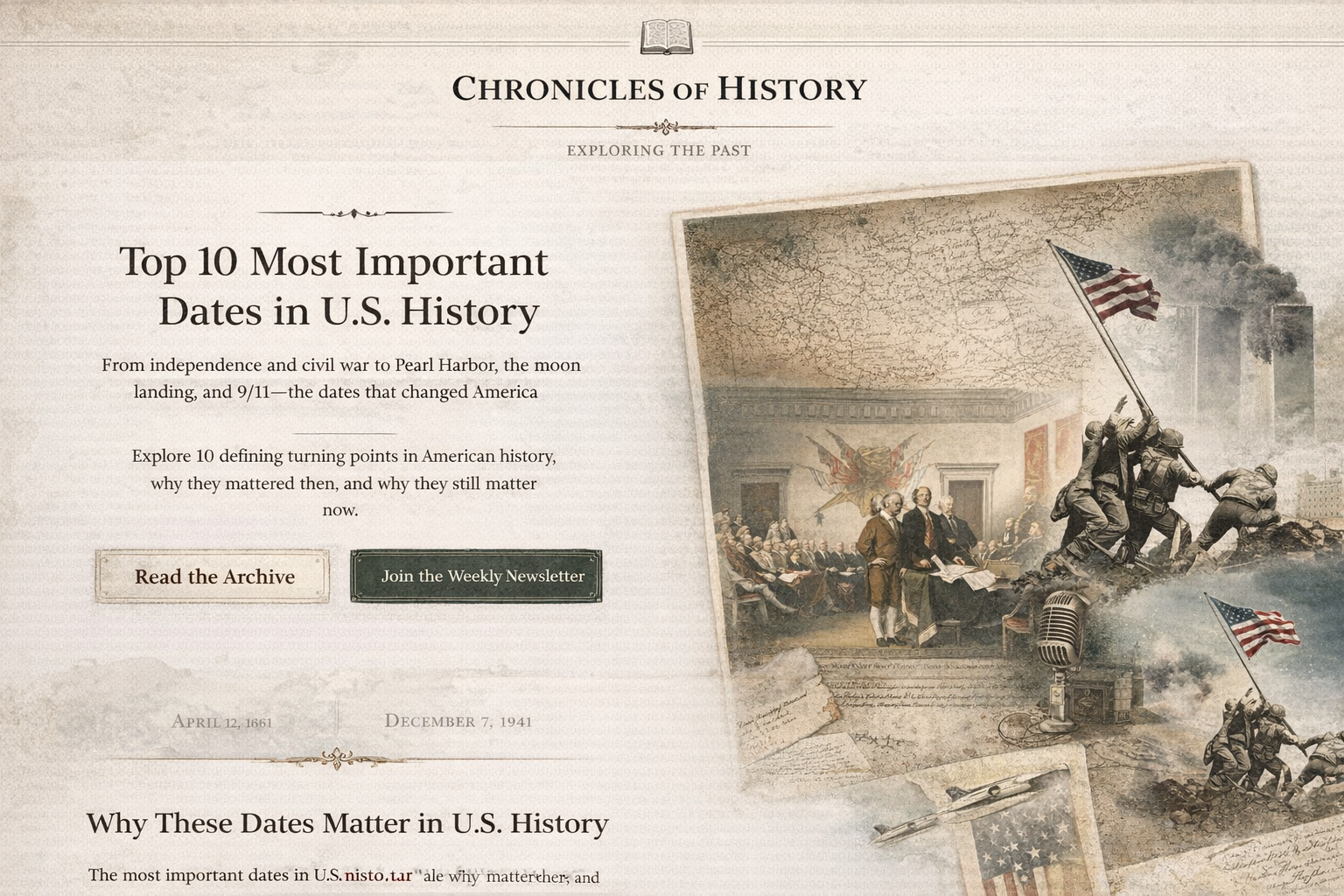
Top 10 Most Important Dates in U.S. History (And Why They Still Matter)
American history is full of turning points — days when the nation changed course forever. Some of these dates are widely celebrated, others are remembered with grief, and a few still spark debate generations later.
If you’ve ever wondered what the most important dates in U.S. history are, this guide breaks down ten of the most significant moments and explains why they still matter today.
From independence and war to tragedy and technological achievement, these are the dates that shaped the American story.
Why These 10 Dates Matter in U.S. History
The most important dates in U.S. history are not just milestones on a timeline. They represent moments when:
the country was founded or redefined
national identity changed
major wars shifted America’s role in the world
public memory and culture were transformed
future generations inherited new freedoms, fears, and responsibilities
This list focuses on dates that had a lasting impact on the United States politically, culturally, militarily, and socially.
1.) July 4, 1776 — Declaration of Independence
Why it matters: July 4, 1776 is the most iconic date in American history. It marks the adoption of the Declaration of Independence, when the thirteen colonies formally declared separation from Great Britain.
What happened on July 4, 1776?
The Continental Congress adopted the final wording of the Declaration, laying out the colonies’ reasons for breaking from British rule and affirming the idea that all men are created equal and possess unalienable rights.
Why July 4 still matters today
It marks the birth of the United States as a nation.
It established the ideals of liberty, self-government, and natural rights.
It became the foundation for future movements seeking to expand freedom.
2.) April 12, 1861 — The Civil War Begins (Fort Sumter)
Why it matters: The attack on Fort Sumter in South Carolina marked the beginning of the American Civil War, the deadliest conflict in U.S. history.
What happened on April 12, 1861?
Confederate forces opened fire on Fort Sumter, a Union-held fort in Charleston Harbor. The bombardment triggered full-scale war between the Union and the Confederacy.
Why this date changed the United States
It launched a war that would determine whether the Union would survive.
It accelerated the national crisis over slavery.
It set the stage for emancipation and constitutional transformation.
The Civil War would reshape federal power, citizenship, and the future of the nation.
3) January 1, 1863 — Emancipation Proclamation Takes Effect
Why it matters: This date marked a major turning point in both the Civil War and the moral direction of the United States.
What happened on January 1, 1863?
President Abraham Lincoln’s Emancipation Proclamation officially took effect, declaring enslaved people in Confederate-held territory to be free.
Why it still matters
It transformed the Civil War into a fight over both Union and freedom.
It discouraged European support for the Confederacy.
It paved the way for the 13th Amendment, which abolished slavery.
While it did not immediately free all enslaved people, it changed the meaning and purpose of the war.
4) April 9, 1865 — Confederate Surrender at Appomattox
Why it matters: The surrender of General Robert E. Lee to General Ulysses S. Grant at Appomattox Court House effectively ended the Civil War.
What happened on April 9, 1865?
Lee surrendered the Army of Northern Virginia, signaling the collapse of the Confederacy’s military resistance.
Why this date is one of the most important in U.S. history
It preserved the Union.
It marked the beginning of Reconstruction.
It opened a new chapter in the struggle over race, rights, and national healing.
This date remains central to understanding the cost and legacy of the Civil War.
5) April 15, 1865 — Abraham Lincoln Dies
Why it matters: President Abraham Lincoln died the morning after being shot by John Wilkes Booth, just days after Union victory.
What happened on April 15, 1865?
Lincoln died after being assassinated at Ford’s Theatre in Washington, D.C. Vice President Andrew Johnson was sworn in as president.
Why Lincoln’s death changed history
The nation lost a leader at a critical moment of reunification.
Reconstruction unfolded without Lincoln’s leadership.
Lincoln became a lasting symbol of unity, sacrifice, and moral courage.
For many historians, this is one of the most tragic and consequential dates in American history. If you’re looking for a damn good read on the death of Abraham Lincoln, check out Killing Lincoln. You won’t be able to put it down.
6) December 7, 1941 — Attack on Pearl Harbor
Why it matters: The Japanese attack on Pearl Harbor pushed the United States into World War II.
What happened on December 7, 1941?
Japan launched a surprise attack on the U.S. naval base at Pearl Harbor in Hawaii, killing more than 2,000 Americans and damaging or destroying numerous ships and aircraft.
Why Pearl Harbor remains a defining U.S. date
It ended the era of U.S. non-intervention in WWII.
It led to a formal declaration of war.
It marked the beginning of America’s rise as a global superpower.
December 7 is remembered as “a date which will live in infamy,” and it remains one of the most recognized dates in U.S. military history.
7) June 6, 1944 — D-Day (Normandy Invasion)
Why it matters: D-Day was one of the most important military operations in U.S. and world history.
What happened on June 6, 1944?
Allied forces, including thousands of American troops, landed on the beaches of Normandy in Nazi-occupied France in the largest amphibious invasion in history.
Why D-Day matters in U.S. history
It opened a major Western front against Nazi Germany.
It accelerated the liberation of Europe.
It became a symbol of courage, sacrifice, and Allied cooperation.
D-Day is one of the most significant dates in the history of the U.S. armed forces.
8) July 20, 1969 — Apollo 11 Moon Landing
Why it matters: The Moon landing represented American technological achievement, Cold War competition, and a giant leap in human history.
What happened on July 20, 1969?
Apollo 11 astronauts Neil Armstrong and Buzz Aldrin landed on the Moon, and Armstrong became the first human to walk on its surface.
Why this date is historically important
It showcased U.S. scientific innovation and national ambition.
It symbolized Cold War-era competition and prestige.
It inspired generations in science, engineering, and exploration.
July 20 is one of the most celebrated dates in U.S. space history.
Now here’s a question for you — Is the moon landing real or fake? There’s a damn good case about how it could have been faked for all these years. I still believe in the American Dream and our winning culture, so I’ll choose to believe it happened. It’s the patriot in me. With that said, strong facts show otherwise, too.
9) November 22, 1963 — Assassination of President John F. Kennedy
Why it matters: The assassination of President Kennedy marked a national trauma and a turning point in American political culture.
What happened on November 22, 1963?
President John F. Kennedy was assassinated in Dallas, Texas, while riding in a motorcade. Vice President Lyndon B. Johnson was sworn in later that day.
Why November 22 remains a major date in American history
It shocked the nation and the world.
It intensified public distrust and conspiracy speculation.
It reshaped the political and cultural mood of the 1960s.
For many Americans, this became a defining “where were you?” moment.
10) September 11, 2001 — 9/11 Terrorist Attacks
Why it matters: September 11, 2001 is one of the most consequential dates in modern U.S. history.
What happened on September 11, 2001?
Terrorists hijacked four commercial airplanes, crashing two into the World Trade Center towers in New York City, one into the Pentagon, and one in Pennsylvania after passengers fought back.
Why 9/11 changed the United States
It transformed U.S. national security and foreign policy.
It led to wars in Afghanistan and Iraq.
It changed air travel, surveillance, and public life.
It became a defining memory for an entire generation.
September 11 remains one of the most searched and remembered dates in contemporary American history.
Honorable Mentions: Other Important Dates in U.S. History
Depending on your criteria, these dates could also belong on a top-10 list:
September 17, 1787 — U.S. Constitution signed
December 15, 1791 — Bill of Rights ratified
January 1, 1803 / 1804 era — Louisiana Purchase expansion period
January 1, 1863 — Emancipation Proclamation (already included)
August 18, 1920 — 19th Amendment ratified (women’s suffrage)
August 6 & 9, 1945 — Atomic bombings (major U.S. wartime turning point)
August 28, 1963 — March on Washington
July 2, 1964 — Civil Rights Act signed
July 20, 1969 — Apollo 11 Moon landing (massive for space exploration in the United States of America)
This is one reason American history remains so compelling: there are many dates that can claim lasting importance.
How to Think About “Most Important” Dates in American History
There is no single perfect list. Some people prioritize:
Founding documents
Wars and battles
Civil rights milestones
Presidential assassinations
Scientific achievements
Moments of national tragedy
A stronger way to think about it is this:
“The most important dates in U.S. history are the days when America’s identity, direction, or destiny changed in a lasting way.”
That includes victories, breakthroughs, failures, and losses.
Final Thoughts: Why These U.S. History Dates Still Matter
Studying the most important dates in U.S. history is not just about memorizing timelines. It helps us understand:
how the country was built
how it was tested
what ideals it claimed
where it succeeded
where it fell short
and what kind of nation it is still trying to become
If you’re exploring American history through a “this day in history” lens, these ten dates are powerful anchors — and each one opens the door to deeper stories.
This Day in History References
We spent countless hours building the Chronicles of History Archive long before artificial intelligence and ChatGPT—our own “This Day in History” reference. You can explore any day of the year by calendar month and see five of the most notable historical events that happened on that date.
If you enjoyed this article, please share this with a friend. It’s the best thing you can do so our work doesn’t go unnoticed.