

This Day In History, April 15th.
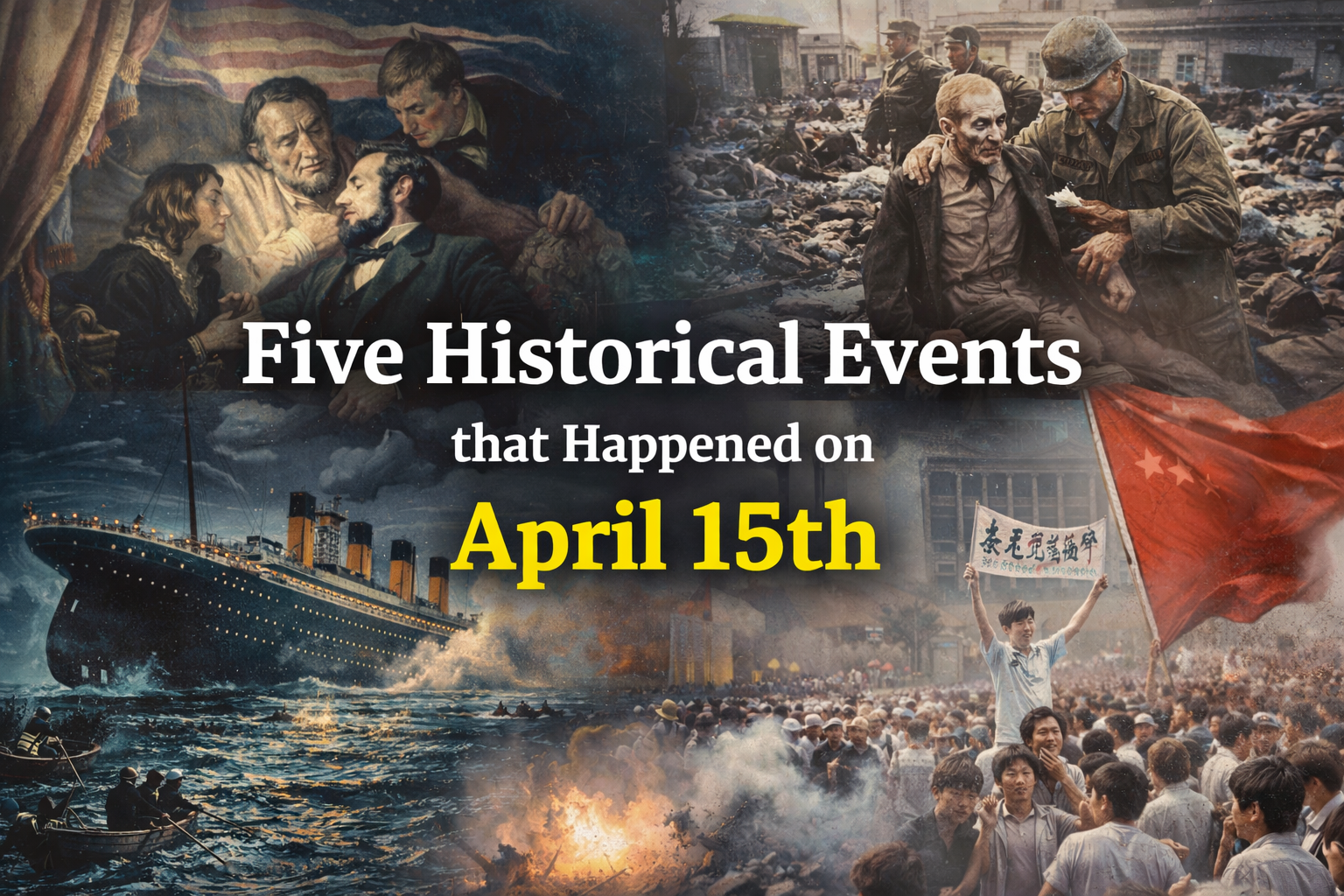
Five Historical Events That Happened on April 15th.
Some dates in history carry a strange weight.
April 15 is one of them.
It is a day tied to grief, courage, tragedy, and turning points that rippled far beyond a single place or generation. On this date, a president died after an assassination that stunned the United States. A luxury liner slipped beneath the icy Atlantic in one of the most famous maritime disasters ever recorded. Allied troops uncovered one of the Nazi regime’s most horrifying crimes. Student protests for political reform began in Beijing and ended in a brutal crackdown. And in modern America, a day of endurance and celebration at the Boston Marathon was shattered by terror.
If you’re exploring what happened on April 15 in history, these five events stand out as some of the most significant and widely remembered. History timelines are always evolving, but this day is a heavy one.
Why April 15 Matters in History
April 15 is not remembered for one single event. It is remembered because it repeatedly appears at moments when history changed direction.
This date touches:
U.S. political history
maritime disaster history
World War II and Holocaust history
modern Chinese political history
modern American terrorism and resilience
What follows are five major events that happened on April 15th — and why they still matter today.
1) 1865 — Abraham Lincoln Dies After Being Shot by John Wilkes Booth
One of the most consequential events in American history occurred on April 15, 1865, when President Abraham Lincoln died after being shot the previous evening at Ford’s Theatre in Washington, D.C.
What happened?
On the night of April 14, 1865, Lincoln was attending a performance at Ford’s Theatre with his wife, Mary Todd Lincoln, when actor and Confederate sympathizer John Wilkes Booth entered the presidential box and shot him in the head. Booth then fled the scene.
Lincoln was carried across the street to the Petersen House, where doctors attended to him through the night. He never regained consciousness.
He died the next morning, April 15, 1865.
Why this mattered so much
Lincoln’s death came at a critical moment in U.S. history:
The Civil War was effectively ending
The Union had survived
The future of Reconstruction was just beginning
The nation needed leadership, healing, and direction
Instead, the country lost the man many believed was best positioned to guide the United States through reunification after four years of war.
Lincoln’s assassination did more than shock the public. It changed the political future of the nation. The years that followed would be marked by conflict over Reconstruction, civil rights, federal authority, and how the former Confederate states would be brought back into the Union.
Why Lincoln’s death is still remembered
Abraham Lincoln remains one of the most revered presidents in U.S. history. His leadership during the Civil War and his role in ending slavery cemented his place in the American story. That is why April 15, 1865 is not simply the date of a president’s death — it is a date tied to national loss and historical consequence.
For many historians, Lincoln’s death is one of the most tragic turning points in American history.
2) 1912 — The RMS Titanic Sinks in the North Atlantic
In the early hours of April 15, 1912, the RMS Titanic sank in the North Atlantic Ocean after striking an iceberg on its maiden voyage.
More than a century later, it remains one of the most famous disasters in modern history.
What happened?
The Titanic had departed Southampton, England, and was bound for New York City. It carried more than 2,200 passengers and crew and was considered one of the most advanced and luxurious ships of its time.
Late on April 14, the Titanic struck an iceberg. The damage proved catastrophic. Over the next several hours, the ship gradually filled with water and began to sink.
By the early morning of April 15, the Titanic had disappeared beneath the surface of the Atlantic.
More than 1,500 people lost their lives.
Why the Titanic disaster became so iconic
The sinking of the Titanic captured the world’s attention for several reasons:
The ship symbolized modern engineering and confidence
The loss of life was staggering
Lifeboat shortages and evacuation failures exposed fatal mistakes
Passenger stories revealed sharp class divides in survival rates
The disaster unfolded as a global media event
In many ways, Titanic became a symbol of the dangers of overconfidence in technology and status.
Why it still matters today
The Titanic is not just remembered because it was dramatic. It led to lasting changes in maritime safety, including:
better lifeboat requirements
improved emergency drills
stronger iceberg monitoring and communication practices
It also remains deeply embedded in public memory through books, films, documentaries, and ongoing historical research.
If you ask people what happened on April 15 in history, the Titanic is almost always near the top of the list.
3) 1945 — Bergen-Belsen Concentration Camp Is Liberated
On April 15, 1945, British and Canadian troops liberated the Bergen-Belsen concentration camp in Germany, exposing horrifying conditions and bringing global attention to yet another site of Nazi crimes.
What happened?
Bergen-Belsen was initially established by the Nazis as a prisoner-of-war camp, but it later became a concentration camp where tens of thousands of prisoners were held in horrific conditions.
By the time Allied troops arrived in April 1945, the camp had become a place of starvation, disease, overcrowding, and death.
When British and Canadian forces entered the camp, they found:
thousands of emaciated prisoners
widespread disease, including typhus
massive suffering and death
evidence of systematic abuse and neglect by the Nazi regime
Many prisoners died even after liberation because their condition was so severe.
Why this was a major historical turning point
The liberation of Bergen-Belsen mattered for several reasons:
It marked a key moment in the final collapse of Nazi Germany
It exposed the brutality of the concentration camp system
It provided undeniable evidence of atrocities committed during the Holocaust
It shaped postwar understanding of Nazi crimes and accountability
For the Allied soldiers who entered the camp, the experience was unforgettable. For the world, images and reports from places like Bergen-Belsen forced a confrontation with the scale of human cruelty under the Nazi regime.
Why it still matters
April 15, 1945, is a date that must be remembered not only as a military event, but as a moral one.
The liberation of Bergen-Belsen is part of the broader history of the Holocaust, remembrance, and the responsibility to document and teach what happened. It reminds us that history includes not just battles and leaders, but also victims, witnesses, and the consequences of ideology and dehumanization.
4) 1989 — The Tiananmen Square Protests Begin in Beijing
On April 15, 1989, student-led demonstrations began in Beijing, China, in what would become known as the Tiananmen Square protests — one of the most important political movements in modern Chinese history.
What happened?
Following the death of reform-minded Chinese leader Hu Yaobang, students gathered in Tiananmen Square to mourn and to call for political reform, government accountability, and greater freedoms.
What began as student demonstrations grew into a much larger movement over the following weeks. Hundreds of thousands of people in Beijing and other cities joined protests, rallies, and public gatherings.
The movement reflected broad frustrations and hopes, including demands for:
more political openness
anti-corruption reforms
freedom of speech and press
democratic change
How it ended
In early June 1989, the Chinese government declared martial law and sent military forces into Beijing.
On June 4, 1989, the protests were violently suppressed. The exact number of deaths remains disputed, but it is widely believed that hundreds, and possibly thousands, of people were killed.
Many others were injured, detained, or imprisoned.
Why April 15, 1989, matters
April 15 marks the beginning of a movement that still carries immense political significance.
The Tiananmen Square protests are remembered because they represent:
public demands for reform
the power and vulnerability of student-led activism
the willingness of authoritarian governments to use force
the long shadow of state censorship and memory control
Even today, discussion of Tiananmen remains highly restricted inside China, which is part of why the date retains such global importance. It is not only a historical event — it is also a reminder of how memory itself can become contested ground.
5) 2013 — The Boston Marathon Bombing Shocks the United States
On April 15, 2013, two bombs exploded near the finish line of the Boston Marathon, killing three people and injuring more than 260 others in one of the most shocking acts of terror on U.S. soil in the 21st century.
What happened?
The Boston Marathon is one of the most famous road races in the world and a major civic event in Boston. On that day, crowds had gathered near the finish line to cheer on runners and celebrate the race.
Then two bombs exploded seconds apart.
The blasts caused chaos and devastation, killing three spectators and injuring hundreds, many with life-changing wounds.
The investigation and manhunt
Authorities quickly launched a major investigation. The suspects were identified as brothers Tamerlan and Dzhokhar Tsarnaev, who were of Chechen heritage and had immigrated to the United States.
What followed was an intense manhunt that drew national attention:
Tamerlan Tsarnaev was killed during a confrontation with police
Dzhokhar Tsarnaev was later captured
He was convicted and sentenced for his role in the attack
Why the Boston Marathon bombing remains historically significant
The Boston Marathon bombing left a lasting mark because it combined public tragedy, fear, and resilience in a very visible American setting.
It became a defining event of the 2010s for many Americans because it:
targeted civilians at a public event
caused widespread trauma and injury
prompted a massive law enforcement response
highlighted acts of bravery from first responders, bystanders, and medical teams
In the aftermath, the phrase “Boston Strong” became a symbol of the city’s resilience and unity.
Why it still matters
April 15, 2013, is remembered not only for the attack itself, but for the human response that followed: emergency care, community solidarity, and national attention on how societies recover after public violence.
It remains an important date in modern American and U.S. history and in the history of domestic security and terrorism response.
Final Thoughts: Why April 15 Is One of History’s Heaviest Dates
When people search “what happened on April 15th in history,” they often expect a list. But what they find is something deeper: a date linked to some of the most emotional and consequential events of the last two centuries.
On April 15, history has given the world:
the death of a president
the sinking of an iconic ship
the exposure of wartime atrocities
the beginning of a protest movement for freedom
a modern act of terror and a city’s response
That range is exactly what makes studying history so powerful. A single date can hold tragedy, warning, courage, and memory all at once.
If you’re building a “This Day in History” archive, April 15 is one of the strongest dates on the calendar — not because of one event, but because of the sheer weight of what happened across time.
If you enjoyed this post, please share it with a friend.