

This Day In History, April 14th. Lincoln Shot, Titanic Collision, and More
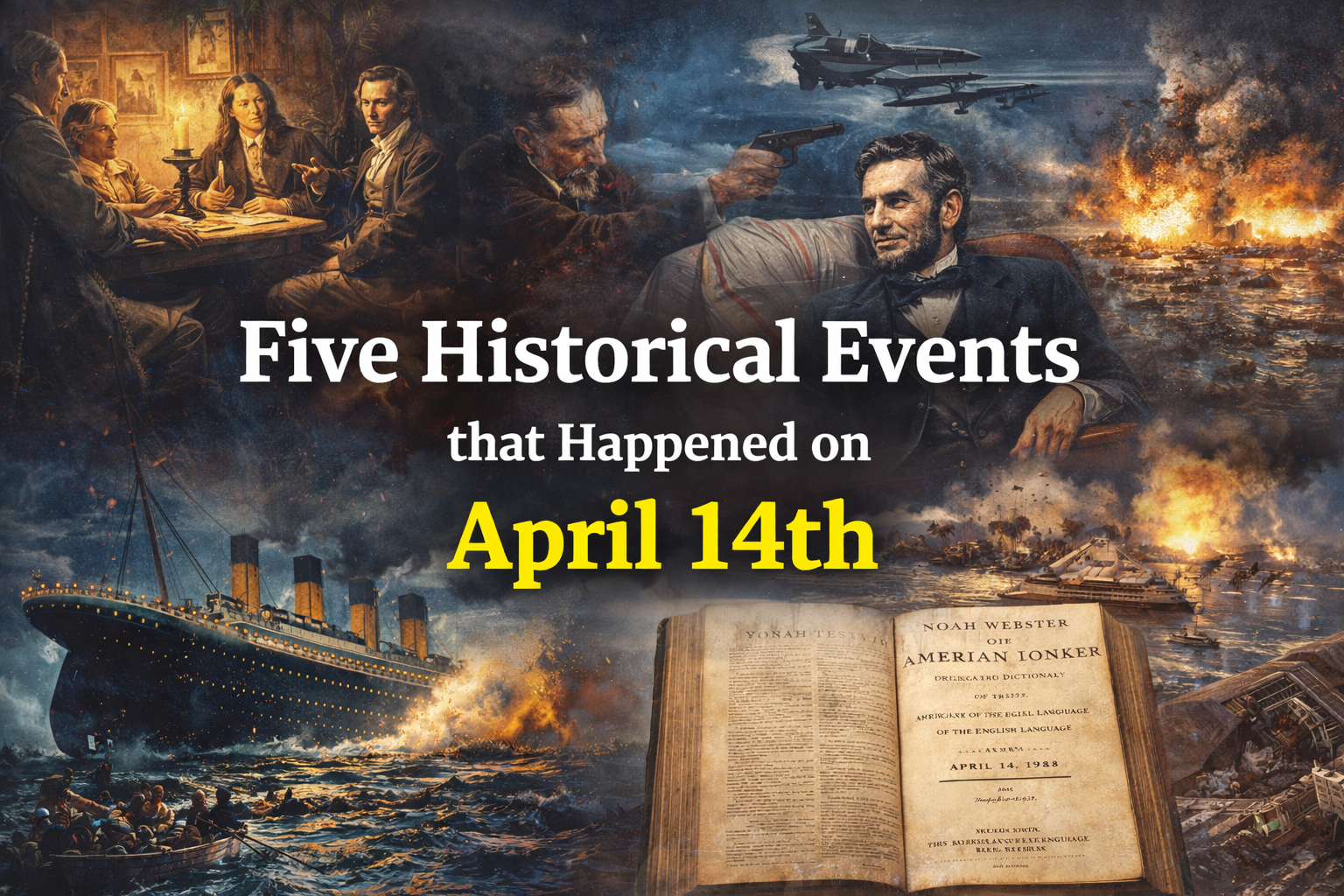
Five Historical Events That Happened on April 14th.
Some dates don’t just sit quietly on a calendar.
They echo.
On April 14 in history, early abolitionists organized in Philadelphia, Noah Webster helped shape American English, Lincoln was shot at Ford’s Theatre, the Titanic struck an iceberg, and the U.S. launched airstrikes on Libya.
April 14th is one of those days. It’s a date that shows up at the intersection of moral movements, national identity, world-changing tragedies, and hard political decisions. On this day, an early American abolitionist organization took shape in Philadelphia. A dictionary that helped standardize American English entered the world. A U.S. president was shot at the theatre in a moment that still feels unreal. The “unsinkable” Titanic struck ice and began its final hours. And in the modern era, U.S. foreign policy took a dramatic and controversial step in Libya. Overall, when it comes to historical April events, it’s an intense month for history.
If you’re looking for what happened on April 14th in history, these five events are among the most significant—and they still matter because they reveal something about human nature: what we choose to build, what we refuse to tolerate, what we mourn, and what we do when the stakes feel existential.
Let’s step into it.
1) 1775 — The First Anti-Slavery Organization in North America Is Founded (Philadelphia)
Long before abolition became a national movement, there were men and women who believed slavery was not simply wrong—but incompatible with the idea of human dignity.
On April 14, 1775, a group in Philadelphia formed what is often recognized as one of the earliest formal anti-slavery societies in North America: the organization that would become known as the Pennsylvania Society for Promoting the Abolition of Slavery (often referred to as the Pennsylvania Abolition Society).
Why this matters
This was not just a club or a conversation group. It represented something rare at the time: organized resistance to the legitimacy of slavery—not in theory, but in action.
The society would later take on the name “The Society for the Relief of Free Negroes Unlawfully Held in Bondage” and became part of a larger moral pressure system that helped shape the American abolitionist movement over the decades that followed.
The deeper significance
What makes this moment powerful is the date: 1775—the year the American Revolutionary War begins. The same era that produced American slogans about liberty also produced a growing confrontation with the contradiction at the heart of the young nation.
April 14th reminds us that the struggle for freedom in America has never been a single moment—it has been a long chain of people saying, “Not this. Not anymore.”
2) 1828 — Noah Webster’s American Dictionary Is Published
If you’ve ever wondered why American English has its own feel—its own spelling, rhythm, and identity—Noah Webster is a major reason why.
In 1828, the first edition of Webster’s American Dictionary of the English Language was published, containing more than 70,000 entries and becoming one of the most influential language projects in U.S. history.
Why this mattered
This wasn’t just a dictionary. It was a cultural declaration.
Webster believed the United States needed its own linguistic identity—one not dependent on Britain. His dictionary emphasized American spelling and usage, helping normalize differences like:
color (vs. colour)
honor (vs. honour)
center (vs. centre)
These weren’t just spelling preferences. They reflected something deeper: America becoming its own nation not only politically, but culturally.
The legacy
Today, “Webster’s” is essentially shorthand for “dictionary” in the United States. The name became a symbol of American language itself—proof that even small details (like spelling) can be part of national identity.
So April 14th isn’t only about wars and tragedy. Sometimes history turns quietly—through books, education, and the shaping of how people communicate.
3) 1865 — Abraham Lincoln Is Shot at Ford’s Theatre
On the evening of April 14, 1865, President Abraham Lincoln attended a performance of Our American Cousin at Ford’s Theatre in Washington, D.C.
It was supposed to be a night of relief.
The Civil War was effectively ending. Richmond had fallen. The Confederacy was collapsing. Lincoln—exhausted by years of war—finally had a moment to breathe.
Instead, April 14th became one of the darkest nights in American history.
Actor and Confederate sympathizer John Wilkes Booth entered the presidential box and shot Lincoln. Booth fled into the night, launching a manhunt that would end days later.
Lincoln did not die immediately. He was carried across the street to a boarding house, where doctors stayed with him through the night.
He would die the next morning, April 15, 1865.
Why this matters (beyond the shock)
Lincoln’s assassination wasn’t just a murder. It was a turning point at the exact moment the nation most needed leadership.
The United States faced questions that would determine its future:
How would the South be brought back into the Union?
What would freedom actually mean after slavery?
How would the nation rebuild after civil war?
Lincoln’s death changed the tone of that era instantly. It reshaped Reconstruction. It intensified division. And it left a wound that still lingers in how Americans remember their past.
April 14th is the night the country lost more than a president—it lost the steady hand of a leader at a moment of national vulnerability.
4) 1912 — The Titanic Strikes an Iceberg (Setting Up the Disaster of April 15)
If April 15th is known as the day the Titanic sank, April 14th is the night it became inevitable.
On the night of April 13, 1912, the RMS Titanic struck an iceberg in the North Atlantic during her maiden voyage from Southampton to New York City.
What followed became one of the most famous tragedies in modern history.
What happened that night
Titanic was massive, luxurious, and viewed by many as a symbol of human progress. But in the freezing darkness of the Atlantic, progress didn’t matter.
After the collision, the ship began taking on water. Over the next hours:
distress signals were sent
lifeboats were lowered (too few, too late, often not full)
passengers realized the “unsinkable” ship was sinking
By early morning of April 15, the Titanic was gone.
More than 1,500 lives were lost.
Why the Titanic remains a historical lesson
Titanic endures because it holds a mirror up to human behavior:
overconfidence in technology
warnings ignored
class systems affecting survival
a tragic gap between what people believed and what was true
The Titanic disaster also changed maritime law and safety practices, reshaping how ships are regulated and prepared for emergencies.
If April 15th is the outcome, April 14th is the fatal moment—the turning point in the dark.
5) 1986 — The U.S. Launches Airstrikes Against Libya After a Berlin Nightclub Bombing
History isn’t always about what’s morally clear. Sometimes it’s about what nations do in the gray.
In April 1986, following a bombing at a Berlin nightclub that killed two American service members, the United States blamed Libya and launched a major airstrike operation against Libyan targets.
The strikes were launched late April 14 (and hit targets into early April 15, depending on local time and reporting), escalating tensions dramatically.
What happened
The nightclub bombing in West Berlin occurred on April 5, 1986. The U.S. government attributed responsibility to Libya.
Days later, American aircraft carried out airstrikes targeting Libyan military and government sites, including areas near Tripoli and Benghazi.
Why it mattered historically
This event sits inside a broader Cold War-era pattern: terrorism, retaliatory strikes, international condemnation, and rising geopolitical tension.
The operation had lasting consequences:
It intensified U.S.–Libya hostility
It influenced how the U.S. approached terrorism and state-sponsored violence
It became a reference point in debates about retaliation, sovereignty, and foreign policy limits
Whether people view the strikes as justified or dangerous escalation, April 14th is tied to a moment when the U.S. made a forceful statement on the world stage—one that reverberated beyond Libya.
One of the best addresses to the Nation on this was from President Ronald Regan, which you can watch below.
Final Reflection: Why April 14th Still Matters
April 14th holds a strange mix of themes:
moral courage (early abolitionist organizing)
national identity (Webster shaping American language)
human tragedy (Titanic strikes ice)
geopolitical force (U.S. strikes Libya)
It’s a reminder that history is not neat. The same date can represent humanity at its best—organizing for justice—and humanity at its most vulnerable—caught off guard, betrayed, or broken by events larger than any one person.
If you want one simple takeaway:
April 14th is a day when the future shifted—sometimes by choice, sometimes by tragedy.